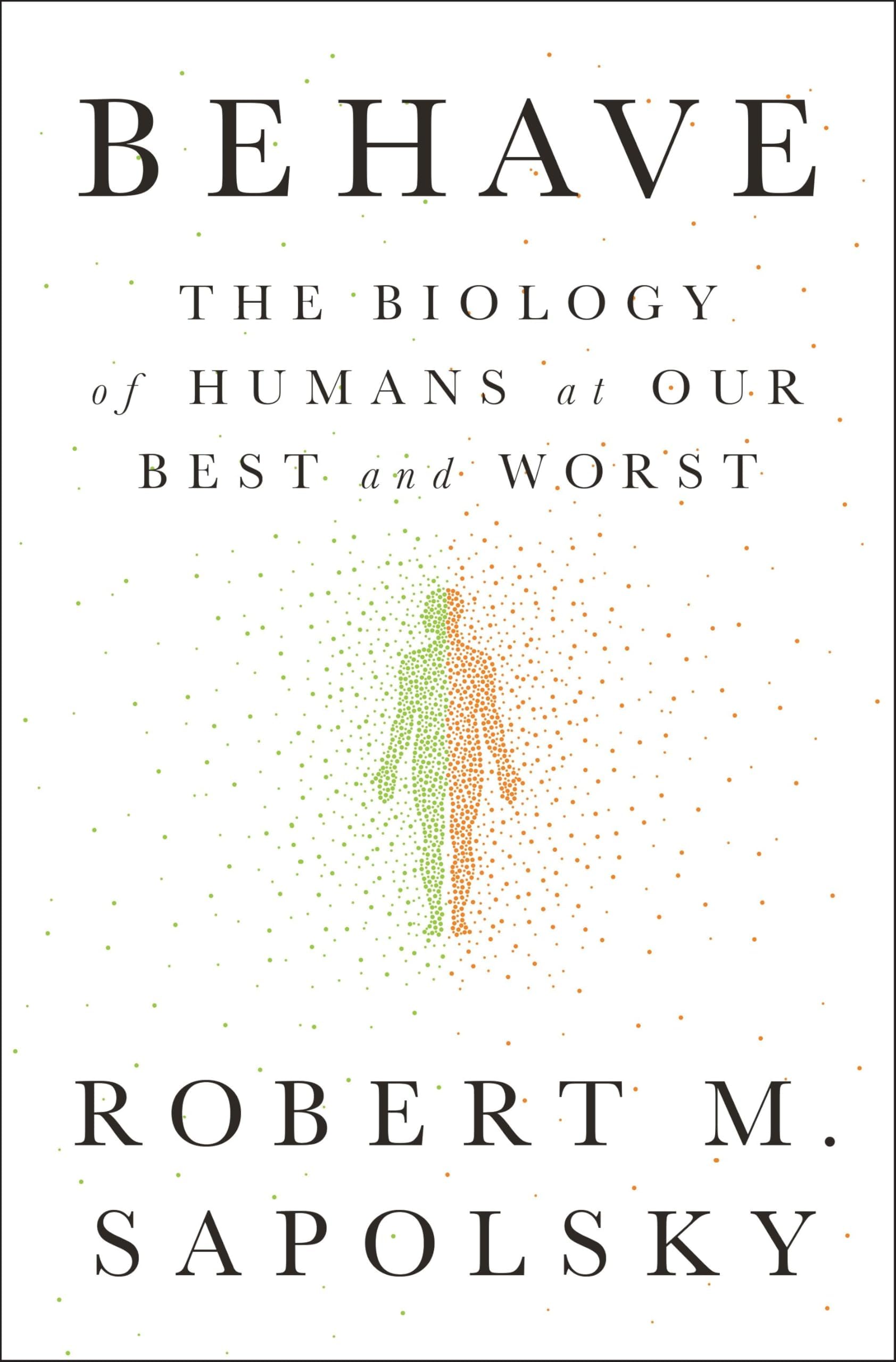
Behave: The Biology of Humans at Our Best and Worst
Product ID: 104694146
⭐4.5/5 from 9,270 readers
📚1000+ pages of deep knowledge
🧠Neuroscience & sociobiology insights
🧬 Unlock the science behind your choices — because knowing is leading.
Behave by Robert Sapolsky is a monumental 1000+ page exploration of human behavior through the lenses of neuroscience, sociobiology, and philosophy. Highly rated and critically acclaimed, it challenges readers to rethink free will, morality, and the biological roots of our actions, making it essential for anyone eager to understand what drives us at our best and worst.

| Best Sellers Rank | #236,072 in Books ( See Top 100 in Books ) #4 in Biology Books #8 in Medicine` #2,194 in Society & Culture (Books) |
| Customer Reviews | 4.5 out of 5 stars 9,270 Reviews |
A**N
Deeply intellectual, informative and stimulating
Fair warning: this book is not for everyone. It’s over 1000 pages long, extremely complicated, full of qualifications and nuances, frequently transitions from one topic to the next, and makes you forget almost as much as it makes you learn. But if you can see it all the way to the end, you deserve to feel proud. This book is an encyclopaedic crash course in neuroscience, sociobiology, philosophy and human morality all rolled into one massive treatise seeking to answer the question: do we humans take decisions of our own free will or does our biology and genealogy do it for us? Are we even responsible for our best and worst behaviours; how can we enhance the former and suppress the latter? Predictably, there is no easy answer but Sapolsky provides both the templates and the catalysts to help answer the question as objectively as possible. His erudition, width and depth of knowledge - and the welcome doses of riotous humour - make him as good an author as he is scientist. One wished he did not complicate every issue with a near-infinite supply of opposing, qualifying and modifying examples - even when they are not always central to the theme under discussion - as it leaves one reeling at the end as to what conclusion to actually draw. It does become clearer as you progress but the process would be more friction-less if the author just recognised that most of us (lay people) can’t actually swim underwater. That apart, this is just a delightful book - full of powerful examples, glittering pearls of knowledge, and those indescribably joyous explanations when something you have always ‘known’ turns out to have a deep, scientific basis. It is also a somewhat encouraging book, as far as the future of our species is concerned, as Sapolosky tries to show that over the centuries and millennia of human existence our best behaviours are becoming more common and ubiquitous and our worst ones a little less so. It cannot be ignored however, that global events over the last 5-7 years, since this book was written, are proving somewhat contrary to this premise. There are wars in several regions of the planet, time-honoured institutions like the UN, WTO, ICJ underpinning the practices of so-called “anonymous pro-sociality” are crumbling, Us-Them dichotomies are widening, we seem to be losing the fight against climate change, and so on. Hopefully, some of them will prove to be just temporary wrinkles in an otherwise upward path. If not, Dr Sapolsky will have to produce a revised edition!
R**A
Long book but worth reading
Amazing book. It goes into details around how the brains thinks and how it evolves over time. Pretty long book but worth reading. Lots of anecdotes are provided from scientific experiments and relevant contexts are provided.
M**L
Behave doesn’t explain humanity; it exposes the breathtaking machinery behind it.
There are books that inform you. There are books that entertain you. And then there are rare, unsettling works that quietly reach inside your skull and rearrange how you understand the human species. Behave: The Biology of Humans at Our Best and Worst by Robert Sapolsky belongs to that third category.....the kind of book that doesn’t merely sit on your shelf after you finish it. It lingers in your thoughts like an unresolved question about the nature of being human. Sapolsky begins with an act as simple as a person pulling a trigger. Not a dramatic cinematic moment.... just a finger tightening on metal. But instead of asking the usual moral question, Why did they do it?, Sapolsky does something far more audacious. He starts moving backward through time. What happened in that person’s brain a second before the trigger was pulled? What hormones were circulating minutes earlier? What childhood experiences sculpted the neural pathways decades before that moment? What cultural values shaped their instincts? And behind all of that, what ancient evolutionary machinery, inherited from ancestors who lived and died on the African savanna, quietly guided the entire sequence? By the time Sapolsky is finished tracing this chain of causation, you begin to realize that a single human action is not a single event at all. It is a geological formation built layer upon layer: neurons firing, hormones surging, childhood memories lingering, social rules whispering, evolutionary ghosts murmuring from a million years ago. The brilliance of Behave lies not merely in its science but in its perspective. Sapolsky has the rare ability to move effortlessly between microscopic biology and the vast theater of human civilization. In one chapter you may find yourself inside the delicate circuitry of the amygdala, watching neurons flash like distant lightning. In the next, you are confronting the brutal realities of tribalism, war, prejudice, compassion, heroism, the entire moral drama of our species. What makes the experience even more extraordinary is Sapolsky himself. He writes not like a distant academic but like a deeply curious human being trying to untangle the contradictions of his own species. His voice is warm, often darkly humorous, and occasionally disarmingly honest. He treats the reader like a companion in a long intellectual journey rather than a student in a lecture hall. And the journey itself is breathtaking !
N**A
👍
Good read
B**R
Here's all your answers on humans and more...
A journey of few years has come to , what feels like a destination. Reading human behavior books I can lay hands on - books by Robert Cialdini, Eric Berne, Viktor Frankl, Richard Thaler, Dan Ariely, Chip & Dan Heath, Daniel Kahneman, Mihaly Csikszentmihalyi etc and to have finally found 'Behave' has given an enormous exhilaration. The dots are now connected, fringes merged, edges melded - its big picture finally. A book I suppose I will return time to time. Reading the above sounds more like a thank you note to Robert Sapolsky than a review. I suppose that was the subconscious intent anyway! Edit on Aug 2024 : Ok, few months passed and now I have read few other "full spectrum" human behavior books. One was referred in this book itself - The righteous mind by Jonathan Haidt. It had more human and emotion leanings to it. Then, serendipity led me to 'Humankind: A hopeful history' by Rutger Bergman. The spectrum feels more complete and meaningful now.
N**I
Behavior, what and why!
The book could be a bible for understanding our own impulses and actions and not just those of others around us. It is technical in the sense that it talks about hormones controlling nervous system. But it not jargon. Anyone ordinary reader, who might have picked up the book, curious to know what's inside, will find it an interesting read. The book could be useful to professionals dealing with human behavior at all levels, including that of psychopaths.
C**N
Difficulty in reading
Since the fond size is very small, certainly the reading might be a laborious task. Hence Kindle edition is suggested
D**R
GOOD BOOK QUALITY
good book and price
Trustpilot
3 days ago
2 days ago