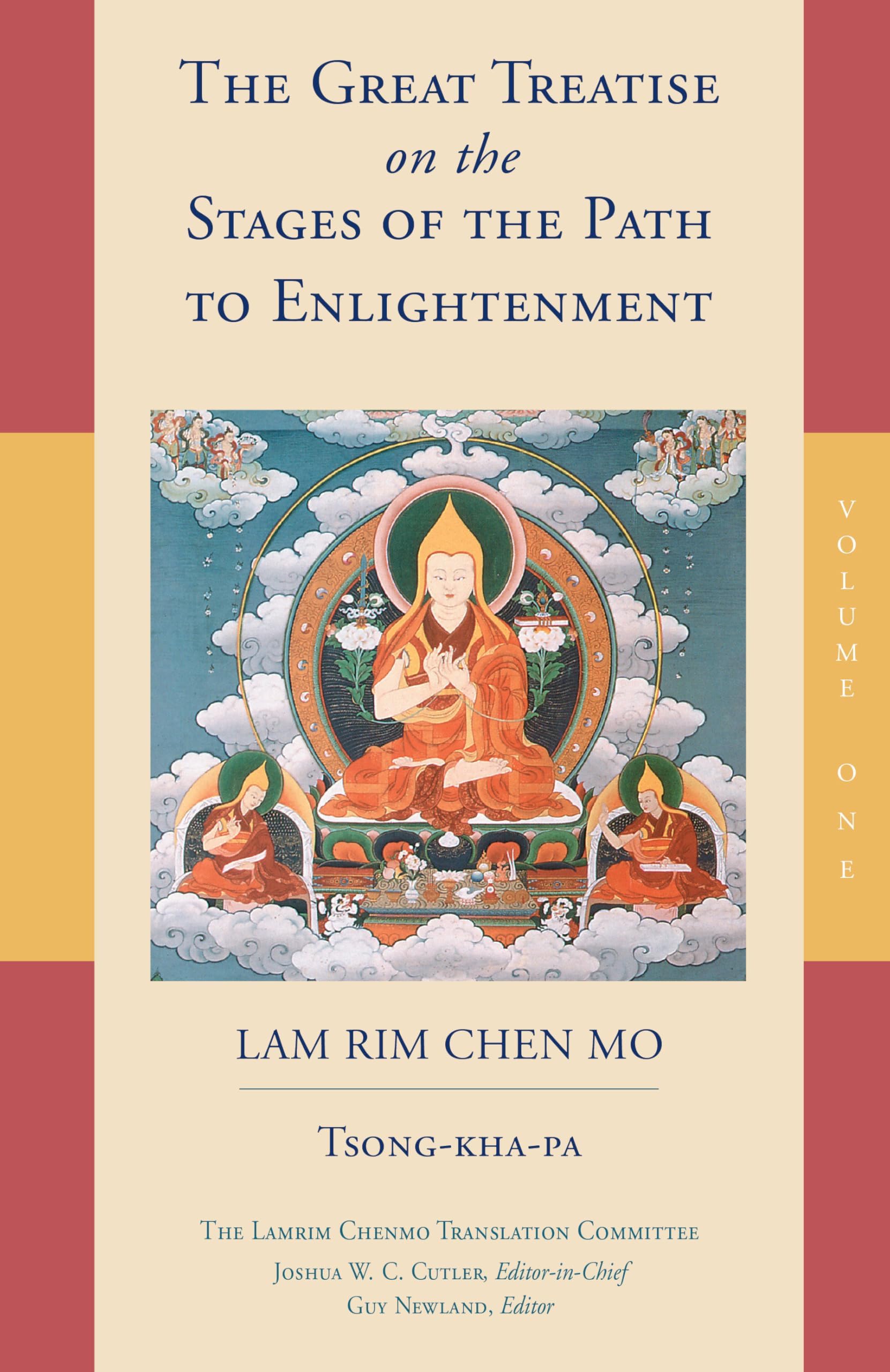
The Great Treatise on the Stages of the Path to Enlightenment (Volume 1) (The Great Treatise on the Stages of the Path, the Lamrim Chenmo)
Product ID: 11085011
The first volume of the 15th-century spiritual classic that condenses Buddhist teachings into one easy-to-follow meditation manual The Great Treatise on the Stages of the Path to Enlightenment (Tib. Lam rim chen mo ) is one of the brightest jewels in the world’s treasury of sacred literature. The author, Tsong-kha-pa, completed it in 1402, and it soon became one of the most renowned works of spiritual practice and philosophy in the world of Tibetan Buddhism. Because it condenses all the exoteric sūtra scriptures into a meditation manual that is easy to understand, scholars and practitioners rely on its authoritative presentation as a gateway that leads to a full understanding of the Buddha’s teachings. Tsong-kha-pa took great pains to base his insights on classical Indian Buddhist literature, illustrating his points with classical citations as well as with sayings of the masters of the earlier Kadampa tradition. In this way the text demonstrates clearly how Tibetan Buddhism carefully preserved and developed the Indian Buddhist traditions. This first of three volumes covers all the practices that are prerequisite for developing the spirit of enlightenment ( bodhicitta ). Review: Effects of 10 non-virtuous actions clearly explained. - Chapter 14 The Varieties of Karma is extremely helpful. Location 2674 explains the effects of non-virtuous actions. Reading this section made me reflect and strengthened my resolve to observe the precepts. Using killing, the first non-virtuous action of the body, as an example. According to The Great Treatise, killing will result in short lifetime and many illnesses. The environmental effects of killing are described below: From the nonvirtuous action of killing, such things in the external environment as food and drink, medicine, and fruits will have little strength, be ineffective, have little potency and power or, being difficult to digest, will induce illness. Hence, most living beings will die without living out their expected life spans. The Great Treatise states clearly that killing has negative impact on one’s health. This is consistent with the law of karma: when we shorten a life, our life will be shortened; when we take a life, our life will be taken. Knowing that non-Buddhists might have trouble with this way of thinking, I wanted to see if I can find evidence to make better explain how karma works. While I have faith in karma, others might want “proof” that killing is harmful to one’s health. Then an idea came to me, why not look up statistics on various professions and see if jobs that require killing shortens the life of those who are in that line of work? What I found was astounding: according to Bureau of Labor Statistics’ National Census of Fatal Occupational Injuries, fishing industry has the highest rate of fatal occupational injuries. At 118 workplace deaths per 100,000 fishermen, a fisherman is more than 30 times more likely to die on job than average! Grouping agriculture, forestry, fishing, and hunting as a sector, statistics showed that the rate of fatal occupational injuries was seven times higher than average. I connected this finding with what I learned about the lifespan of vegetarians: vegetarians live 7 to 9 years longer than non-vegetarians. While there many views and debates on why vegetarian diet leads to longer lifespan, statistics show unambiguously that vegetarians live significantly longer. This is consistent with Buddhist teaching: those who refrain from killing will live longer. Read this book! Just one section changed my life! Review: THE Manual for Life - In short, this is THE manual for life. Based on ancient findings and universal laws, the most in depth exploration of the mind by Indian and Tibetan masters, it provides the A to Z 'operational guidelines' for every human being. That includes the ones with lesser, as well the ones with greatest capacity. If you're sincerely interested in developing your potential to any degree - ultimately fully to enlightenment - this is the ultimate and perfect instruction, provided you've found yourself a qualified teacher. If you haven't, the text provides instructions on how to find one and identify the fonies out there. And one final advice - yes, find a qualified teacher ASAP. We're reluctant on this issue, but it's obvious to us to have teacher when learning a new language, music instrument etc. So, a person with higher capacities and exemplary conduct and attainments is inevitable to lead us on the path of our personal/spiritual development. Finally, the text is best studied with the original Atisha's work and the commentaries. Also, try to attend the teachings on this subject you can find online. H.H. Dalai Lama's recent teaching in Mundgod, Southern India is a good start. The knowledge will expand your consciousness to a new extent that will be visible to you, and that you'll be able to use in your daily life. Which, honestly, is the most important after all :) (This review concerns all three volumes of the text)
| Best Sellers Rank | #1,328,630 in Books ( See Top 100 in Books ) #363 in Buddhist Sacred Writings (Books) #576 in Tibetan Buddhism (Books) #3,078 in Philosophy Movements (Books) |
| Customer Reviews | 4.8 out of 5 stars 255 Reviews |
P**G
Effects of 10 non-virtuous actions clearly explained.
Chapter 14 The Varieties of Karma is extremely helpful. Location 2674 explains the effects of non-virtuous actions. Reading this section made me reflect and strengthened my resolve to observe the precepts. Using killing, the first non-virtuous action of the body, as an example. According to The Great Treatise, killing will result in short lifetime and many illnesses. The environmental effects of killing are described below: From the nonvirtuous action of killing, such things in the external environment as food and drink, medicine, and fruits will have little strength, be ineffective, have little potency and power or, being difficult to digest, will induce illness. Hence, most living beings will die without living out their expected life spans. The Great Treatise states clearly that killing has negative impact on one’s health. This is consistent with the law of karma: when we shorten a life, our life will be shortened; when we take a life, our life will be taken. Knowing that non-Buddhists might have trouble with this way of thinking, I wanted to see if I can find evidence to make better explain how karma works. While I have faith in karma, others might want “proof” that killing is harmful to one’s health. Then an idea came to me, why not look up statistics on various professions and see if jobs that require killing shortens the life of those who are in that line of work? What I found was astounding: according to Bureau of Labor Statistics’ National Census of Fatal Occupational Injuries, fishing industry has the highest rate of fatal occupational injuries. At 118 workplace deaths per 100,000 fishermen, a fisherman is more than 30 times more likely to die on job than average! Grouping agriculture, forestry, fishing, and hunting as a sector, statistics showed that the rate of fatal occupational injuries was seven times higher than average. I connected this finding with what I learned about the lifespan of vegetarians: vegetarians live 7 to 9 years longer than non-vegetarians. While there many views and debates on why vegetarian diet leads to longer lifespan, statistics show unambiguously that vegetarians live significantly longer. This is consistent with Buddhist teaching: those who refrain from killing will live longer. Read this book! Just one section changed my life!
G**O
THE Manual for Life
In short, this is THE manual for life. Based on ancient findings and universal laws, the most in depth exploration of the mind by Indian and Tibetan masters, it provides the A to Z 'operational guidelines' for every human being. That includes the ones with lesser, as well the ones with greatest capacity. If you're sincerely interested in developing your potential to any degree - ultimately fully to enlightenment - this is the ultimate and perfect instruction, provided you've found yourself a qualified teacher. If you haven't, the text provides instructions on how to find one and identify the fonies out there. And one final advice - yes, find a qualified teacher ASAP. We're reluctant on this issue, but it's obvious to us to have teacher when learning a new language, music instrument etc. So, a person with higher capacities and exemplary conduct and attainments is inevitable to lead us on the path of our personal/spiritual development. Finally, the text is best studied with the original Atisha's work and the commentaries. Also, try to attend the teachings on this subject you can find online. H.H. Dalai Lama's recent teaching in Mundgod, Southern India is a good start. The knowledge will expand your consciousness to a new extent that will be visible to you, and that you'll be able to use in your daily life. Which, honestly, is the most important after all :) (This review concerns all three volumes of the text)
Y**I
Flexibound is the best binding for this book
If you're on the fence between the flexibound cover and the paperback, go for the flexibound for sure. I have both editions now, and I can say without a doubt that the flexibound is a remarkable improvement over the original paperback binding this was released in.
J**D
I love Je Tsong-Kha-Pa
I love this book. As I read I feel I have a personal relationship with Je Tsong-Kha-Pa. I wake in the morning happy to know I am going to read Dharma from a friend and a trusted teacher. The writing is simple and profound. My analytical meditations are deeper. I cannot stress enough the joy I feel having this book in my home. I am so grateful for the original teachings and for the years of work the translation all 3 volumes took to bring Lamrim to an English reading audience. Volume 2 is on its way and it will end up sitting on the shelf for awhile. I read "Liberation in the Palm of your Hand" and found it fairly easy to read. I did not feel compelled to stop, consider, meditate, re read, converse about or ponder. I read until I was finished. With Je Tsong-Kha-Pa the pace is much slower, as though he has given me permission to take the time to discover obscurations and to consider ideas from many different angles. I no longer feel pressure to become enlightened. As a result of reading this book I find I am now determined to attain Buddhahood in order to benefit all sentient beings, and this has totally removed the expectation of I MUST. What I have gotten from this presentation is that as my attachments, aversions, ignorance, anger and bias are cleared away my life is happier, I am kinder and more compassionate and the end result, in this or in a future life will be Buddhahood. While I must study Dharma in this life, I will carry it to the next and the next and the next..... with love and kindness and joy. This book has been instrumental in clarifying the Lamrim path. I am incredibly grateful.
F**X
Every word is sublime!
Despite this book being written over 600 years ago, it feels completely current and practical. I actually have all three volumes of The Great Treatise on the Stages of the Path to Enlightenment by Je Tsongkhapa. Sometimes, the book might feel like dense reading, but I use it as a reference and go to sections I'm currently trying to practice. It would be a hard read for me if I attempted to read it it cover to cover like an ordinary book, but these volumes have everything--EVERYTHING--all the steps to enlightenment. I highly recommend these books.
J**S
A book that changes my life with every page read
Very practical and accessible instructions. The Lam Rim is not a sugarcoated Buddhist Text that tells you of the roses that bloom and the bliss that emerges from constant meditation. It is actually the equivalent of a guidebook on the path and serves contemplative practice hand in hand. These books are true pearls of meditation and life literature. In fact, I use the parts on choosing a teacher etc. etc. for my daily life (we all end up choosing someone to emulate whether it may be Nelson Mandela or Mahatma Gandhi or Richard Dawkins). Wonderful Wonderful!!
R**N
Thank you
This set is invaluable and a treasure to have access to. Thank you for offering all three books
A**M
Good, but a hard read.
If you are very well versed in Buddhism, especially Tibetan Buddhism, this is a great book. But it's not for the casual reader. It's a hard read. But for someone with a good Buddhist background, this is a must-read. I did, however, has a problem with some of the guidelines laid down in the book. I felt they were not the true teachings that I have come to learn about Buddhism. For example, in the teaching about sexuality, it admonished men that it was okay to hire a prostitute. I didn't think that was an especially enlightened admonishment. Furthermore, it totally ignored how a woman should behave. This is quite a turn off as it is one reason many women turn off of all religions. It also didn't allow tolerance for other traditions. This goes against everything I hear HH The Dalai Lama speak about. So I did have some problems with the text and I'm not sure how true to the traditional oral tradition of Tibetan Buddhism it remains. I would welcome other thoughts on this.
A**R
Lovely book.
Beautiful book with so much to absorb. I had some issues with Amazon in terms of shipping but we got it all straightened out. Thank you Amazon.
C**G
An essential textbook of Tibetan Buddhism.
It's recommended in Tibetan Buddhism Tradition as a must have. And to read & study & reflect for your own practice. A vast understanding can arise from it.
B**C
One of the main works of Tibetan Buddhism, by ...
One of the main works of Tibetan Buddhism, by its most revered author. Translation is a little intrusive with too many notes for casual reading, but as this book is one that is meant to be studied for years (and often is in eastern monasteries) the notes are excusable.
M**O
Dogmático em algumas passagens e conceitos
Requer o exercício de ler e pensar no contexto histórico, cronológico cultural em que os textos originais foram escritos. Para então transcender aos mesmos e fazer emergir o conhecimento que nos auxilia a superar esse ciclo de nascer e morrer.
K**T
This informative, enjoyable book series is not to be missed, glad it was recommended to me, as I highly do to you.
Fantastic explanations & examples, well written, informative, love this series, luckily more, as sadened when completed, but hope to refer to by reading again & again in the future fir further understanding, thankyou.
Trustpilot
2 days ago
2 weeks ago