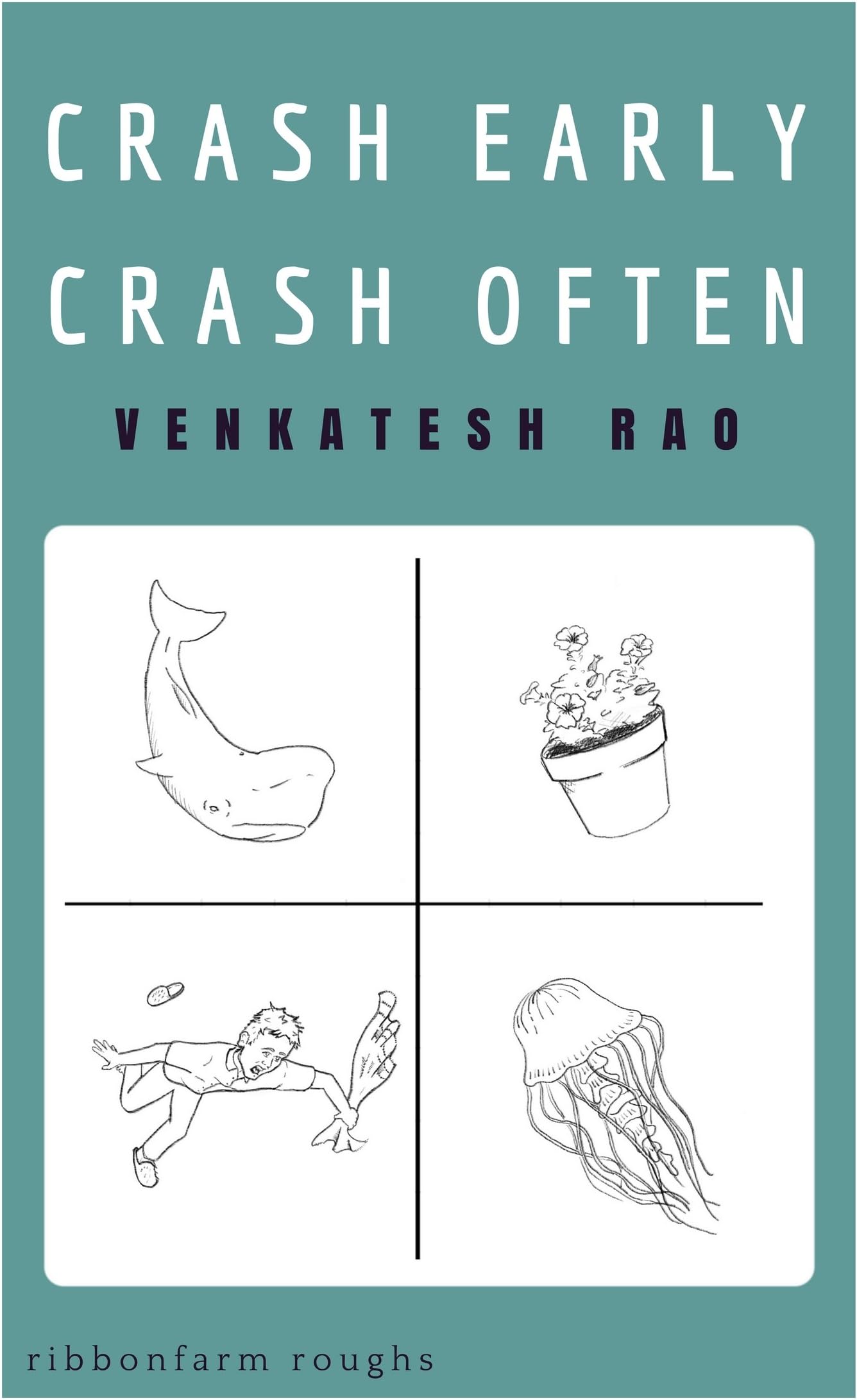
Crash Early, Crash Often (Ribbonfarm Roughs Book 3)
Product ID: 124165117
In this fine collection of essays, the third volume in the Ribbonfarm Roughs series, Venkatesh Rao (author of Tempo, The Gervais Principle, and Be Slightly Evil) ponders midlife crises, immortality, graceful aging, learning, personal growth, community, individualism, and the Big Question of how to live a life full of meaning, dignity and significance. Drawing on the lessons of his own life and the philosophies of Douglas Adams and James Carse among others, he attempts to construct a playbook for a life full of enriching experiences, satisfying accomplishments, and deep relationships. After a dozen long, meandering essays, he entirely fails to get to anywhere even remotely useful, and crashes gracelessly to the edge of the void, where he discovers the void giving him the stink eye. Originally published on ribbonfarm.com between 2014, when Rao turned 40, and 2016, when he turned 42 (a significant threshold in his religion), having learned nothing in the interim, these essays provide a poignant and vivid illustration of the art of entering middle age with all your indignity, incomprehension, and cluelessness intact. Review: unusual and excellent - I have just read Venkatesh Rao’s book Crash Early, Crash Often. This crashing advice sounds like that given in a startup incubator. I subscribe to his blog and I think the book was given to me without cost. Neither desertcart nor Venkatesh Rao know who I am, other than a name on a subscription list. The book caused me to think in ways that books typically do not. It was almost a book about me for this reason. There are many lists that one can position oneself on. Two of these lists are: Time travel: If you could travel in time for 5 minutes 1. Would you choose to travel to the future or the past? 2. If you choose the past, would you attempt to change the course of history to make your present better, or would you use it to participate in an experience that has always fascinated you, like the cowboy era? 3. If you went to the future, would you spend your time in the future memorizing stock prices or shopping for things to bring back to your own time, or would simply wander around, trying to see as much as possible? 4. Would you find a time-machine that allowed for ghostly, non-participatory observation, but no intervention (with future stock prices and sports results being beeped from your memory after), almost as interesting, or uninteresting, because of its practical uselessness? 5. If both kinds of time machines were available, how much more would you be willing to pay for a trip on the first kind? Would you rather take two non-interventionist trips on the second machine, or one interventionist trip on the first kind? -------------- There are at least 13 ways to own a backpack: 1. Own it like a satisfier, while it does the job <— me 2. Own it like you’re acting dead, made of recycle materials, and recyclable, and use it tattered 3. Own it while it feels new, until something newer and nicer catches your eye. 4. Own it like a geek, with OCD attention to materials and construction; inhabit backpack forums 5. Own it optimally, with great attention to how efficiently it holds the things you might carry 6. Own it fashionably, with a view to tribal affiliations it can signal 7. Own it like a 1%er, paying as much as you can, for the most prestigious kind you can get 8. Own it as an extension of your social identity, as hipsters sporting 1970s canvas backpacks do 9. Don’t own one, pointedly choosing a messenger bag or briefcase instead 10. Own it thoughtlessly and obliviously, so it becomes a source of serious friction in your life 11. Own it spiritually and mindfully, being all wabi-sabi about it. 12. Own it like an heirloom, with a provenance worth knowing and a story worth telling 13. Own it like a behaviorist, with an eye on packing/unpacking rituals and airline carry-on rules. For completeness let me say that I would probably travel to the past to the time when Christopher Marlowe was supposedly killed in a tavern brawl. I would not interfere. If he acknowledged my presence I would assure him that “Shakespeare” would be known as our greatest writer. As far as backpacks go, mine is utilitarian and simple. Functionality was my chief concern. Venkatesh Rao is brilliant – you should avail yourself of his insights. Review: Self-help for disillusioned intellectuals - There are no writers like Venkatesh Rao, something that cannot be said of about 99.5% of writers. Venkat's perspective is one of a person who is able to conceive and turn structures, concepts, and the distinctions between them over in his head until they are tumbled into shiny, legible gems for the benefit of those whose minds are not yet so great at polishing. Though one can taste the vague flavors of his influences, the insights themselves are deliciously new. As the title of this review implies, the ideal reader of this book has iterated through all the major self-help themes - learning social skills, a la How to Win Friends and Influence People, freeing oneself from bad economic bargains, a la Four-Hour Workweek or Rich Dad Poor Dad, and meaning-making/strategic detachment, a la some kind of meditation practice. Only then will you be prepared for something like this. Attempting to read it sooner will likely result in confusion or disgust. If you have read anything at all on Ribbonfarm, his blog, and enjoyed it, you are also very likely to enjoy this book. Though I cannot project which of the essays will or will not do the same for you, reading the essay "A Dent in the Universe" was especially shocking, painful, and enlightening for me personally. In fact, when I've made a habit of reading Venkat's work often, I have tended to lose sleep; for relentless seekers of answers, attempting to parse his conclusions can lead to a great deal of mental hyperactivity and angst. To read Venkat's writing is to watch what you once thought were pure and good truths (and their associated pursuits) become hollow echoes of wishful thinking. At first this will taste like ashes in your mouth, but, given time, it will transform into a creeping sense of freedom.
| Best Sellers Rank | #959,098 in Kindle Store ( See Top 100 in Kindle Store ) #8,117 in Philosophy (Kindle Store) #8,149 in Personal Transformation #27,055 in Personal Transformation Self-Help |
R**R
unusual and excellent
I have just read Venkatesh Rao’s book Crash Early, Crash Often. This crashing advice sounds like that given in a startup incubator. I subscribe to his blog and I think the book was given to me without cost. Neither Amazon nor Venkatesh Rao know who I am, other than a name on a subscription list. The book caused me to think in ways that books typically do not. It was almost a book about me for this reason. There are many lists that one can position oneself on. Two of these lists are: Time travel: If you could travel in time for 5 minutes 1. Would you choose to travel to the future or the past? 2. If you choose the past, would you attempt to change the course of history to make your present better, or would you use it to participate in an experience that has always fascinated you, like the cowboy era? 3. If you went to the future, would you spend your time in the future memorizing stock prices or shopping for things to bring back to your own time, or would simply wander around, trying to see as much as possible? 4. Would you find a time-machine that allowed for ghostly, non-participatory observation, but no intervention (with future stock prices and sports results being beeped from your memory after), almost as interesting, or uninteresting, because of its practical uselessness? 5. If both kinds of time machines were available, how much more would you be willing to pay for a trip on the first kind? Would you rather take two non-interventionist trips on the second machine, or one interventionist trip on the first kind? -------------- There are at least 13 ways to own a backpack: 1. Own it like a satisfier, while it does the job <— me 2. Own it like you’re acting dead, made of recycle materials, and recyclable, and use it tattered 3. Own it while it feels new, until something newer and nicer catches your eye. 4. Own it like a geek, with OCD attention to materials and construction; inhabit backpack forums 5. Own it optimally, with great attention to how efficiently it holds the things you might carry 6. Own it fashionably, with a view to tribal affiliations it can signal 7. Own it like a 1%er, paying as much as you can, for the most prestigious kind you can get 8. Own it as an extension of your social identity, as hipsters sporting 1970s canvas backpacks do 9. Don’t own one, pointedly choosing a messenger bag or briefcase instead 10. Own it thoughtlessly and obliviously, so it becomes a source of serious friction in your life 11. Own it spiritually and mindfully, being all wabi-sabi about it. 12. Own it like an heirloom, with a provenance worth knowing and a story worth telling 13. Own it like a behaviorist, with an eye on packing/unpacking rituals and airline carry-on rules. For completeness let me say that I would probably travel to the past to the time when Christopher Marlowe was supposedly killed in a tavern brawl. I would not interfere. If he acknowledged my presence I would assure him that “Shakespeare” would be known as our greatest writer. As far as backpacks go, mine is utilitarian and simple. Functionality was my chief concern. Venkatesh Rao is brilliant – you should avail yourself of his insights.
C**S
Self-help for disillusioned intellectuals
There are no writers like Venkatesh Rao, something that cannot be said of about 99.5% of writers. Venkat's perspective is one of a person who is able to conceive and turn structures, concepts, and the distinctions between them over in his head until they are tumbled into shiny, legible gems for the benefit of those whose minds are not yet so great at polishing. Though one can taste the vague flavors of his influences, the insights themselves are deliciously new. As the title of this review implies, the ideal reader of this book has iterated through all the major self-help themes - learning social skills, a la How to Win Friends and Influence People, freeing oneself from bad economic bargains, a la Four-Hour Workweek or Rich Dad Poor Dad, and meaning-making/strategic detachment, a la some kind of meditation practice. Only then will you be prepared for something like this. Attempting to read it sooner will likely result in confusion or disgust. If you have read anything at all on Ribbonfarm, his blog, and enjoyed it, you are also very likely to enjoy this book. Though I cannot project which of the essays will or will not do the same for you, reading the essay "A Dent in the Universe" was especially shocking, painful, and enlightening for me personally. In fact, when I've made a habit of reading Venkat's work often, I have tended to lose sleep; for relentless seekers of answers, attempting to parse his conclusions can lead to a great deal of mental hyperactivity and angst. To read Venkat's writing is to watch what you once thought were pure and good truths (and their associated pursuits) become hollow echoes of wishful thinking. At first this will taste like ashes in your mouth, but, given time, it will transform into a creeping sense of freedom.
Z**K
A highly interesting juxtaposition of weirdness and truth
Mr. Rao is quietly paving important neural and social cowpaths. I am convinced that future history will remember his work better than most. His ability to draw (and defend) surprising conclusions is balanced by the fact that he never takes himself too seriously. In other words, he's a very approachable intellectual. The structure of the book is perhaps my favorite part. It's easier to define it by what it's not. It's not a Gladwellian novel, making a contrarian statement early and slowly building the narrative using seemingly unconnected case studies. It doesn't promise life hacks like a four hour work week or a simple guide to better habits. Instead, it's a bunch of essays that are kind of related to each other. It's structured more like DaVinci's diary, a collection of curated thought. In this way it mimics the human mind, oscillating between humor and existentialism, deep thought and casual conclusions. It encourages you to think differently, which might lead to contrarian/ surprising insights. And if you are brave enough to pursue those insights you may end up expediting your way up Maslow's hierarchy (which is the Ultimate life hack). In other words, the Gladwell's of the world want you to think like them, while Ferris and company want to you act like them. Rao wants you to think for yourself and act like yourself. And he shows you how to do that by example.
B**S
How to Crash, and Crash Well
I saw the seeds for this some of this book in Rao's 2012 answer to a question on Quora: "What are the three most important tools for radically reinventing your life when you feel stuck?" "1. Hitting rock bottom. Keep sinking to find this tool. It might be a while. 2. Burning bridges. Find someone nice and decent who is keeping you afloat and piss them off irreversibly. 3. Forrest Gumption. Start running. Stop when unstuck." If you've lived long enough to react to that advice thoughtfully and with a smile, instead of assuming it is meant for someone more desperate or less precious than you, then you're ready for Crash Early, Crash Often. A collection like this is a great way to experience Rao's work. Thoughtful and laugh-out-loud funny.
A**R
Actually very interesting
A collection of blogs turned into a book from a guy with an unconventional perspective. Gave me a lot to think about. Excited to read more from VR.
M**L
Mindbending
I went to bed feeling frustrated almost every night after reading this book. If that doesn’t elicit a five star rating, I’m not sure what does.
A**R
A fun little inside into the mind of how to think in life
The book is absolutely fun to read quite inside and should be with the great assault. I had quite a lot of fun fun, reading it
Trustpilot
1 month ago
1 week ago