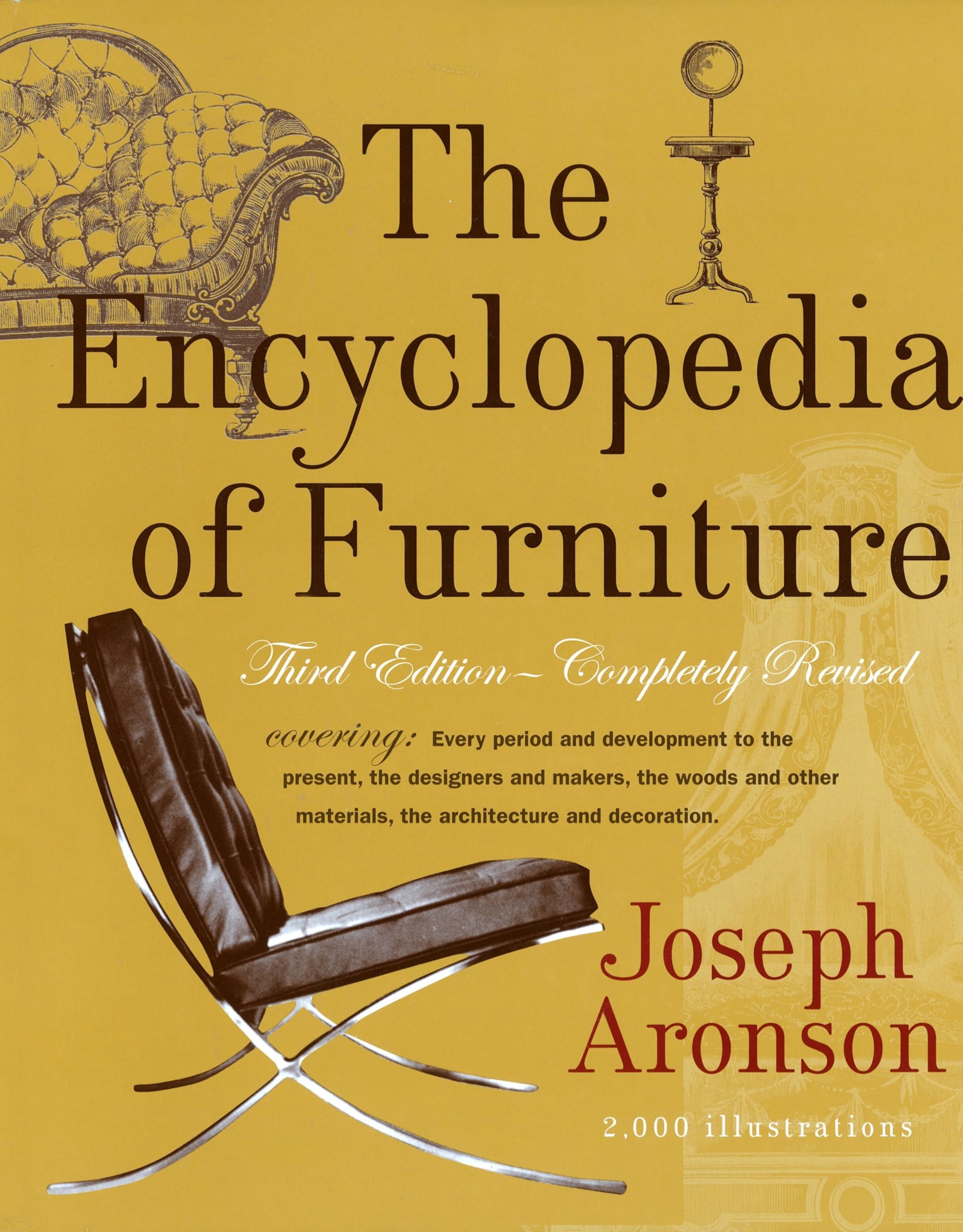
The Encyclopedia of Furniture: Third Edition - Completely Revised
Product ID: 1564301
Buy anything from 5,000+ international stores. One checkout price. No surprise fees. Join 2M+ shoppers on Desertcart.
Desertcart purchases this item on your behalf and handles shipping, customs, and support to Congo.
A completely revised edition, covering every period and development to the present, the designers and makers, the woods and other materials, the architecture and decoration. 2,000 photographs. Glossary. Bibliography. Index. Review: Fast shipping - Great book excellent seller. Thank you Review: Dated, but still excellent - I purchased a used copy of this book via desertcart. Coming from the ninth printing of third edition, this book came off the press in 1975. Now, 46 years later, there are some signs of wear and tear—but no more than reasonable, and the seller was excellent in all categories. Joseph Aronson authored the first edition of this encyclopedia in 1938. In the foreword to it, he wrote, “It has long seemed to me that the art and industry of furniture sorely needed a convenient encyclopedia.” He sought to meet the reference-work needs of furniture designers, makers, collectors, architects, and the like, recognizing that to keep the encyclopedia compact enough to be a single tome, some details such would have to be omitted. The reception of the first and second editions were numerous, strong, and enthusiastic. The inside flap of my copy says that previous to its existence, more than 150,000 copies of the book were sold. In his foreword to the third edition, Aronson acknowledges that many revisions have been made, a substantial number of which came from critiques and suggestions regarding the first two editions. The first thing to note about the book is that it is, to modern eyes, remarkably Eurocentric. Given the era in which it was written, the locale, and the predominance of English, French, and other European styles, techniques, etc., in the influencing of American furniture making, sales, and so forth, it is not surprising. But don’t look here for much on Asian furniture, for instance, regardless of the merits thereof. (There are a few examples, but not sufficient to claim anything like thorough coverage of the subject.) The format of the book is one of the somewhat quaintly old-fashioned “encyclopedia” sort, much akin to a dictionary. Entries are alphabetical, and each is defined, described and/or explained in as concise a manner as the author thought acceptable. Many entries are augmented will illustration; some are simple b/w drawings/engravings, others photographs (again, all b/w), and there are more than 2000 of them, virtually all of which are valuable in a reference of this sort. As a budding furniture maker, I’m already finding this book very helpful in clarifying what is meant by some terms of art, or acquiring a photographic example of something to cement the idea of, say, just what a c-scroll is and looks like. Or what features might be expected of German Rococo furniture. It will continue to be a useful reference pretty much until I give up the activity, I’m sure. For those who wish ready reference to a broad range of phrases, names, design details, etc., of the furniture produced over the last several centuries, with an eye cast mostly toward European influence, this remains, as best I can tell, the best single resource. Recommended for students of design history, furniture design, repair, and construction, artists, and more.
| Best Sellers Rank | #175,512 in Books ( See Top 100 in Books ) #9 in Antique & Collectible Furniture (Books) #41 in Furniture Design (Books) #110 in Antiques & Collectibles Encyclopedias |
| Customer Reviews | 4.4 out of 5 stars 180 Reviews |
M**T
Fast shipping
Great book excellent seller. Thank you
P**K
Dated, but still excellent
I purchased a used copy of this book via Amazon. Coming from the ninth printing of third edition, this book came off the press in 1975. Now, 46 years later, there are some signs of wear and tear—but no more than reasonable, and the seller was excellent in all categories. Joseph Aronson authored the first edition of this encyclopedia in 1938. In the foreword to it, he wrote, “It has long seemed to me that the art and industry of furniture sorely needed a convenient encyclopedia.” He sought to meet the reference-work needs of furniture designers, makers, collectors, architects, and the like, recognizing that to keep the encyclopedia compact enough to be a single tome, some details such would have to be omitted. The reception of the first and second editions were numerous, strong, and enthusiastic. The inside flap of my copy says that previous to its existence, more than 150,000 copies of the book were sold. In his foreword to the third edition, Aronson acknowledges that many revisions have been made, a substantial number of which came from critiques and suggestions regarding the first two editions. The first thing to note about the book is that it is, to modern eyes, remarkably Eurocentric. Given the era in which it was written, the locale, and the predominance of English, French, and other European styles, techniques, etc., in the influencing of American furniture making, sales, and so forth, it is not surprising. But don’t look here for much on Asian furniture, for instance, regardless of the merits thereof. (There are a few examples, but not sufficient to claim anything like thorough coverage of the subject.) The format of the book is one of the somewhat quaintly old-fashioned “encyclopedia” sort, much akin to a dictionary. Entries are alphabetical, and each is defined, described and/or explained in as concise a manner as the author thought acceptable. Many entries are augmented will illustration; some are simple b/w drawings/engravings, others photographs (again, all b/w), and there are more than 2000 of them, virtually all of which are valuable in a reference of this sort. As a budding furniture maker, I’m already finding this book very helpful in clarifying what is meant by some terms of art, or acquiring a photographic example of something to cement the idea of, say, just what a c-scroll is and looks like. Or what features might be expected of German Rococo furniture. It will continue to be a useful reference pretty much until I give up the activity, I’m sure. For those who wish ready reference to a broad range of phrases, names, design details, etc., of the furniture produced over the last several centuries, with an eye cast mostly toward European influence, this remains, as best I can tell, the best single resource. Recommended for students of design history, furniture design, repair, and construction, artists, and more.
D**X
Very Valuable
Aronson's ENCYCLOPEDIA OF FURNITURE is a must have if you do not know every detail of every style in every period of furniture development. It defines terms and shows sketches and photos of many of them. It has good summaries of each term. Organized by terms and presented in alphabetical order, if you don't find the information under one term, it will send you to the term where you can find information instead. Used in my History of Furniture class, I highly recommend it paired with Crochet's DESIGNER'S GUIDE TO FURNITURE STYLES, 2nd Edition. Together, you will have everything you need to know about the history of furniture.
D**D
this is a very detailed book that has just thousands of wonderful black and white pictures of many
the cover is different on my book, but its the same book. this is a very detailed book that has just thousands of wonderful black and white pictures of many, many types of furniture! and even a few sketches. it even has a section with pictures of different "cuts" of wood making different grains. a must have book if you are even slightly interested in the style and design of furniture!
S**Y
A Must-Have Resource Book for all Design Libraries
I cannot stress enough how fabulous this book is - it really is Must-Have Resource book for ALL Design Libraries. Having studied the applied arts/ craft arts & design this book is a great reference guide and something I use to check on original & replica styles from furniture suppliers, especially for historical aspects to help further inform clients on their choices/ placement & ultimately purchases. If you love furniture, design or are in both - then this is a great addition to your resources.
A**L
Not worth buying
It’s not that nice bad quality photos all through the book. I’m sure they can get updated photos for this book and maybe make it in color some of the photos are so bad I can’t even tell what I’m looking at it’s just a black shape no detail or reference of what I’m looking at and very little detail on the photos
D**S
Good but dated content deserves a new revision
This book is just what I was looking for: Illustrated descriptions of styles and terms used for furniture. If you want to know what terms like "cabriole" mean (for which you really need illustrations), this is probably the right book for you. I say "probably" because The Encyclopedia of Furniture was originally published in 1938 and the current edition was revised almost 50 years ago. Given that most of the material is historical, that's not as bad as it sounds The Encyclopedia of Furniture would benefit greatly from the better editorial and production values that computerized compilation methods have made possible. (Unfortunately, most publishers--reflecting the ownership of many by huge multinational media corporations--are more interested in how fast they can publish than whether the material is comprehensive or even factually correct.) Following are examples of the kinds of problems that could be eliminated with some editorial direction and modern production techniques (which will also give you an idea of what's covered by The Encyclopedia of Furniture): --The criteria for deciding what or who deserves an entry aren't clear. For example, an entry appears for William Morris but none for Breuer or Thonet. And does James Gillingham (an 18th century Phila. furniture maker whose name isn't identified with a chair or any other piece of furniture) warrant more space than either of these? --It appears that only photographic plates are numbered, but line drawings don't always appear adjacent to the text they illustrate. Because there are 1800+ illustrations, this can create confusion. For example, to what do the unlabeled line drawings numbered a-e at the top of col. 1, p. 389 refer (none of the text appearing on pages 388-389 appears to reference these). --The illustrations don't always appear with the most appropriate entry. For example, there's no illustration for KNEEHOLE but illustrations of kneehole desks appear under both DESK and ENGLAND. --The means of illustration are also sometimes inappropriate. PERIOD FURNITURE (p. 336) is illustrated by a hand-drawn timeline whereas it should have been typeset---or perhaps the timeline (which certainly deserves space in this encyclopedia) belongs someplace else. --In some places (e.g., the heavily illustrated ENGLAND section) the illustrations sometimes don't even fit the printed page (they just kind of slide off the end). --INTAGLIO (p. 262) references illustration 32, which is a Queen Anne armchair. Does this mean that the three-toed DRAKE FOOT of the chair leg is an example of intaglio? The entry is vague, and so is the illustration. --Running heads and folios are essential but are sometimes missing just where they are needed most (e.g., the lengthy ENGLAND section). This great reference is most deserving of an extensive, up-to-date revision.
N**E
Great info, wish the pictures were colored
The book features many examples, some examples don't have names or information which is weird. And another thing I didn't like was that the pictures were all black and white.
L**H
They are not exaggerating when they say “Encyclopedia” Thank you for such thorough content 👍
The book is great, only flaw is it’s dust cover arrived torn in two places. This is a book that’s going to be used a lot… so it’ll show wear & tear eventually. No love lost 🥰
Trustpilot
2 months ago
1 week ago