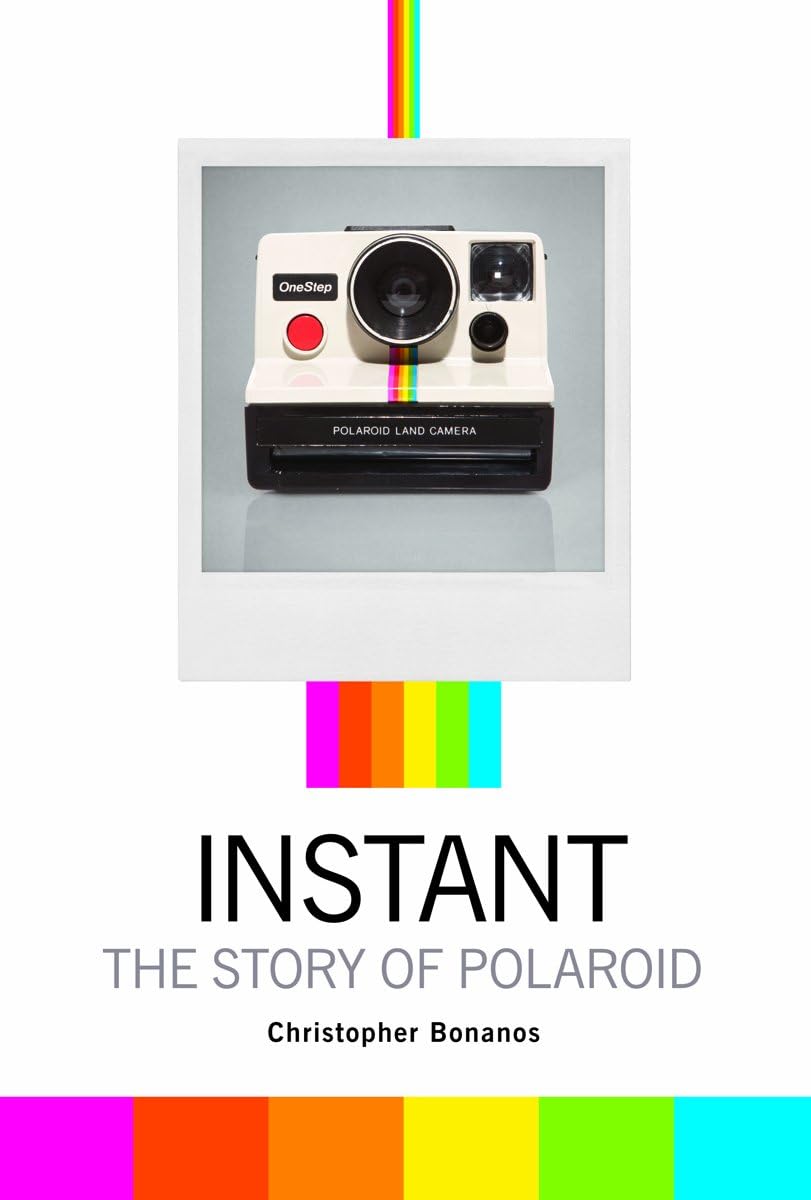

Instant: The Story of Polaroid
Product ID: 1564379
Buy anything from 5,000+ international stores. One checkout price. No surprise fees. Join 2M+ shoppers on Desertcart.
Desertcart purchases this item on your behalf and handles shipping, customs, and support to Congo.
"Instant photography at the push of a button!" During the 1960s and '70s, Polaroid was the coolest technology company on earth. Like Apple, it was an innovation machine that cranked out one must-have product after another. Led by its own visionary genius founder, Edwin Land, Polaroid grew from a 1937 garage start-up into a billion-dollar pop-culture phenomenon. Instant tells the remarkable tale of Land's one-of-a-kind invention-from Polaroid's first instant camera to hit the market in 1948, to its meteoric rise in popularity and adoption by artists such as Ansel Adams, Andy Warhol, and Chuck Close, to the company's dramatic decline into bankruptcy in the late '90s and its unlikely resurrection in the digital age. Instant is both an inspiring tale of American ingenuity and a cautionary business tale about the perils of companies that lose their creative edge. Review: Very well done, readable, good pictures, just the right level of detail. - Very nice, couldn't put it down. Well-written, well-informed, just the right level of detail, insightful. If you're interested in Land and Polaroid you'll enjoy this book. I remember a lot of the products and events mentioned and it brought them to life for me. It connected a lot of dots... for example, I'd wondered about the Fujifilm Instax cameras showing up in stores; basically, Polaroid technology had been licensed to Fuji under a business deal, and when Polaroid was destroyed by corporate raiders, Fujifilm kept on with it. The pictures are very well done. For reasons I don't understand, Kindle books often seem to have low-resolution pictures, or pictures with technical problems. These don't. And, almost magically, the color pictures actually seem to capture the _look_ of Polaroid color. Review: The magical picture machine - Looking for an addictive and breezy little non-fiction book that you can polish off on a round trip plane flight? "Instant" is your ticket. This slim little volume covering the history of one of the most recognizable names in corporate America--and purveyors of one of the world's most memorable products--is written in a friendly, conversational style that really pulled me along. Everyone except the very youngest among us fondly remember the pre-digital thrill of snapping a photo and seeing the results just seconds later. In a time when amateur photographers dropped their film cassette off at the nearest Foto Hut and waited a week for the prints to come back from the lab, Polaroid's instant print was rather magical. Steve Jobs has often been compared to the father of instant film and co-founder of Polaroid, Edwin Land. They shared the common trait of being passionate visionaries who built a cult-like following of true believers who wanted to work for them. They ran companies that certainly wanted to make money, but that were first and foremost dedicated to the dream of their magical product. Both men were unshakable in their own self-confidence and their unwavering belief in the righteousness of their cause. Land, a fascinating character who has already inspired books covering his life in detail, gets less attention in "Instant" than one might want, but the nature of this book is to be brief. If you're interested in following up for more, you certainly have that option elsewhere. Part biography of Edwin Land and part company history, "Instant" also reviews the technical challenges of creating a self-contained, portable photo developing system, highlighting both its successes and notable shortcomings. (Various early incarnations of instant prints curled, discolored or required the application of an inconvenient liquid fixitive following printing.) It was a full twenty years after the debut of instant black-and-white Polaroid film that the familiar color prints with their large, white bottom border appeared in the early 70s. "Instant" also covers a little-known aspect of the Polaroid story: the small band of artists who were some of the product's biggest fans. (Did you know that none other than visual perfectionist Ansel Adams had a decades-long association with Polaroid?) Other prominent big names who were advocates of Polaroid film included Chuck Close and Andy Worhol, among others. This is perhaps one of the more surprising aspects of the story. Polaroid was often regarded by connoisseurs as a synonym for inferior photographs meant strictly for the amateur who didn't mind things like soft focus or less than accurate color saturation. But Polaroid produced a number of other far lesser-known instant-film products dedicated to professional applications. In fact, they produced super large format studio cameras capable of delivering superior quality prints that could compete with the finest equipment. Alas, despite the successes of Polaroid and its visionary leader who gave the world a magical product, it became a victim of its devotion to the very product that inspired it. The tragedy of Polaroid is that it was generally well positioned to take advantage of the digital revolution but it failed--for a complex number of reasons--to do so. For those of us who remember the joy of watching photos resolve into existence from the gray-green haze of a Polaroid frame, the final chapters of "Instant" leave us with a wistful feeling.
| Best Sellers Rank | #1,186,267 in Books ( See Top 100 in Books ) #332 in Popular Culture Antiques & Collectibles (Books) #1,146 in Photography History #2,141 in Photograpy Equipment & Techniques |
| Customer Reviews | 4.4 out of 5 stars 240 Reviews |
D**H
Very well done, readable, good pictures, just the right level of detail.
Very nice, couldn't put it down. Well-written, well-informed, just the right level of detail, insightful. If you're interested in Land and Polaroid you'll enjoy this book. I remember a lot of the products and events mentioned and it brought them to life for me. It connected a lot of dots... for example, I'd wondered about the Fujifilm Instax cameras showing up in stores; basically, Polaroid technology had been licensed to Fuji under a business deal, and when Polaroid was destroyed by corporate raiders, Fujifilm kept on with it. The pictures are very well done. For reasons I don't understand, Kindle books often seem to have low-resolution pictures, or pictures with technical problems. These don't. And, almost magically, the color pictures actually seem to capture the _look_ of Polaroid color.
G**R
The magical picture machine
Looking for an addictive and breezy little non-fiction book that you can polish off on a round trip plane flight? "Instant" is your ticket. This slim little volume covering the history of one of the most recognizable names in corporate America--and purveyors of one of the world's most memorable products--is written in a friendly, conversational style that really pulled me along. Everyone except the very youngest among us fondly remember the pre-digital thrill of snapping a photo and seeing the results just seconds later. In a time when amateur photographers dropped their film cassette off at the nearest Foto Hut and waited a week for the prints to come back from the lab, Polaroid's instant print was rather magical. Steve Jobs has often been compared to the father of instant film and co-founder of Polaroid, Edwin Land. They shared the common trait of being passionate visionaries who built a cult-like following of true believers who wanted to work for them. They ran companies that certainly wanted to make money, but that were first and foremost dedicated to the dream of their magical product. Both men were unshakable in their own self-confidence and their unwavering belief in the righteousness of their cause. Land, a fascinating character who has already inspired books covering his life in detail, gets less attention in "Instant" than one might want, but the nature of this book is to be brief. If you're interested in following up for more, you certainly have that option elsewhere. Part biography of Edwin Land and part company history, "Instant" also reviews the technical challenges of creating a self-contained, portable photo developing system, highlighting both its successes and notable shortcomings. (Various early incarnations of instant prints curled, discolored or required the application of an inconvenient liquid fixitive following printing.) It was a full twenty years after the debut of instant black-and-white Polaroid film that the familiar color prints with their large, white bottom border appeared in the early 70s. "Instant" also covers a little-known aspect of the Polaroid story: the small band of artists who were some of the product's biggest fans. (Did you know that none other than visual perfectionist Ansel Adams had a decades-long association with Polaroid?) Other prominent big names who were advocates of Polaroid film included Chuck Close and Andy Worhol, among others. This is perhaps one of the more surprising aspects of the story. Polaroid was often regarded by connoisseurs as a synonym for inferior photographs meant strictly for the amateur who didn't mind things like soft focus or less than accurate color saturation. But Polaroid produced a number of other far lesser-known instant-film products dedicated to professional applications. In fact, they produced super large format studio cameras capable of delivering superior quality prints that could compete with the finest equipment. Alas, despite the successes of Polaroid and its visionary leader who gave the world a magical product, it became a victim of its devotion to the very product that inspired it. The tragedy of Polaroid is that it was generally well positioned to take advantage of the digital revolution but it failed--for a complex number of reasons--to do so. For those of us who remember the joy of watching photos resolve into existence from the gray-green haze of a Polaroid frame, the final chapters of "Instant" leave us with a wistful feeling.
F**S
Great story
Very well written, enjoyed the detailed information...book arrived quickly and packaged extremely well...
J**R
A lovely book-as-object and book-as-story
The paper, the pictures, the font, the dust-jacket--everything about this book as a physical object is beautifully executed. The story, too, is a treasure. It's both inspiring and admonitory, and you can't help but feel real affection for its human protagonist, an affection shared by Land's employees and one that's evident on every page by the author's rendering. I'm loath to agree with the man, but Nixon was right: this country needs more Dr. Lands. If only more technology CEOs appreciated the complementary interplay of the humanities and sciences and strived to create a workplace where employees are motivated to flourish, as Land did.
F**A
Good book on Polaroid -- but, oddly, the photos are lacking...
This nicely put together book is a great (and quick) read about the origins of Polaroid, and having been published in 2012, probably the most up-to-date account of it's history. It also has a great bibliography for further reading on both Polaroid and its founder Edwin Land. My biggest disappointment is this: the photos of Polaroid products and their packaging--or rather, the lack thereof. The author tells us how important the design aesthetic was at Polaroid but includes only about SEVEN pics of cameras out of the entire line of products & packaging! Products are mentioned, but never shown, such as the large format cameras, we get one head-on view of the Polavision movie camera, no shots of the later models or the brightly colored packaging that was their signature. (I guess I'll have to pick up Paul Giambarba's "The Branding of Polaroid" for that). The majority of photos are samples of the artistic use of Polaroids (nice, but a bit repetitive) and too many shots of celebrities (few of which were of any interest to me). I would rather have seen more pics of the great minds behind Polaroid's innovations--especially since in terms of their hiring practices, they were ahead of their time, and many of those scientific minds belonged to women. Lets' see who these people were! I found myself constantly turning to the internet (and the author's blog) to find photos & more info about the the subjects in the book. This book is good enough for the publisher to revisit the layout: considering the careful thought that went in to the dust jacket, colors, etc. of this hardcover edition, I would love to see them print a larger softback edition with more photos of the items & people which are actually the subject matter of the text--I think they'd have a real winner on their hands.
M**S
Overview of Polaroid's Brilliance, Its Rise, and Its Precipitous Fall.
The Polaroid name and patents are now owned by a Dutch company that used to be called The Impossible Project, but Polaroid disappeared in 2008 in the minds of most consumers when it stopped making integral film for the instant cameras that had been ubiquitous since the 1970s. That was after the company's first bankruptcy and before its second. In "Instant: The Story of Polaroid", Christopher Bonanos takes the reader through Polaroid's beginnings and its string of successes in consumer instant cameras and film at the direction of the company's genius founder Edwin Land, then the poor decisions, changes in ownership, and criminal exploitation that led to its gut-wrenching downfall. There are more than seventy color photos and illustrations scattered throughout the book, some the work of Polaroid artists and some behind-the-scenes photos or advertisements. Bonanos begins with Polaroid's birth in 1932 as a partnership between George W. Wainwright III and Edwin Land, who had patented the world's first polarizer in 1929. The company was a manufacturer and supplier of sheet polarizers, and Edwin Land's values were in evidence everywhere –the product's presentation, company communication, every word chosen for its annual report. In 1937, the company was reincorporated as Polaroid Corporation and parted ways with Wheelwright. The book's second chapter talks about Land's unorthodox hiring practices and its success in 3D glasses and sunglasses, followed by a boon from military contracts during World War II. The first Polaroid camera, an 8x10 view camera, made its debut in 1947. In 1948, the Model 95, weighing 4 pounds, appeared on the shelves of a Boston department store and sold out in one day. It used a peel-apart orthochromatic sepia film and was Polaroid's first big success with consumers. A black-and-white Type 41 film was introduced in 1950. It needed a print-coater to prevent the image from fading, as did every Polaroid film until 1970. That's why people "shake it like a Polaroid picture." People waved the photos around to get the print-coater to dry faster. Chapter 4 takes us through Polaroid's hey day in the 1950s and 1960, which saw the company produce a string of innovative consumer cameras and films. There is discussion of research and development, advertising, and the design team that made Polaroid cameras desirable and memorable. Chapter 5 covers the creation of Polaroid's first integral film in 1972: SX-70, know for its ability to manipulate the image until it was discontinued in the 2000s, and the fantastic Land Camera that would use that film. Polaroid's first failure is discussed in Chapter 6. That was Polavision in 1977, an instant movie film. The problem was that it was behind the times. Video tape had recently been invented and would soon take the market for home movies. Chapter 7 covers the decades-long legal battle with Kodak over its instant film that allegedly infringed twelve of Polaroid's patents. On the other hand, Polaroid struck a deal with Fuji that allowed that company to produce instant film for the Japanese market. The Fall: The changes in management, in product philosophy, discontinuation of a lot of R&D, catastrophic decisions to abandon digital technologies, especially printing, and the mounting debt from resisting a hostile takeover in the 1980s and 1990s are cataloged in Chapter 8. Polaroid had a string of presidents who made bad decisions and lacked an overarching vision for the company. The downward spiral continues in Chapter 9 with the controversial sale of the company to Bank One, who might have fixed the price. In the end, Polaroid was the victim of fraud for which Tom Petters went to prison, an ignominious end for perhaps the most innovative company ever. There are other books about Edwin Land and Polaroid, but "Instant" is a concise, readable, and informative overview.
D**N
A Must for Polaroid fans
This was an excellent book. I am an aficionado of Polaroid photography, and it was nice to learn about the history of the company, and of Edwin H. Land. The final chapters of the book remind me very much of reading about the making of "Let It Be," and the challenges The Beatles faced near the end of their run. I know that's a bit random, but the creativity, tenacity, and the rise of Polaroid, the incredible popularity, the changes and eventual ending...in my mind it parallels. A must read for anyone interested in instant photography, entrepreneurs, inventors, and history. It's all there, and packed with great Polaroid photos as well.
A**N
Fascinating
This is a history that reads like a novel. From the larger than life nature of the main character to the grimy super villain, I couldn't put it down. The technological nature of some of the content contrasts nicely with the fairy tale nature of Land's character and the deep business lessons to be learned. It was at once accessible and quite educational. Highly recommended from this design, tech, and history nerd.
J**Z
Muy bueno
Excelente historia de la marca Polaroid. Descripción de lo que pudo hacer todo un genio con una sola ganial idea y el espíritu innovador por bandera.
M**E
Excellent read.
Well written and full of interesting information.
C**Y
Great Book!
this book is so romantic! i love it so much and it takes you back on how technology grew from :D shake it like a polaroid picture!
D**N
A fascinating read with lovely photos.
A fascinating read with lovely photos.
J**R
FRom nothing an indiividual can creat an wonderful product
During my life time a new and useful product was developed and was so useful to many people
Trustpilot
1 month ago
1 month ago