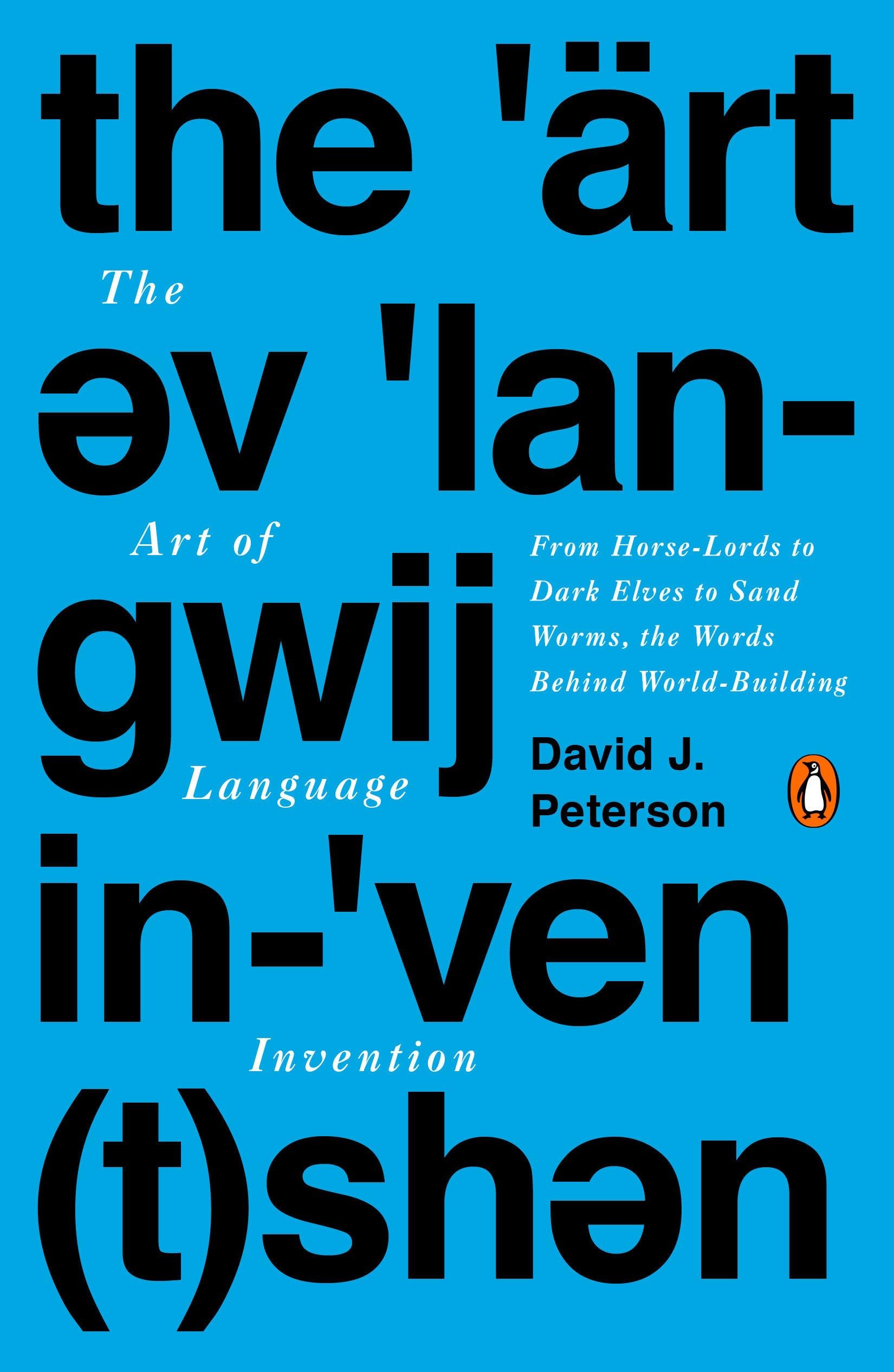
The Art of Language Invention: From Horse-Lords to Dark Elves to Sand Worms, the Words Behind World-Building
Product ID: 18564723
Buy anything from 5,000+ international stores. One checkout price. No surprise fees. Join 2M+ shoppers on Desertcart.
Desertcart purchases this item on your behalf and handles shipping, customs, and support to Congo.
An insider’s tour through the construction of invented languages from the bestselling author and creator of languages for Legendary's Dune , the HBO series Game of Thrones and the Syfy series Defiance From master language creator David J. Peterson comes a creative guide to language construction for sci-fi and fantasy fans, writers, game creators, and language lovers. Peterson offers a captivating overview of language creation, covering its history from Tolkien’s creations and Klingon to today’s thriving global community of conlangers. He provides the essential tools necessary for inventing and evolving new languages, using examples from a variety of languages including his own creations, punctuated with references to everything from Star Wars to Janelle Monáe. Along the way, behind-the-scenes stories lift the curtain on how he built languages like Dothraki for HBO’s Game of Thrones and Shiväisith for Marvel’s Thor: The Dark World , and an included phrasebook will start fans speaking Peterson’s constructed languages. The Art of Language Invention is an inside look at a fascinating culture and an engaging entry into a flourishing art form—and it might be the most fun you’ll ever have with linguistics. The Art of Language Invention includes a new chapter on phrases, specifically, word order, negation, question formation, pragmatic concerns, relativization, and subordination, providing a complete introduction to language creation and linguistics. Invented languages featured in the book now include Chakobsa from Legendary’s Dune , Trigedasleng (or Grounder) from The 100 , Méníshè language from Motherland: Fort Salem and Ravkan from the Netflix series Shadow and Bone . Review: The Art of Language Invention educates and inspires as much as it entertains. - I spent a lot of time waiting in doctors’ offices last week, and I needed something to save me from boredom- and anxiety-induced insanity. What better choice could I have made than The Art of Language Invention by David J. Peterson? Back when I was a kid, one of my favorite books was Dougal Dixon’s After Man: a Zoology of the Future. As an exercise in speculative biology, the book is responsible for maybe 90% of my enthusiasm about evolution, anatomy, and animal behavior. The fact that I know anything about those subjects at all is because I was enthusiastic for them, which puts Dixon to blame for most of what I know about the natural world. When I read The Art of Language Invention, the same thing happened with linguistics. You can’t create a good made-up language without knowing about real languages. Through the lens of his invented languages and his experience using them, Peterson educates the reader about the forces that shape the way we speak—a practical gift wrapped in shiny packaging. Like all good speculation, The Art of Language Invention educates and inspires as much as it entertains. And it IS entertaining, if for no other reason than the cat and onion jokes. Go read it. I expect to see your new language on my desk by Monday. Review: I like this book - For various reasons, over my life I have been exposed to six or seven languages, including tonal ones, and even learned a few of those, including ASL. Languages are fascinating, at least to me. But the idea of just making up a reasonably plausible language was not in my experience. I guess the Army did use their own made up language to select folks who could do well in language school. That was fun too - taking a test based on a language you had just met - so to speak.
| Best Sellers Rank | #110,525 in Books ( See Top 100 in Books ) #16 in Science Fiction & Fantasy Writing #49 in Alphabet Reference #154 in Fiction Writing Reference (Books) |
| Customer Reviews | 4.6 out of 5 stars 628 Reviews |
D**N
The Art of Language Invention educates and inspires as much as it entertains.
I spent a lot of time waiting in doctors’ offices last week, and I needed something to save me from boredom- and anxiety-induced insanity. What better choice could I have made than The Art of Language Invention by David J. Peterson? Back when I was a kid, one of my favorite books was Dougal Dixon’s After Man: a Zoology of the Future. As an exercise in speculative biology, the book is responsible for maybe 90% of my enthusiasm about evolution, anatomy, and animal behavior. The fact that I know anything about those subjects at all is because I was enthusiastic for them, which puts Dixon to blame for most of what I know about the natural world. When I read The Art of Language Invention, the same thing happened with linguistics. You can’t create a good made-up language without knowing about real languages. Through the lens of his invented languages and his experience using them, Peterson educates the reader about the forces that shape the way we speak—a practical gift wrapped in shiny packaging. Like all good speculation, The Art of Language Invention educates and inspires as much as it entertains. And it IS entertaining, if for no other reason than the cat and onion jokes. Go read it. I expect to see your new language on my desk by Monday.
M**D
I like this book
For various reasons, over my life I have been exposed to six or seven languages, including tonal ones, and even learned a few of those, including ASL. Languages are fascinating, at least to me. But the idea of just making up a reasonably plausible language was not in my experience. I guess the Army did use their own made up language to select folks who could do well in language school. That was fun too - taking a test based on a language you had just met - so to speak.
J**L
Lands immediately in my short list of Favorite Books Ever
Psst, don't tell anyone -- but you're reading a linguistics textbook! Everything from allophones to exponence to ergativity to pragmatics -- but it's super-fun and carries you along. Yes, there are Dothraki and High Valyrian examples -- and plenty of context about natural languages as well. Peterson carries off helping you understand linguistics in detail without making it feel like work.
J**D
How to be a conlanger.
David Peterson is a genuinely nice guy, a trained linguist. a good writer and probably the most successful creator of languages today. All of this comes together in his book, which tells how to create a realistic language with copious examples from how Peterson actually did create Dothraki and the half dozen or so other languages now playing on your screen, large or small. While there is enough technical material to satisfy most conlanger needs, it is always wrapped in practical applications to make it palatable. The main theme is to grow your created language as much like a natural one as possible, starting in the past and working toward your target. As a result, most of standard linguistics finds their places along with a lot of less systematic advice -- the way things typically go, even if there is no rule about it. And each section is illustrated with an inside look at how its content applied in one of Peterson's languages, for the added buzz that may bring. Now, I am an engelanger myself, with only minor excursions into artlangs of the sort that Peterson is describing, so I feel somewhat left out. But only somewhat, for Peterson's discussion of linguistics and the way languages actually work have great value for more outre' languages -- as something to NOT do, if nothing else, but mainly as a guide to a unified creation that might be learnable and speakable, while still performing some experimental task. Auxlangers, seeking an international auxiliary language, will be less left out, since they do look for some sort of naturalness along with universal appeal. And it is quite clear that Petersons's languages, however many people learn them to talk to khaleesi, are meant for their own cultures, not for ours. If you are bitten by the desire to create a language, this is the easiest path to satisfying that urge> You may want to go to other works later, but this gives you the foundation and the direction you will need.
S**M
A Great Read for Conlang Lovers
While very technical, The Art of Language Invention is a really good book on the more advanced concepts of creating a fictional language, and the structure of real-life language. I will say this - if you don't know at least a little bit about some basic language principles, like the IPA, syllable structure, and word structure, you might get lost. Even as a big fan of conlanging and language, some bits were very confusing. Read this AFTER you are at least a little bit familiar with basic conlanging stuff.
N**N
An excellent guidebook on conlanging.
If you have the patience yo go through several chapters of the anatomy of a language, before getting to the nitty gritty of how to build one, then this book is perfect for you. Despite the fact that I gook several linguistics courses during my Bachelors and masters degrees, I really struggled with the first part of the book. It can be daunting, with dozens of terms that only a linguist would recognize, but it had to be covered if one were to attempt constructing a decent language. The latter part was quite interesting, and I was especially fascinated by font creation. Now I'm ready to construct my first language (a hybrid of several languages as a result of 500 years of several cultures cohabiting on one new colonized planet.) Here goes.
M**Y
if you are simply looking for a narrative of how languages like Dothraki and Shiväisith were created
Really interesting read! As others have said, if you are simply looking for a narrative of how languages like Dothraki and Shiväisith were created, this book is going to be overload. If, however, you'd like to see the nuts and bolts of how languages are created - and maybe try it yourself! - David has essentially given us Conlang 101 with lots of humor and examples from both natlangs and conlangs to illustrate the major facets of a language. As so much of the book relies on the *sounds* of language, I highly recommend the audiobook. I read the paperback while listening to the audio, and look forward to revisiting both versions as resources as I set about creating my own language(s).
D**T
Fun intro to conlanging
What this book is: a primer on the key areas that go into language invention. It covers roughly the same material that would be covered in the first year or two of a linguistics BA, but in extremely condensed form. What it is not: a guidebook on language creation. If you want to invent your own language, find an online conlanger group, read their FAQ, and get started. Like any other creative practice, no book will teach you more than jumping in and making a huge mess. As a basic informational book, it's interesting enough. Not amazing, but not mind-numbingly dull either. GoT fans are likely to enjoy the many scattered references to Dothraki, High Valyerian, etc. Conlangers probably know most of what's included already, but people who are simply curious as to how or why someone might invent an entire language will find a lot of interesting features of languages unknown to people who aren't either (a) conlangers or (b) linguistics majors. I would recommend memorising the sections on the IPA before getting too deep into the book. It's used extensively throughout and not being able to keep up with it will make already dense material even more inaccessible. Fortunately, the IPA isn't hard, just a bit tedious to get your head around. A quick internet search will pull up a few different IPA to audio translators for those who don't mind setting the book down to type.
S**Y
Muito bom
O livro veio em bom estado e o conteúdo é muito interessante. Não me arrependo de nada!
A**Y
Ein professioneller Spracherfinder berichtet - und unterrichtet
Wer sich mit Conlangs, also erfundenen Sprachen, wie Quenya, Klingonisch oder Na'vi beschäftigt, hat wahrscheinlich den Namen David Peterson schon einmal gehört. Er ist u.a. der Erfinder der Sprachen Dothraki und Valyrisch aus der erfolgreichen Serie "Game of Thrones". Seit vielen Jahren beschäftigt er sich mit dem Thema des Sprachenerfindens, soweit, dass er damit Geld verdienen kann. Dieses Buch ist einerseits ein Bericht seiner Entwicklung als Spacherfinder, mit Erfahrungen in der Zusammenarbeit mit anderen Conlangern, mit Fernsehproduzenten und Fans. Daneben leitet er die Leserin, die schon etwas Vorerfahrung haben sollte, an, wie sie selbst beim Erfinden einer Sprache vorgehen könnte, und was sie alles bedenken könnte, wie Laute, Wörter, Sprachentwicklung und Schriftsysteme. Ich habe einiges Neues über Sprachen gelernt, was ich so noch in keinem Linguistik-Kurs gehört hatte. Er ergänzt seine Ausführungen durch viele Beispiele aus den von ihm erfundenen Sprachen Shiväisith, Castithan, Irathient, Indojisnen, Kamakawi und Vaeyne Zaanics. Für Leute, die dem Hobby Conlanging frönen, sehr zu empfehlen. Das Englisch in diesem Buch ist eher für Fortgeschrittene.
D**L
A lot of great information
This book breaks down languages in an amazing way. It breaks down the different sounds humans can make, tells you the history of some languages, compares the sentence structures of different languages, and many more.
C**W
Great book
Great book, good introduction, casual and friendly tone
A**R
Amazing
The best book on language constuction and understanding, full of useful and interesting facts
Trustpilot
1 week ago
1 day ago