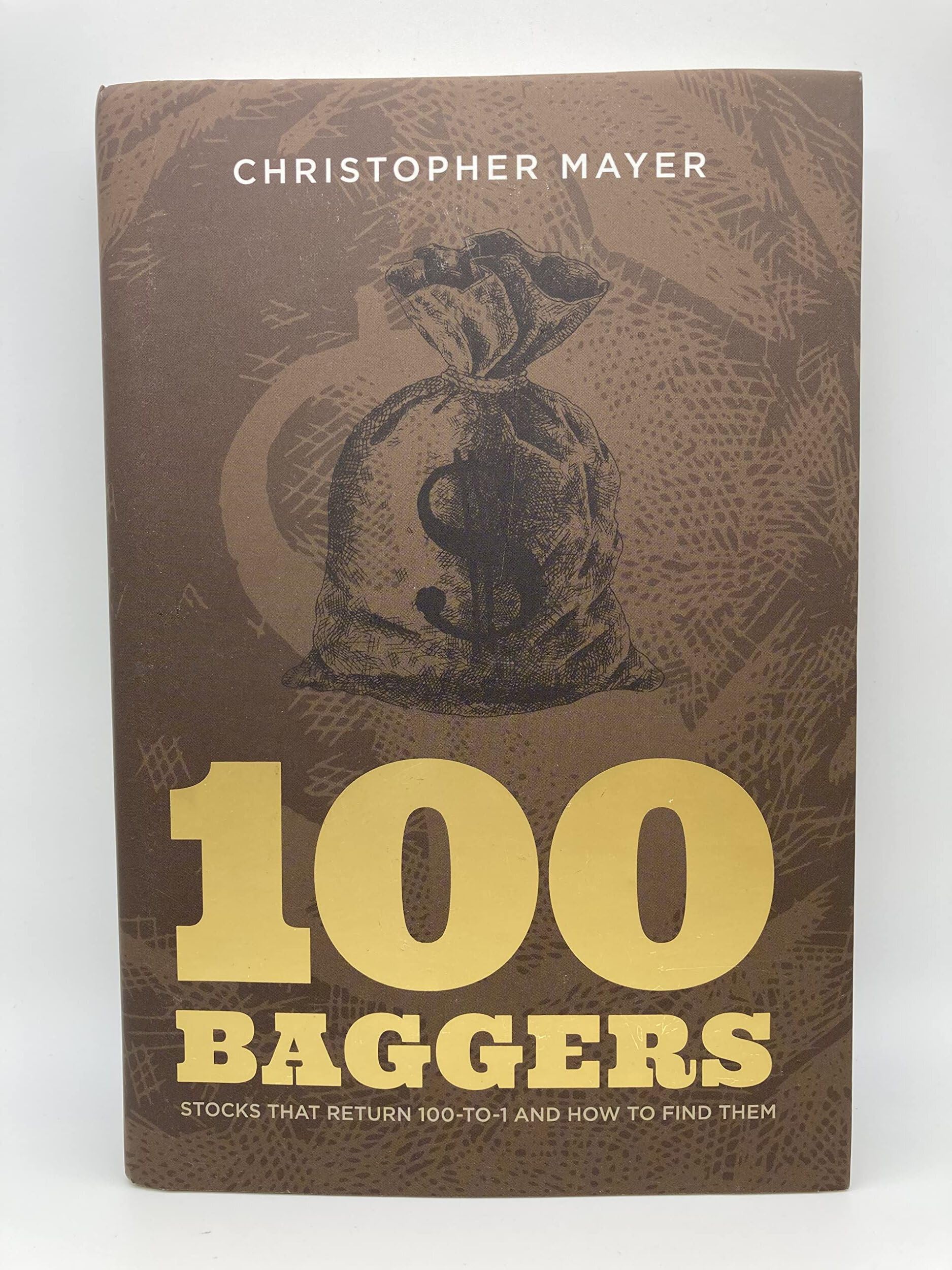
100 Baggers: Stocks That Return 100-to-1 and How To Find Them
Product ID: 19320999
Buy anything from 5,000+ international stores. One checkout price. No surprise fees. Join 2M+ shoppers on Desertcart.
Desertcart purchases this item on your behalf and handles shipping, customs, and support to Congo.
100 Baggers: Stocks That Return 100-to-1 and How To Find Them [Mayer, Christopher W] on desertcart.com. *FREE* shipping on qualifying offers. 100 Baggers: Stocks That Return 100-to-1 and How To Find Them Review: The Only Review You Will Ever Need - I loved this book. I rarely write reviews because I rarely finish reading a book. However, I could not put this one down. I like this book for several reasons: 1- Originallity. Most stock investing books focus on one of the two most common approaches: fundamental or technical analysis. This one however does not follow any dogma but focuses only on 100 baggers, which is a fascinating topic by itself. 2- Content. Because the author does not follow any predefined framework, he looks at every element that may be related to the origination of 100 baggers. Though at times he may sound repetitive, each chapter is a world in itself. The book is loaded with a variety of well researched topics, in addition to the already invaluable statistical information on 100 baggers. 3- Style. The author is simply a very good writer. He is effective at conveying his message and knows how to keep the reader engaged. It makes for an entertaining and interesting read. There are other aspects of the book that I liked a lot. For example, the author quotes and references a lot of other interesting books and papers that may expand on a specific topic. This also means that the author is to some extent already doing the work of processing and summarizing all that information for you. Not a minor point if you ask me. Related to item 1 above, I'm glad that the author has not made use and abuse of the name of Ben Graham. In fact, I'm not sure if he mentions him even once. I don't know about you folks, but I find this quite refreshing. Not to discredit any of the great contributions Graham made to the field, but I'm kind of tired of seeing Graham's name in the first paragraph of every stock investing book. On the other hand, I have to admit that I was rather skeptical when I started reading this book. Because of my background in statistics, I just could not easily digest the author's approach of "only focusing on 100 baggers to try to find the magic sauce". From a strictly scientific standpoint, what one should do is to take all type of stocks (not only the successful ones) and then find a model that explains the returns of all of those stocks. By finding a model, I mean finding a collection of features that winning stocks have and losing stocks miss (or vice versa). From an statistical point of view, the problem with the author's approach is that the key factors he finds for 100 baggers may also be present in losing stocks. He does not know that because he did not look at those. As a consequence, he does not know what proportion of the stocks with those key factors are winning/losing stocks. In other words, he does not know the probability for a stock with those attributes to be a winning one. Now, why am I giving this book a 5-star rating in spite of these shortcomings? Well, there's at least a couple of reasons: A- Conducting a proper scientific research on this topic is extremely difficult. Because 100 baggers may take decades to actually multiply their value 100 fold, the database to be used for research should span at least those many years. This is what the author did here and he deserves kudos for that. Now, if you also want to add all the non-100 baggers to the analysis, you not only need to think about existing companies that never got to the 100-bagger status but also about those stocks/companies that no longer exist. Good luck dealing with that piece of the data. This is important because many of those non-existing companies ended up going bankrupt (some others merged or were acquired by other companies). Leaving those out would be almost the same as focusing exclusively on 100-baggers. This is because the surviving non-100 baggers do not really add much information to the analysis -for the real risk measure is that of losing 100% of your capital in any of your positions, not merely the volatility of the stock price. Under those circumstances, focusing only on 100 baggers does represent a sensible alternative. B- The argumentation is conceptually sound. All the ideas presented make sense. For example: *good companies are those that consistently make money - look for those with high ROIC and a moat. *invest in companies with a capable, honest, and committed management *look for companies with growth potential - small caps over large ones and companies with a disruptive product/service/business model. *don't pay stupid prices *stay for the long haul -sooner or later the market recognizes the value of sound and consistent businesses. If I had to place this book in any of the different stock investing categories, I would place it in the Quality Investing section. This is Warren Buffett's investment style, as he long ago moved away from the traditional Value Investing approach. This is also Phillip Fisher, Peter Lynch, and Charlie Munger's philosophy. "Buy wonderful companies at a fair price" or "Growth at a reasonable price" kind of thing. Finally, the key insight of the book: the average 100-bagger requires 26 years to multiple its value 100 times. This is equivalent to a 19.4% CAGR. Assuming a starting capital of $10,000 and annual additions of $10,000, compounding capital at this rate would leave you with a little over 6 million dollars after 26 years. Not bad considering that you only contributed a total of $260,000 in cash. Now, this is assuming that you will be able to grow your entire portfolio at the pace of an average 100-bagger. This is very unlikely to happen. Using a 16% CAGR instead (still a pretty good rate) leaves you with 3.4 million dollars after 26 years -considerably less than 6 million. A 14% CAGR leaves you with 2.4 million. Still great money...but in any of these cases you still have to wait 26 years! On the other hand, consider the alternative of buying and holding an index fund. Historically, the US equity market has had a CAGR of about 10% including dividends. For the sake of being conservative, let's assume that we can only expect the overall market to make 8% going forward. Using this CAGR and assuming annual contributions of $15,000, leaves you with 1.85 million after 30 years. This is not all that different than those 2.4 million. Granted, we're contributing $5000 more a year and we're taking 4 more years to get there. However, because this is a very simple buy and hold index investing strategy, the results are almost guaranteed. What I'm trying to say here folks is that the search for 100 baggers may not be as practical as it may seem. It is still a very long term, buy and hold investment strategy. And the problem is that you still have to do all that work to try to find those winning stocks (and I hope you do). Wouldn't it be easier to just focus on keeping your personal finances in order and save a little bit more every year? Then you just focus on living your life and stop worrying about these things. And by the way, in this analysis I do not even include the effect of taxes or company matches that employers offer with their 401K plans. They both play in favor of the index investing strategy. And just so you guys know, any active trading strategy that can produce 50% annual returns will leave you with $1.7 million after only 10 years (assuming annual contributions of $10,000). Review: The ONLY book about investing you will ever need to read - If I were to choose one book about investment, be it for novice or more professional investor, that would be it. This book contains everything you need to be sucessful in the world of investment (stocks). Simple but deep truths, which are forgotten in modern day of crazy day-trading, quick profit, meme-stonks etc. I have heard about long term horizon probably 1000 times and it kicked in only after I have read this book! I have heard about return on investment, but it has entrenched in my brain only after I have digested this book. It is well written, with lots of interesting stories, insight of many great investors. It discusses the basics, itbut also risks and things to pay attention to. It is also pleasure to read, the language is very comprehensible. And the best of all is that this book shows that you do not have to have CFA lvl 3, you do not need to work in high profile investment bank to be sucessful in stock market - anyone can do it, if you remember about some (simple) rules. I loveds every page of it, would recommend to everyone, especially those who are in their first 1-5 years in their journey of investment adventure.
| Best Sellers Rank | #37,921 in Books ( See Top 100 in Books ) #103 in Finance (Books) |
| Customer Reviews | 4.6 out of 5 stars 2,399 Reviews |
E**O
The Only Review You Will Ever Need
I loved this book. I rarely write reviews because I rarely finish reading a book. However, I could not put this one down. I like this book for several reasons: 1- Originallity. Most stock investing books focus on one of the two most common approaches: fundamental or technical analysis. This one however does not follow any dogma but focuses only on 100 baggers, which is a fascinating topic by itself. 2- Content. Because the author does not follow any predefined framework, he looks at every element that may be related to the origination of 100 baggers. Though at times he may sound repetitive, each chapter is a world in itself. The book is loaded with a variety of well researched topics, in addition to the already invaluable statistical information on 100 baggers. 3- Style. The author is simply a very good writer. He is effective at conveying his message and knows how to keep the reader engaged. It makes for an entertaining and interesting read. There are other aspects of the book that I liked a lot. For example, the author quotes and references a lot of other interesting books and papers that may expand on a specific topic. This also means that the author is to some extent already doing the work of processing and summarizing all that information for you. Not a minor point if you ask me. Related to item 1 above, I'm glad that the author has not made use and abuse of the name of Ben Graham. In fact, I'm not sure if he mentions him even once. I don't know about you folks, but I find this quite refreshing. Not to discredit any of the great contributions Graham made to the field, but I'm kind of tired of seeing Graham's name in the first paragraph of every stock investing book. On the other hand, I have to admit that I was rather skeptical when I started reading this book. Because of my background in statistics, I just could not easily digest the author's approach of "only focusing on 100 baggers to try to find the magic sauce". From a strictly scientific standpoint, what one should do is to take all type of stocks (not only the successful ones) and then find a model that explains the returns of all of those stocks. By finding a model, I mean finding a collection of features that winning stocks have and losing stocks miss (or vice versa). From an statistical point of view, the problem with the author's approach is that the key factors he finds for 100 baggers may also be present in losing stocks. He does not know that because he did not look at those. As a consequence, he does not know what proportion of the stocks with those key factors are winning/losing stocks. In other words, he does not know the probability for a stock with those attributes to be a winning one. Now, why am I giving this book a 5-star rating in spite of these shortcomings? Well, there's at least a couple of reasons: A- Conducting a proper scientific research on this topic is extremely difficult. Because 100 baggers may take decades to actually multiply their value 100 fold, the database to be used for research should span at least those many years. This is what the author did here and he deserves kudos for that. Now, if you also want to add all the non-100 baggers to the analysis, you not only need to think about existing companies that never got to the 100-bagger status but also about those stocks/companies that no longer exist. Good luck dealing with that piece of the data. This is important because many of those non-existing companies ended up going bankrupt (some others merged or were acquired by other companies). Leaving those out would be almost the same as focusing exclusively on 100-baggers. This is because the surviving non-100 baggers do not really add much information to the analysis -for the real risk measure is that of losing 100% of your capital in any of your positions, not merely the volatility of the stock price. Under those circumstances, focusing only on 100 baggers does represent a sensible alternative. B- The argumentation is conceptually sound. All the ideas presented make sense. For example: *good companies are those that consistently make money - look for those with high ROIC and a moat. *invest in companies with a capable, honest, and committed management *look for companies with growth potential - small caps over large ones and companies with a disruptive product/service/business model. *don't pay stupid prices *stay for the long haul -sooner or later the market recognizes the value of sound and consistent businesses. If I had to place this book in any of the different stock investing categories, I would place it in the Quality Investing section. This is Warren Buffett's investment style, as he long ago moved away from the traditional Value Investing approach. This is also Phillip Fisher, Peter Lynch, and Charlie Munger's philosophy. "Buy wonderful companies at a fair price" or "Growth at a reasonable price" kind of thing. Finally, the key insight of the book: the average 100-bagger requires 26 years to multiple its value 100 times. This is equivalent to a 19.4% CAGR. Assuming a starting capital of $10,000 and annual additions of $10,000, compounding capital at this rate would leave you with a little over 6 million dollars after 26 years. Not bad considering that you only contributed a total of $260,000 in cash. Now, this is assuming that you will be able to grow your entire portfolio at the pace of an average 100-bagger. This is very unlikely to happen. Using a 16% CAGR instead (still a pretty good rate) leaves you with 3.4 million dollars after 26 years -considerably less than 6 million. A 14% CAGR leaves you with 2.4 million. Still great money...but in any of these cases you still have to wait 26 years! On the other hand, consider the alternative of buying and holding an index fund. Historically, the US equity market has had a CAGR of about 10% including dividends. For the sake of being conservative, let's assume that we can only expect the overall market to make 8% going forward. Using this CAGR and assuming annual contributions of $15,000, leaves you with 1.85 million after 30 years. This is not all that different than those 2.4 million. Granted, we're contributing $5000 more a year and we're taking 4 more years to get there. However, because this is a very simple buy and hold index investing strategy, the results are almost guaranteed. What I'm trying to say here folks is that the search for 100 baggers may not be as practical as it may seem. It is still a very long term, buy and hold investment strategy. And the problem is that you still have to do all that work to try to find those winning stocks (and I hope you do). Wouldn't it be easier to just focus on keeping your personal finances in order and save a little bit more every year? Then you just focus on living your life and stop worrying about these things. And by the way, in this analysis I do not even include the effect of taxes or company matches that employers offer with their 401K plans. They both play in favor of the index investing strategy. And just so you guys know, any active trading strategy that can produce 50% annual returns will leave you with $1.7 million after only 10 years (assuming annual contributions of $10,000).
S**O
The ONLY book about investing you will ever need to read
If I were to choose one book about investment, be it for novice or more professional investor, that would be it. This book contains everything you need to be sucessful in the world of investment (stocks). Simple but deep truths, which are forgotten in modern day of crazy day-trading, quick profit, meme-stonks etc. I have heard about long term horizon probably 1000 times and it kicked in only after I have read this book! I have heard about return on investment, but it has entrenched in my brain only after I have digested this book. It is well written, with lots of interesting stories, insight of many great investors. It discusses the basics, itbut also risks and things to pay attention to. It is also pleasure to read, the language is very comprehensible. And the best of all is that this book shows that you do not have to have CFA lvl 3, you do not need to work in high profile investment bank to be sucessful in stock market - anyone can do it, if you remember about some (simple) rules. I loveds every page of it, would recommend to everyone, especially those who are in their first 1-5 years in their journey of investment adventure.
V**A
Must read for meaningful investments
[HALF WAY THROUGH THE BOOK] PROS: - Easy to read, even for non-traders - Easy to follow - Very nicely paced - Anecdotal writing style - informative references throughout the book - book has a hook for sure CONS: - framework is quite diagnostic in approach … mainly based on historical data - Examples cited may not be relevant in 2023 (for instance VWMCX went defunct in 2020) - throws lot of names of big guns, which kind of take the attention away from the crux of matter - most examples are reverse engineered CAUSE & EFFECT scenarios
J**L
Hit It Big
This is a great book. If we could all just get a one hundred bagger once in our lifetime we'd all be happiest ( and wealthier). Luck, honesty and perseverance have a great deal to do with getting a 100 bagger. This book gives plenty of examples of not only what to look for, but what to keep in this splendid venture. The average stock took 25 years, earning about 21% a year to become a 100 bagger, so this is a long term adventure, most of which is to let the stock keep moving. After learning how to make money in the stock market , knowing your average stock should be held for several years, one should look into long term holdings that have a reasonable chance of proliferating. This is one of the top seven or eight stock market books to read , but realizing one has to be patient and let time and excellence do its magic.
J**O
Excellent! I've invested in rental properties
Excellent! I've invested in rental properties, commodities and, of course, the stock market. I've spent a lot of time trying to understand the quirks of the market... both short-term and long-term. This book distills what I've had to learn the hard way... the best strategy for investing is to buy right and hang on. Why is that such a hard lesson ;) This book does not skimp on details or examples and has an easy, uncomplicated writing style. Its not an overly technical book, but it provides enough straight-forward numbers to get the point across. It's not a book for traders or impatient investors... but it might convert some of them to the simplicity of finding a 100 Bagger. I've read it twice... and I got my money's worth both times. If you're sick of dealing with a stockbroker... if you're spread across a hundred different stocks and your portfolio seems to never go anywhere... if fees, taxes and paperwork complicate your life; give this book a read.
A**R
A must read book for anyone who wants to invest
I have read a lot of stock market books and this book is a must read for anyone who wants to invest in the stock market. Every chapter in this book tells you about important things that you need to look for to find a good stocks in a simple language and with a lot of examples. Excellent
G**D
It is okay
Not as good as thomas phelps original book but makes some salient points along the way and has overall a good perspective.
T**T
This book is easily the best $9 I ever spent
What a delightful payoff for time spent reading this book. I highlighted the Kindle book extensively. Sometimes 5 pages in a row had gems of wisdom I had to pause to highlight. I'd recommend you buy the book. Go ahead. Risk $9 to make a million, or read a sample, then definitely buy the book. I'll warn you, this book advocates a buy and hold strategy for patiently getting very rich over years, not months. If you are the kind of investor that watches your money grow by the hour, and gets excited by the fun of buying and selling, this book is NOT for you. In the appendix the author shares a list of 365 companies that multiplied investors' money 100X or more--often many times more. The author mentions a few dozen investor names, and the titles and authors of some extremely valuable books that influenced his own thinking. If I have one criticism of the book; it is this: the author advocates never selling a stock. Well, I'm already at retirement age, and I think that might be ok for 30-45 year olds. So I will say this: Treat yourself to a bit of your wealth along the way, just don't spend it extravagantly. Just know that that $12,000 European trip or that $20,000 kitchen renovation may ultimately cost you long-term $100,000 or more in stunted wealth accumulation. But what good is all that money if you never see Europe, never have that fine new kitchen, or never own a luxury car? Enjoy a bit your money along the way. Invest $9 in this book today. Last piece of advice? Buy right, sit tight, sleep tight.
Trustpilot
1 month ago
5 days ago