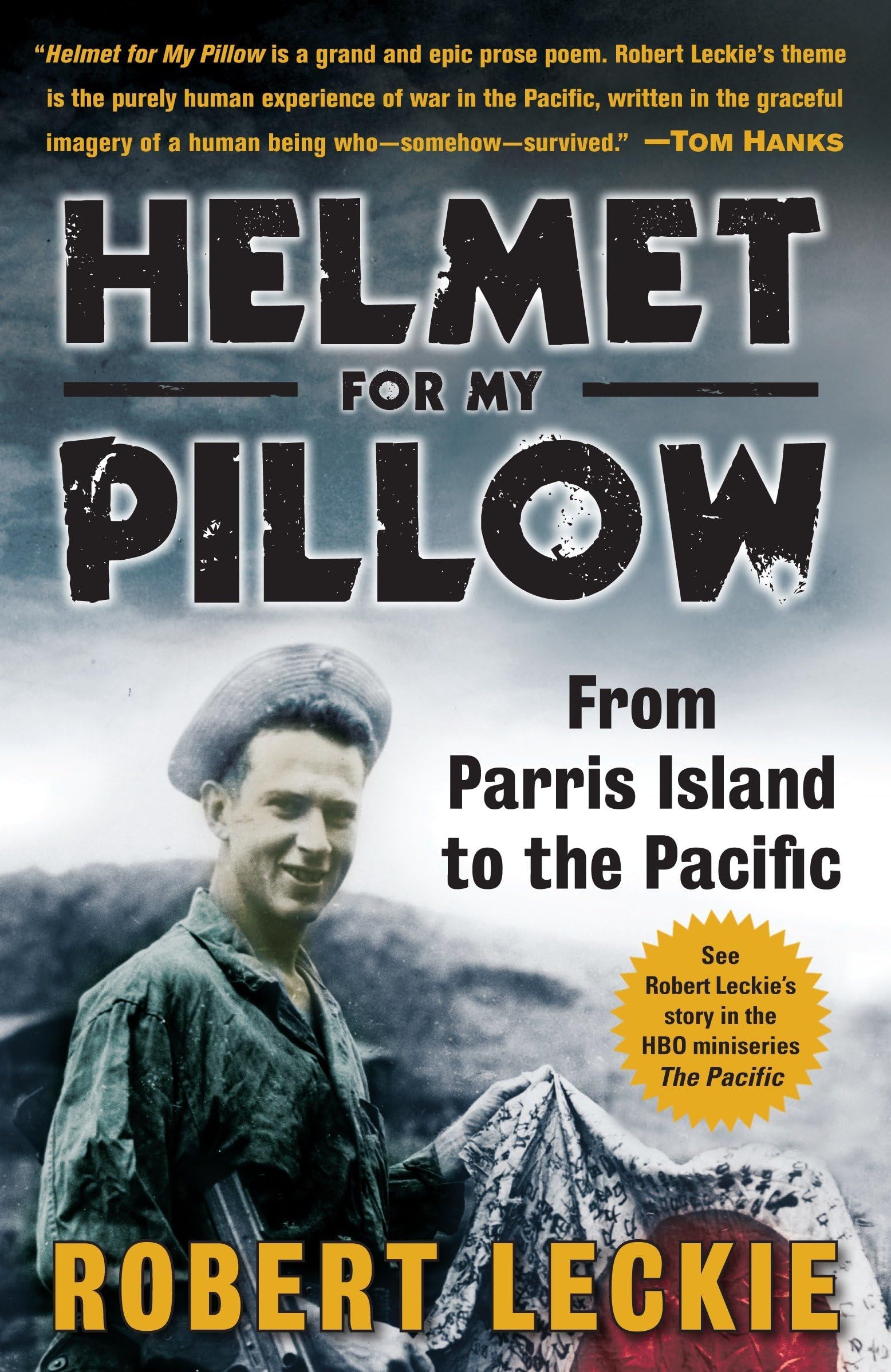

Helmet for My Pillow: From Parris Island to the Pacific [Leckie, Robert] on desertcart.com. *FREE* shipping on qualifying offers. Helmet for My Pillow: From Parris Island to the Pacific Review: Classic Memoir: A Helmet For My Pillow, A Helmet For My Heart - World War Two Classic Memoir: Helmet For My Pillow From Parris Island to the Pacific, Robert Leckie, Bantam Books, 305 pp., 1957, 2010 edition, 16.00. First published in 1957, Helmet for My Pillow is the World War Two memoir of Robert Leckie, United States Marine Corps veteran and military historian. Born in 1920, Philadelphia Pennsylvania native Leckie served in the Pacific Theatre with the First Marine Division as a machine gunner and intelligence scout during the Battle of Guadalcanal and later campaigns. One of eight children born into an Irish Catholic family began his writing career, at age 16 as a sports writer for The Bergen Evening Record in New Jersey. In 1941, the day after the attack on Pearl Harbor, Leckie enlisted in the Marines. He was assigned to H Company, 2nd Battalion, 1st Marine Regiment. He deployed to Guadalcanal, Australia, New Guinea, and Cape Gloucester and participated in every major First Marine Division campaign except Okinawa. Drill instructors, disappearing individuality, drunkeness, and new comrades enter Leckie's life during boot camp in MCRD Parris Island, South Carolina, and then during his first post at New River, North Carolina. Each take their toll on Leckie: heavy combat at Guadalcanal, jungle patrols in New Guinea, bread-and-water in the brig twice, more months of combat at Point Glouster, assignment to the psychiatric ward for a month, more combat at Bloody Nose Ridge, and blast concussion. His comrades are Artist, Chuckler, Commando, Hoosier, Ivy League, Runner, Souvenir, and Straight Talk. Officers steal his cigars and his foot locker. Like William Manchester's Goodbye, Darkness Leckie's memoir offers brilliant descriptions, an amazing use of language, and masterful storytelling. The 2010 HBO mini-series The Pacific was adapted in large part from Helmet for My Pillow, and Eugene Sledge's With the Old Breed: At Peleliu and Okinawa. Leckie's memoir is literature. Leckie's work is fascinating, compelling, highly descriptive writing by one who lived through what hell mankind could make. The conclusion of the story is humane and heartfelt with reflections of the use of the atomic bomb, the loss of comrades, and the nature of sacrifice. A few weeks ago David McCullough prescribed a remedy for the dearth of knowledge about American history among citizens, young and old. He wishes teachers would create history lab exercises for students much like National History Day competitions. CWL would teach history through biography and on the list would be Robert Leckie's Helmet for My Pillow: From Parris Island to the Pacific. Review: A Different Perspective of War - A true telling of Robert Leckie's war experience, good and bad. I'm troubled by this book. I consider myself a patriotic reader of the heroism of our soldiers but Leckie's book includes many acts of non-heroism: a month in a psychiatric ward where he didn't belong, repeated run-ins landing him in the brig twice, and a complete disrespect for authority when the mood so moved him. But also included are the many acts of heroism if heroism can be described as doing the mundane fighting necessary to achieve our victory in WWII. Approximately 40% of the book is of fighting, 30% of the layover and adventure with ladies, liquor and shenanigans in Australia and the remaining 30% is of the camaraderie of the soldiers, whether in the line of duty or usurping authority in theft of food or AWOL adventures. So, maybe this is the first truthful book I have read of WWII with the remaining of the books covering only what the author believes the readers will want to hear and not exposing the warts of war. It certainly leaves the reader with a perplexing feeling as it is so different from the typical book of war. Leckie joins the Marines the day after Pearl Harbor and after boot camp is stationed at New River NC, a marine base I lived on with my Naval father in the 1960s. Shenanigans and disrespect for authority prevail prior to departure to Guadalcanal where his unit performs masterfully in repelling the Japanese while stranded on the island. This is probably the clearest picture of battle as his ability to sense the state of the battle by who controls the air and sea is effectively relayed. The most telling part of this section is when they have no idea whether Americans even know what they are doing only to have this dispelled upon return to the ship when a sailor explains that all of the country know of the great victory and bravery of the soldiers of Guadalcanal. Next the book wanders into the stay in Australia where debauchery is reined on the nation and accepted by the welcoming ladies of Australia who feel they were rescued from invasion. This is a welcome interlude for the soldiers and for the readers and really provides a good look at what it was like even when not on the battlefield. This is also where his rebellious tendencies raise their head and he ends up in the brig twice. After battle in New Guinea Leckie's disrespect for authority land him in a mental ward which is really a strange segway for a book of a fighting hero. I applaud the honesty but must admit it was almost like he was hiding from the battlefield until he realizes where he should be. His fighting career ends on Peleliu in some of the most devastating fighting of the war. Of 1,500 in his regiment only 28 survive unscathed such was the horrible fighting. But there is a much better book of the fighting on Peleliu, "With the Old Breed at Pelelui and Okinawa" by E. B. Sledge. Leckie's career on this island only lasted a couple of days and then he was transported by ship to the states. I read this book as it was one of three used for the HBO miniseries The Pacific. From watching the show and having read one of the other books I conclude that this book dominated the most time of the miniseries, probably because he touched a number of campaigns as well as the noncombat sections. I'm curious as to the decision to keep so much nonessential parts of the War in the miniseries that came from this book. I'm always inspired as I read these stories, this being no different. But possibly this was the most disturbing and non-enjoyable of all the books I have read of WWII and its fighting men. Still a worthwhile story to read. Interestingly, Leckie, the writer closes with some very interesting and depressing thoughts of the "mushroom cloud" that ended the war vs. the American soldier.

| Best Sellers Rank | #368,697 in Books ( See Top 100 in Books ) #27 in WWII Biographies #40 in World War II History (Books) #472 in Memoirs (Books) |
| Customer Reviews | 4.5 4.5 out of 5 stars (13,684) |
| Dimensions | 5.18 x 0.7 x 8 inches |
| ISBN-10 | 0553593315 |
| ISBN-13 | 978-0553593310 |
| Item Weight | 2.31 pounds |
| Language | English |
| Print length | 305 pages |
| Publication date | February 2, 2010 |
| Publisher | Bantam Books |
C**N
Classic Memoir: A Helmet For My Pillow, A Helmet For My Heart
World War Two Classic Memoir: Helmet For My Pillow From Parris Island to the Pacific, Robert Leckie, Bantam Books, 305 pp., 1957, 2010 edition, 16.00. First published in 1957, Helmet for My Pillow is the World War Two memoir of Robert Leckie, United States Marine Corps veteran and military historian. Born in 1920, Philadelphia Pennsylvania native Leckie served in the Pacific Theatre with the First Marine Division as a machine gunner and intelligence scout during the Battle of Guadalcanal and later campaigns. One of eight children born into an Irish Catholic family began his writing career, at age 16 as a sports writer for The Bergen Evening Record in New Jersey. In 1941, the day after the attack on Pearl Harbor, Leckie enlisted in the Marines. He was assigned to H Company, 2nd Battalion, 1st Marine Regiment. He deployed to Guadalcanal, Australia, New Guinea, and Cape Gloucester and participated in every major First Marine Division campaign except Okinawa. Drill instructors, disappearing individuality, drunkeness, and new comrades enter Leckie's life during boot camp in MCRD Parris Island, South Carolina, and then during his first post at New River, North Carolina. Each take their toll on Leckie: heavy combat at Guadalcanal, jungle patrols in New Guinea, bread-and-water in the brig twice, more months of combat at Point Glouster, assignment to the psychiatric ward for a month, more combat at Bloody Nose Ridge, and blast concussion. His comrades are Artist, Chuckler, Commando, Hoosier, Ivy League, Runner, Souvenir, and Straight Talk. Officers steal his cigars and his foot locker. Like William Manchester's Goodbye, Darkness Leckie's memoir offers brilliant descriptions, an amazing use of language, and masterful storytelling. The 2010 HBO mini-series The Pacific was adapted in large part from Helmet for My Pillow, and Eugene Sledge's With the Old Breed: At Peleliu and Okinawa. Leckie's memoir is literature. Leckie's work is fascinating, compelling, highly descriptive writing by one who lived through what hell mankind could make. The conclusion of the story is humane and heartfelt with reflections of the use of the atomic bomb, the loss of comrades, and the nature of sacrifice. A few weeks ago David McCullough prescribed a remedy for the dearth of knowledge about American history among citizens, young and old. He wishes teachers would create history lab exercises for students much like National History Day competitions. CWL would teach history through biography and on the list would be Robert Leckie's Helmet for My Pillow: From Parris Island to the Pacific.
R**L
A Different Perspective of War
A true telling of Robert Leckie's war experience, good and bad. I'm troubled by this book. I consider myself a patriotic reader of the heroism of our soldiers but Leckie's book includes many acts of non-heroism: a month in a psychiatric ward where he didn't belong, repeated run-ins landing him in the brig twice, and a complete disrespect for authority when the mood so moved him. But also included are the many acts of heroism if heroism can be described as doing the mundane fighting necessary to achieve our victory in WWII. Approximately 40% of the book is of fighting, 30% of the layover and adventure with ladies, liquor and shenanigans in Australia and the remaining 30% is of the camaraderie of the soldiers, whether in the line of duty or usurping authority in theft of food or AWOL adventures. So, maybe this is the first truthful book I have read of WWII with the remaining of the books covering only what the author believes the readers will want to hear and not exposing the warts of war. It certainly leaves the reader with a perplexing feeling as it is so different from the typical book of war. Leckie joins the Marines the day after Pearl Harbor and after boot camp is stationed at New River NC, a marine base I lived on with my Naval father in the 1960s. Shenanigans and disrespect for authority prevail prior to departure to Guadalcanal where his unit performs masterfully in repelling the Japanese while stranded on the island. This is probably the clearest picture of battle as his ability to sense the state of the battle by who controls the air and sea is effectively relayed. The most telling part of this section is when they have no idea whether Americans even know what they are doing only to have this dispelled upon return to the ship when a sailor explains that all of the country know of the great victory and bravery of the soldiers of Guadalcanal. Next the book wanders into the stay in Australia where debauchery is reined on the nation and accepted by the welcoming ladies of Australia who feel they were rescued from invasion. This is a welcome interlude for the soldiers and for the readers and really provides a good look at what it was like even when not on the battlefield. This is also where his rebellious tendencies raise their head and he ends up in the brig twice. After battle in New Guinea Leckie's disrespect for authority land him in a mental ward which is really a strange segway for a book of a fighting hero. I applaud the honesty but must admit it was almost like he was hiding from the battlefield until he realizes where he should be. His fighting career ends on Peleliu in some of the most devastating fighting of the war. Of 1,500 in his regiment only 28 survive unscathed such was the horrible fighting. But there is a much better book of the fighting on Peleliu, "With the Old Breed at Pelelui and Okinawa" by E. B. Sledge. Leckie's career on this island only lasted a couple of days and then he was transported by ship to the states. I read this book as it was one of three used for the HBO miniseries The Pacific. From watching the show and having read one of the other books I conclude that this book dominated the most time of the miniseries, probably because he touched a number of campaigns as well as the noncombat sections. I'm curious as to the decision to keep so much nonessential parts of the War in the miniseries that came from this book. I'm always inspired as I read these stories, this being no different. But possibly this was the most disturbing and non-enjoyable of all the books I have read of WWII and its fighting men. Still a worthwhile story to read. Interestingly, Leckie, the writer closes with some very interesting and depressing thoughts of the "mushroom cloud" that ended the war vs. the American soldier.
S**N
I had to read a book for one of my history classes and remembered I had purchased this book after watching the pacific. All 312 pages were read in one day. The book had me from the start. From the descriptiveness of the drill Sargent calls and hollering to the wading through Japanese owned forests listening for the snapping of twigs underfoot to the bombs bursting overhead. I was very happy with my selection to do this for my assignment and clearly saw the reason why HBO could create a stunningly similar representation to book that Robert Leckie had written. Even if you have watched the HBO mini series, I would still recommend reading this book. The descriptiveness alone provided for a perfect image in my mind of every place he had been making the book very easy to follow along and imagine the landscape and people who so bravely sacrificed so much.
T**N
Highly recommended to anyone interested in Pacific War. A must read along with Eugene Sledges' book. Read and learn. The author was a gifted writer. He can keep you riveted on your seat.
C**N
Libro da leggere assolutamente per chi ha visto "The Pacific" e se ne è innamorato. Leckie sa rendere benissimo l'idea dell'inferno che hanno vissuto durante quegli anni
T**O
Despues de ver The Pacific, y no habiéndolo leído antes, es obligado leer esta maravilla.
G**L
Hier schreibt einer, der das kann. Im Gegensatz zu vielen anderen Amerikanischen Berichten merkt man, dass Leckie ein Journalist mit einer fundierten Ausbildung ist. Insofern auch für einen Deutschen etwas schwieriger zu lesen, dafür auch informativ und unterhaltsam.
Trustpilot
2 months ago
2 weeks ago