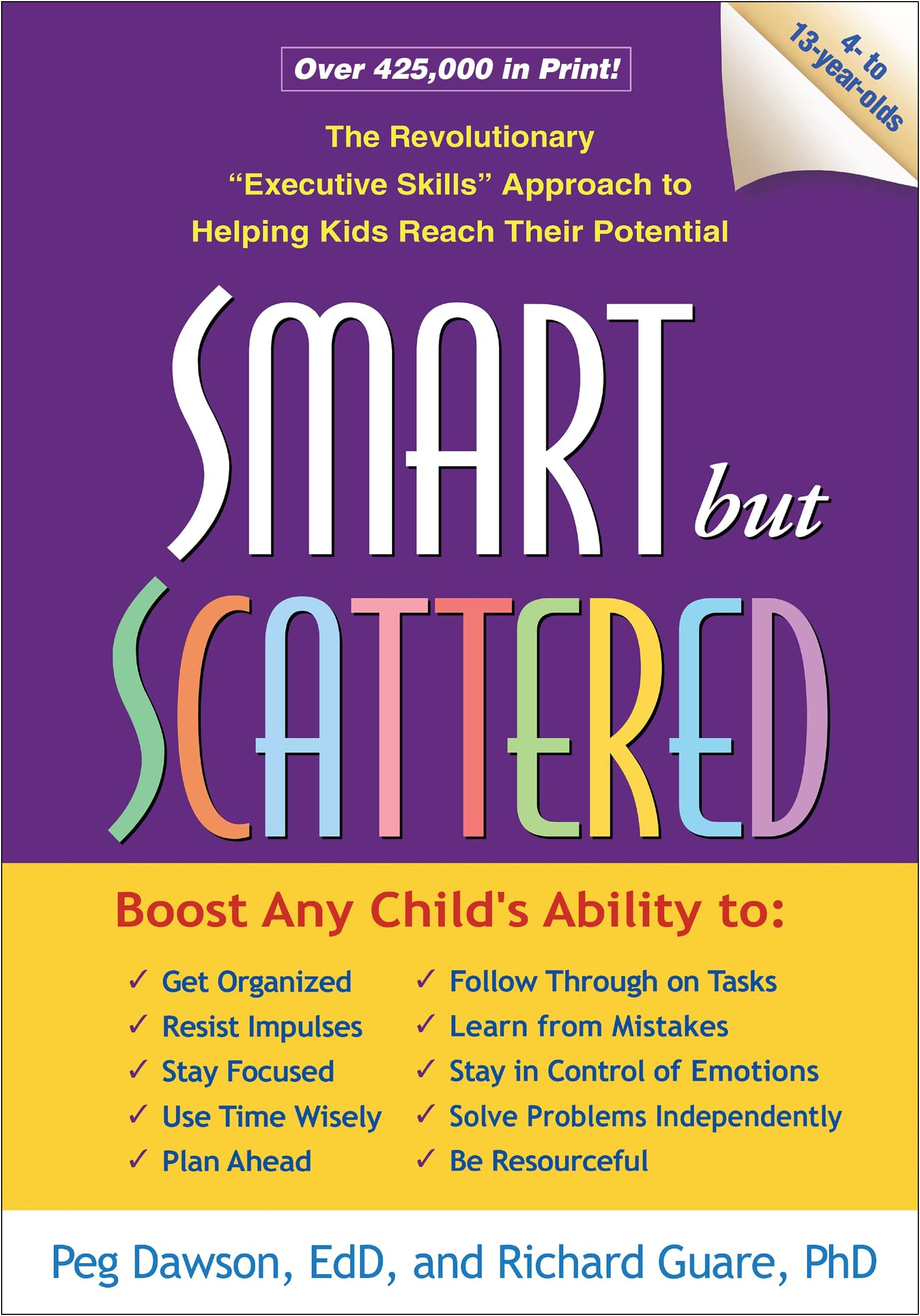
Smart but Scattered: The Revolutionary "Executive Skills" Approach to Helping Kids Reach Their Potential
Product ID: 245177
Buy anything from 5,000+ international stores. One checkout price. No surprise fees. Join 2M+ shoppers on Desertcart.
Desertcart purchases this item on your behalf and handles shipping, customs, and support to Congo.
There’s nothing more frustrating than watching your bright, talented son or daughter struggle with everyday tasks like finishing homework, putting away toys, or following instructions at school. Your “smart but scattered” child might also have trouble coping with disappointment or managing anger. Drs. Peg Dawson and Richard Guare have great news: there’s a lot you can do to help. The latest research in child development shows that many kids who have the brain and heart to succeed lack or lag behind in crucial “executive skills”--the fundamental habits of mind required for getting organized, staying focused, and controlling impulses and emotions. Learn easy-to-follow steps to identify your child’s strengths and weaknesses, use activities and techniques proven to boost specific skills, and problem-solve daily routines. Small changes can add up to big improvements--this empowering book shows how. Review: I finally "get" my 9-year-old daughter...and myself! - My 9-year-old daughter, "A," has been struggling with staying on task. I've been struggling to parent her through it! When a friend talked about her daughter's ADHD diagnosis, it just clicked. A hasn't received that diagnosis, but seeing her struggles, we decided to start by learning how to help her in ways that don't involve medication. (There is absolutely a place for ADHD meds, but if we can avoid them, particularly while she's a growing kid, that feels like a positive.) I looked on desertcart and ordered this book. I just finished it today. It's EXCELLENT. It explains what executive skills are (various skills that help one function and "get things done.") I understand both my kids better, as well as understanding my own executive skills strengths and weaknesses. I have a great toolbox of new strategies and ideas to pull from as we get back to "real life" next week. In fact, I'm already using some of the things I've learned. When the kids were packing to return home from our Christmas trip, my nagging wasn't helping A get things done. So I remembered that kids with difficulties in these areas often need to do things in short bursts with frequent rewards. I told A that for every 10 items she packed, she could film one slow-motion video on my phone. It worked like a dream, and the atmosphere in the room totally changed--laughter instead of frustration. The next day when we got home, I used the same strategy for unpacking, challenging her a little more (15 items for each video.) I don't remember A complaining once, and her unpacking was done in a fairly timely fashion. I still had to remind her to get back on task a couple of times, but it didn't feel like a battle. Of course, different strategies work for different kids. The frequent little rewards work for A because while she has weaknesses in the areas of task initiation and working memory, she has a strength in the area of goal-directed persistence. One thing I loved about this book is that it showed me her strengths, which helps devise strategies to help her in the areas where she struggles. We will be creating a new plan to help A with her after-school routine (the biggest at-home struggle currently--supposed to focus on one at a time), and we're already communicating with her teachers about how to help her succeed more at school. Both teachers are so glad we want to work with them in an effort to help A. A note on the length of the book--it looks pretty intimidating, and if you have a weakness in the executive skill of time management, as I've learned I have, that can spell disaster for a long, nonfiction book! I was pleased to find that a lot of parts were "skimmable." A large portion of the book is composed of chapters that address each executive skill individually. I merely skimmed the chapters covering skills that my kids don't struggle with. I also skimmed quite a bit of the beginning of the book, when the authors go into a lot of detail of how executive skills develop, brain development, etc. It's good info, but I was anxious to get on with the practical tips, and I didn't end up needing all the scientific basis to make sense of the rest of the book. Review: This will change you and your family for the better! - This is another gem of a book. Dawson and Guare, the authors, have quite a few of these books ranging from kids, teens Smart but Scattered Teens: The "Executive Skills" Program for Helping Teens Reach Their Potential , to adults The Smart but Scattered Guide to Success: How to Use Your Brain's Executive Skills to Keep Up, Stay Calm, and Get Organized at Work and at Home . I love how they not only give you ideas and checklists to fill out for your kids strengths and weaknesses, but they also include a version for parents to assess themselves. This is a great way to begin a nice dialogue and could be very eye-opening. Once you have informally assessed your child's strengths and weaknesses, each chapter focuses on a specific area to target with strategies. I have found this extremely beneficial for my role as a parent but as a teacher I find myself recommending this book more and more. If this sounds interesting to you or like you want to read more on executive skills here are some other products I have found personally helpful and recommend for families, check out: The Sensory Child Gets Organized: Proven Systems for Rigid, Anxious, or Distracted Kids The Out-of-Sync Child ADDitude


| Best Sellers Rank | #48,639 in Books ( See Top 100 in Books ) #45 in Children & Adolescent's Learning Disorders #73 in Attention-Deficit/Hyperactivity #96 in Parenting Books on Children with Disabilities |
| Customer Reviews | 4.7 out of 5 stars 2,604 Reviews |
C**H
I finally "get" my 9-year-old daughter...and myself!
My 9-year-old daughter, "A," has been struggling with staying on task. I've been struggling to parent her through it! When a friend talked about her daughter's ADHD diagnosis, it just clicked. A hasn't received that diagnosis, but seeing her struggles, we decided to start by learning how to help her in ways that don't involve medication. (There is absolutely a place for ADHD meds, but if we can avoid them, particularly while she's a growing kid, that feels like a positive.) I looked on Amazon and ordered this book. I just finished it today. It's EXCELLENT. It explains what executive skills are (various skills that help one function and "get things done.") I understand both my kids better, as well as understanding my own executive skills strengths and weaknesses. I have a great toolbox of new strategies and ideas to pull from as we get back to "real life" next week. In fact, I'm already using some of the things I've learned. When the kids were packing to return home from our Christmas trip, my nagging wasn't helping A get things done. So I remembered that kids with difficulties in these areas often need to do things in short bursts with frequent rewards. I told A that for every 10 items she packed, she could film one slow-motion video on my phone. It worked like a dream, and the atmosphere in the room totally changed--laughter instead of frustration. The next day when we got home, I used the same strategy for unpacking, challenging her a little more (15 items for each video.) I don't remember A complaining once, and her unpacking was done in a fairly timely fashion. I still had to remind her to get back on task a couple of times, but it didn't feel like a battle. Of course, different strategies work for different kids. The frequent little rewards work for A because while she has weaknesses in the areas of task initiation and working memory, she has a strength in the area of goal-directed persistence. One thing I loved about this book is that it showed me her strengths, which helps devise strategies to help her in the areas where she struggles. We will be creating a new plan to help A with her after-school routine (the biggest at-home struggle currently--supposed to focus on one at a time), and we're already communicating with her teachers about how to help her succeed more at school. Both teachers are so glad we want to work with them in an effort to help A. A note on the length of the book--it looks pretty intimidating, and if you have a weakness in the executive skill of time management, as I've learned I have, that can spell disaster for a long, nonfiction book! I was pleased to find that a lot of parts were "skimmable." A large portion of the book is composed of chapters that address each executive skill individually. I merely skimmed the chapters covering skills that my kids don't struggle with. I also skimmed quite a bit of the beginning of the book, when the authors go into a lot of detail of how executive skills develop, brain development, etc. It's good info, but I was anxious to get on with the practical tips, and I didn't end up needing all the scientific basis to make sense of the rest of the book.
L**U
This will change you and your family for the better!
This is another gem of a book. Dawson and Guare, the authors, have quite a few of these books ranging from kids, teens Smart but Scattered Teens: The "Executive Skills" Program for Helping Teens Reach Their Potential , to adults The Smart but Scattered Guide to Success: How to Use Your Brain's Executive Skills to Keep Up, Stay Calm, and Get Organized at Work and at Home . I love how they not only give you ideas and checklists to fill out for your kids strengths and weaknesses, but they also include a version for parents to assess themselves. This is a great way to begin a nice dialogue and could be very eye-opening. Once you have informally assessed your child's strengths and weaknesses, each chapter focuses on a specific area to target with strategies. I have found this extremely beneficial for my role as a parent but as a teacher I find myself recommending this book more and more. If this sounds interesting to you or like you want to read more on executive skills here are some other products I have found personally helpful and recommend for families, check out: The Sensory Child Gets Organized: Proven Systems for Rigid, Anxious, or Distracted Kids The Out-of-Sync Child ADDitude
G**E
Smart but scattered
This book was an excellent resource. Once my son was diagnosed I was dismayed by the schools response. They are not as equipped as I'd expected. One would think the teaching "experts" could guide an inexperienced parent. Wrong!! This book has strategies for every aspect of executive weaknesses. It is a perfect help mate to an uninformed parent. It has complete information the brain. It offers both arguments to medicate or not. It is broken down in an easy to read fashion. Once you've read it you can return to the specific chapter & strategy that applies to you specific needs. This book helped me to articulate specific requests to my son's educators. I used this book to facilitate appropriate behavior modifications for him in his classroom. I'm faced with a particularly inflexible teacher who makes our current situation painful. This book was a big relief. I've been reading my son correctly. Now I can help him to become the bright shiny star a I love.
M**Y
Informative, but not easy
This book helps the reader to understand children with attention difficulties. A bit dry, I found it a long read, but I did gather some informative things to help me navigate life with my ADHD child.
N**A
Facing my own weaknesses in helping my children
Another parent here. I have three highly gifted kids who nevertheless seem unable to accomplish simple tasks. A friend recommended this book, and it's forcing me to endure a complete paradigm shift, not only about my expectations for them, but of my own weaknesses in this area. Sure, I've had trouble staying organized, I start tasks only to leave them half-completed, and I feel like I have far more potential than I produce. But until I took the inventory for parents in this book, I didn't realize how truly weak my own executive skills are all around (unless I'm inspired, and then I'm a machine! ... just like my daughter). My husband took the quiz and -- not surprisingly -- his EF (executive function) skills are nearly off the charts on the other end. He laughed a little as he said he wondered how honest I was going to be, but he agreed with my self-assessment. Suddenly, I understand why a disastrous house sends me into tears, but he can get to work and make it spotless in a couple hours. But this book also showed me that it's not an inherent personality failure on my part -- it's that I never learned these skills properly! After just a weekend of talking about some issues together, my daughter (8) and I have created strategies to help us with our organizational skills. I'm also staying more patient with my 5-yr-old son, who is pretty much a 1 on emotional control (but quite good with organization). This book isn't an instant silver bullet solution, but it provides new ways of thinking and conceptualizing about your children's (and your own) strengths and weaknesses. If your children are also very smart, I also *highly* recommend reading this book together with: Living With Intensity: Understanding the Sensitivity, Excitability, and the Emotional Development of Gifted Children, Adolescents, and Adults When you understand low and evolving EF skills in combination with overexcitabilities/intensities, you can finally stop asking, "What have I done wrong? Why are *MY* kids -- who are otherwise so bright and capable -- so sensitive/dramatic/disorganized/fidgety/distractable/loud/rebellious, etc.?" Because they *aren't* like other kids. They are shooting stars who will challenge but delight and amaze you! And the _Smart but Scattered_ book will help them manage those overexcitabilities through developing better executive skills.
S**N
Excellent book for parent/s who want to help their kids help them selves to a smoother future.
I'm 2/3 of the way through reading and IMPLEMENTING this book and it seems like we're pulling one of my kids away from being diagnosed as ADD/ADHD by using this book to clarify our situation and helping our kid be a little better organised and less pressured at school. We have other problems but unraveling and separating problems lets us understand we have a kid who is smart, head strong poorly organised and sometimes just plain badly behaved but who does not need medication. This book will help involved parents and suffering parents and kids pick out and define the situation. I do not claim that this book is an alternative to medication if your doctor decides that's what your kid needs BUT try this book first OR at the same time. Even if your kid isn't so smart (Ohhhh how could we parents think that!!!) nor so scattered this is a very useful book for helping a family help their kids to develop good life skills - helping me too!
N**I
I would definitely recommend reading this book before you take any big steps
Thinking that your child might possibly suffer from ADD? I would definitely recommend reading this book before you take any big steps. It's a well written book that will help your child and yourself understand what is going on. There are charts and diagrams that help you track, to figure out the underlying issue at hand. I believe this book is for younger to young preteen age. It helps cover home life and school. It's a good learning device, if you are interested in learning different skills to help your child. This book will definitely teach you skills to help your child(ren). It will also help the parent understand what is going on. It helps you stay on task no matter what. It helps them to be able to finally achieve what they need to achieve. It helps get your child focused and task oriented. It's definitely a good read. I recommend this book for any parent out there! I received this book in exchange for my honest opinion.
A**R
Smart but Scattered, What I learned about myself, A Review
In Smart but Scattered, authors Peg Dawson, EdD, and Richard Guare, PhD, define executive skills, their development trajectory, methods for teaching them, and provide assessments for your children and yourself to see which skills are strengths and which are weaknesses. They bring over 30 years experience to the writing of this book and it shows on every page. I liked the assessments, the skills definitions, and the routines for improving skills. Alsio of great use are the hints and tips on how to develop your own skills building routines. I learned a lot about my strength, flexibility, which didn't surprise me at all, and my weaknesses planning/prioritizing and time management, also not surprising. I have already started to implement some of the routines recommended by the authors and have learned how to build my own improvement routines. I would recommend this book to parents, teachers, and adults who are or who work with kids who are smart but for what ever reason just aren't living up to their potential. I give it 5/5 stars.
P**G
Practical Book
Very happy with this book
B**N
Very useful
Lots of strategies and helpful information for ADHD people
A**R
Great for sussing out why you and your child argue again and again about the same issue
Haven't waded through it all because there's quite a lot to read. What is extremely useful is that it has questionnaires that elicit both the parent's and the child's cognitive strengths and weaknesses. And then individual chapters telling you how to develop those executive functions. Now I know why my daughter and I argue a lot. Our brains are wired differently, so skills that I could do with my eyes closed, she finds impossible and vice versa. If you suspect that you and/or your child are ADHD/Autistic, this book can help you.
M**N
Excellent Resource
This book is an excellent resource for parents, caregivers, educators, and therapists who are caring for children with executive function difficulties including ADHD and even kids on the autistic spectrum. I found this book simple to read and practically applicable to life. The suggestions were not difficult to implement and were extremely effective in helping the ADHD kids I deal with to complete work more effectively while not focusing on ADHD as a deficit. The mantra of the book is that ADHD is an explanation, not an excuse. The book provides excellent suggestions to help keep kids organized such as replacing toy boxes with clear containers and then putting pictures on each container so that kids can practice their organization skills. It also provides useful tools for educators such as building in choice to the curriculum and how to help kids get on track when they have trouble with task initiation, sustained attention, goal persistence, memory and organization. I would highly recommend this book.
J**P
Five Stars
I really loved it
Trustpilot
3 weeks ago
1 month ago