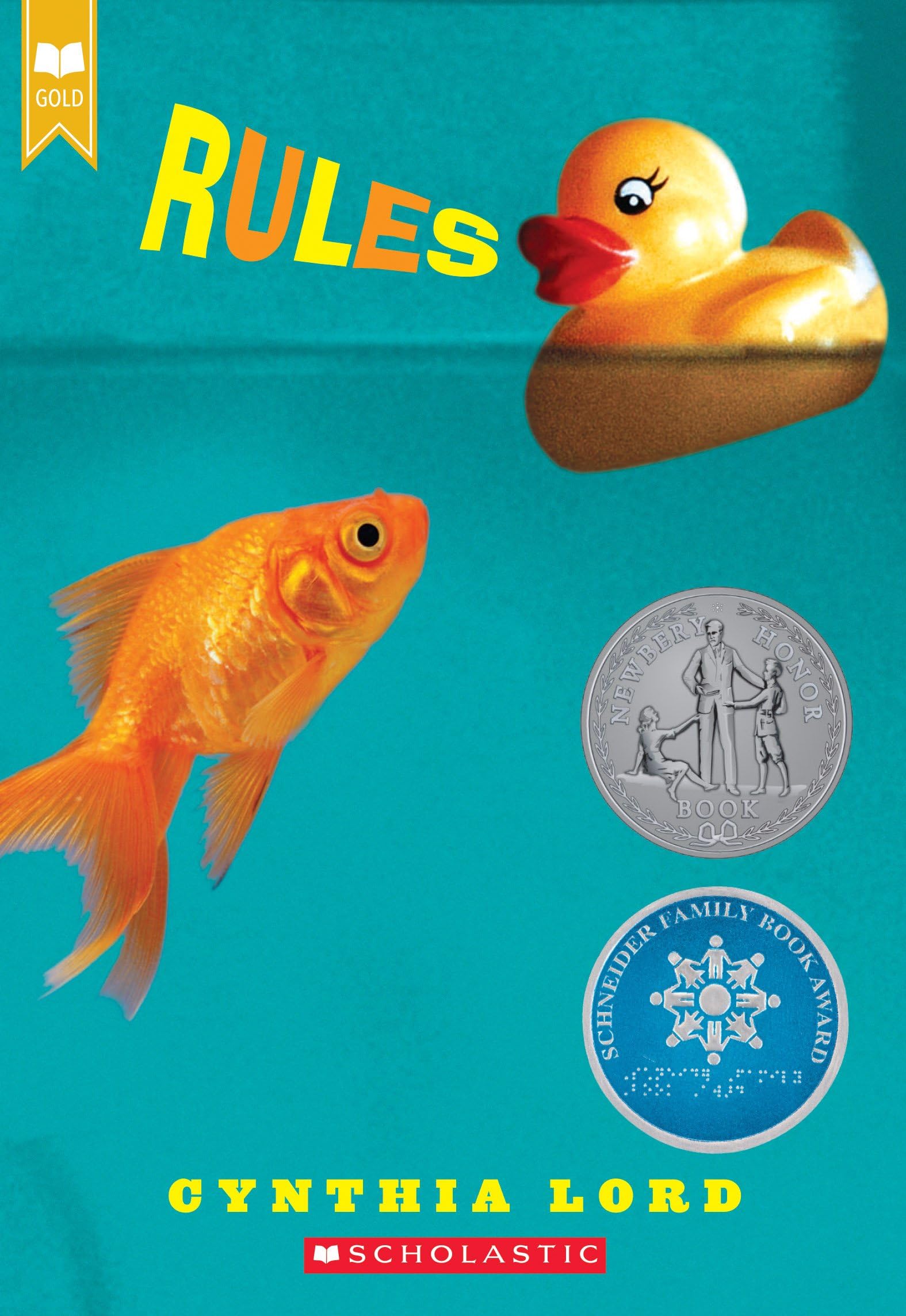
Rules (Scholastic Gold)
Product ID: 2666569
⭐4.6/5 from 3,576 reviews
📚Top #17 in Disability Books
🧩Authentic autism & disability portrayal
Buy anything from 5,000+ international stores. One checkout price. No surprise fees. Join 2M+ shoppers on Desertcart.
Desertcart purchases this item on your behalf and handles shipping, customs, and support to Congo.
🧠📖 Unlock empathy and challenge perceptions with every page!
Rules (Scholastic Gold) by Cynthia Lord is a critically acclaimed young adult novel ranked #17 in Children's Books on Disabilities. With a 4.6-star rating from over 3,500 readers, it authentically portrays autism and physical disabilities through the eyes of a fifth grader navigating family, friendship, and societal expectations. This emotionally rich story fosters empathy, inclusion, and understanding, making it essential for families, educators, and anyone passionate about social awareness.


| Best Sellers Rank | #5,748 in Books ( See Top 100 in Books ) #8 in Children's Books on Disabilities #46 in Children's Siblings Books (Books) #125 in Children's Books on Emotions & Feelings (Books) |
| Customer Reviews | 4.6 out of 5 stars 3,590 Reviews |
A**E
she realizes how instead of getting annoyed with David’s behaviors
Rules, a realistic fiction novel written by Cynthia Lord describes a young teen living with her autistic brother and the struggles she faces while trying to have an adventurous summer with a new friend and having to deal with the stigma attached to her brother. The main character, Catherine, matures throughout the book with how she deals with her brother, David, and how she begins to accept his disabilities. At first, she is very embarrassed by David and his actions in public, but through meeting a special friend, Jason, at occupational therapy (OT), she realizes how instead of getting annoyed with David’s behaviors, she should learn to accept them and view things more positively. From the beginning of the book it is clear how insecure Catherine feels about having a brother with autism. She takes care of him a lot, but is incredibly strict with him by trying to make set rules for everything he does. David does learn these rules, but as the book continues, it seems that the rules are more “helpful” for Catherine’s feelings then for David himself. We first see Catherine’s self consciousness appear when she has a new next door neighbor, a girl her age named Kristi. All Catherine wants is a friend for the summer since her best friend is not home. She hopes she can hide David from Kristi, fearing that he would scare her off and she would not want to be Catherine’s friend. However, when Kristi does meet David, she is not immediately scared off. An ongoing issue throughout the book is how frustrated Catherine gets that she was to babysit and help David more than (she feels) her parents do. Instead of viewing her time with David as special sibling bonding time, she views it as a burden, continuously thinking about what she could be doing if she did not have to be with her brother. The only time we see Catherine genuinely excited about being with David is when she goes with her mom to take David to OT. Catherine made a new friend there, Jason, who is a boy about her age in a wheelchair and is nonverbal. They communicate through Jason’s communications book, where Catherine takes it upon herself to draw and create new words to fill up Jason’s book. She surprises him each week with a set of new words to learn so they have a better way of talking and getting to know each other. Immediately, they form a close connection, each making the other jump out of their comfort zone in some way or another. Instead of viewing and treating Jason the way she treats David, Catherine truly treats him like her friend. When Jason said he wants to run, Catherine has the idea to take him outside in the parking lot, and run while pushing him, so he could get the rush and feeling of freedom. Jason invites Catherine to his birthday party, where she decides to spend all her savings to buy him a used guitar so he could practice making music. At his party, Jason decides to ask Catherine to the community dance that night, and when she hesitates and makes excuses, not only does he call her out but also he asks why she is embarrassed of him. This is the moment when Catherine finally puts into perspective how she treats Jason and David, and how she should. She realizes that just like her, they are normal people who deserve getting treated fairly. After apologizing and asking Jason to the dance, she explains to him that she realized it was never about being embarrassed of him, it was her own insecurity of how people would view her. Lord does a fantastic job with introducing the reader into the mind of two boys with disabilities, but also, the perspectives of family members and friends who are very relevant in these kids’ lives. Rules was Cynthia Lord’s first novel, and has won two awards: the 2007 Newberry Honor Book award and the Schneider Family Book Award. She then went on to write three more young adult books. I feel as if this book if very eye opening but also heart warming to any reader. Even though it is meant for ages 8-12, I still found myself, a 20-year-old college student, laughing, crying, and truly connecting to all the characters in this novel. I think everyone should read this to get incite into families with children that have special needs, but also, to, like Catherine, discover how to treat people with disabilities. Without being too simple or too intense of a story, Lord creates characters and a plotline that every age can enjoy and understand.
G**L
Good book
Good book. I read it as a kid and gifted it to a young relative. He liked it too. Helpful for siblings who are learning how to live with a neurodiverse family member.
O**O
Great all around!
Very nice. The storyline itself was great and the book came without any creases or imperfections.
P**R
Engaging Read Filled With Light And Love
We create rules as a way to manage our time, personalities, and behaviors. We make rules in order to control our lives and give order to the world around us. Rules let us agree on a common way of acting, of certain expectations being met, and of certain boundaries not being crossed. Rules tell us how to live. Following rules and finding our place in the world is central to Cynthia Lord’s Rules , a powerful young adult novel about a fifth grade girl, Catherine, and her autistic brother, David. Along the way they befriend a non-verbal, wheelchair-bound boy named Jason, who, despite his physical limitations, helps set Catherine free of her self-imposed and restrictive “rules.” After all, rules are meant to be broken. Catherine wishes her brother’s autism would simply disappear, that he’d just wake up “normal” one day. But in case that doesn’t happen, she’s compiling a list of rules so “at least he’ll know how the world works, and I won’t have to keep explaining things.” Catherine gives voice to the siblings of special needs individuals everywhere when she notes: “Everyone expects a tiny bit from him and a huge lot from me.” Later, Catherine talks honestly with her father. “I have to matter, too. As much as work and your garden, and even as much as David. I need you, too.” Catherine ponders the nature of her brother’s disability. As the father of a son with autism I found her insights packed an emotional wallop. (Note: Cynthia Lord is the mother of boy with autism.) “How can his outside look so normal and his inside be so broken? Like an apple, red perfect on the outside, but mushy brown at the first bite.” Catherine struggles with being both embarrassed by her brother and protective of him in equal measure. She hates when people treat her brother “like he’s invisible. It makes me mad, because it’s mean and it makes me invisible, too.” Two of Catherine’s most simple rules are the most profound. There are flaws in all of us—not just those with special needs. And We all try to do the best we can to fit in, but things don’t always end up the way we intend. There are quite a few laughs here, and a few weepy emotional moments, too. Some of the most profound highlight the differences in Catherine and David’s mental capacities. At one point both kids get a chance to make a wish. Catherine says: I wish everyone had the same chances. Because it stinks a big one that they don’t. What about you? David wishes for grape soda. Cynthia Lord plays it straight in Rules, and doesn’t overdo it on the sentimentality. The result is an engaging read filled with light and love. A couple of Lord’s rules are bound to stick with you after the novel’s close: Sometimes you’ve gotta work with what you’ve got. And Looking closer can make something beautiful. -30-
J**.
Wonderful book about siblings, friendship, and disabilities
Catherine is struggling this summer without her best friend, who has gone to California - on the other side of the country, though I might as well be on the other side of the world. She just wants a normal life with a best friend and a brother who understands social cues and doesn't embarrass her around other people. Things start to look up when she finds out that the family moving in across the street has a daughter her age, Kristi, and she begins to hope they can be friends. But Catherine is also worried about how she might be perceived when the new girl finds out about David, Catherine's 8-year-old brother who has autism. David doesn't understand social cues, and he doesn't learn or understand all those social cues and rules that other people get without thinking. But David does understand rules. So, Catherine makes him rules: Just because someone is late, it doesn't mean they aren't coming; No toys in the fish tank; No opening door or turning on the TV in someone else's house. One day, while with David and her mother at David's OT appointment, Catherine meets Jason. She and Jason develop a friendship through words. Though she considers Jason a friend and Kristi a maybe friend, she keeps them separate. As summer passes, Catherine struggles with her separate worlds and keeping them separate, until Catherine begins to question just what is "normal" anyway? This was such a good book dealing with some very tough issues. Catherine clearly loved her brother, but she also struggled with how others perceived David. Even when she wishes David would just be "normal" it is because of the way others were behaving and not wanting David to have to deal with that. I really felt for Catherine in her interactions with her parents and how she was consistently being pushed aside or told she couldn't have something because David needed them more or David needed such and such. I cheered when she began standing up for herself with her Dad. The interactions between Catherine and David reminded me very much of the interactions between siblings Casey and Sam in the TV show Atypical. Both Casey and Catherine love their respective brothers and would do anything for them - and Heaven help anyone who tried to pick on their brother - but having a brother with autism is hard, and both Catherine and Casey struggle with that in their own lives. I highly recommend this book to anyone over the age of 10. It's a wonderful book with characters that we don't get to see in books often and when we do, it's usually sad. This book, on the other hand, shows that sadness is not the only emotion experienced, and the other emotions are equally important.
T**D
Great book
Daughter loves it
J**N
Autism and physical disabilities in Rules: Accurate and fun to read.
Of all of the rules 12 year old Catherine makes for her little brother, David, "sometimes you've gotta work with what you've got" is quite fitting when it comes to describing what it is like to have someone in your life born with a disability. Cynthia Lord enables the reader of her book, Rules, to come to understand what it is like to grow up with someone with autism. The character David shows many of the classic symptoms of autism including sensory sensitivity, functional echolalia, obsession with certain interests, and lack of social interaction skills. In the story, one of the other key characters is a 15 year old boy named Jason Morehouse. Jason has a physical disability which restricts him to a wheel chair and an apparent voice disability which limits his communication to pointing at words in a communication book. While I am not certain what specific category this low-incidence disability might fall under, it is captured in the book in as respectful and accurate a manor as David's autism. When Catherine's family brings David to occupational therapy she befriends Jason through her artistic talent when she offers to make and illustrate more words for his communication book. The main conflict in the story arises when Kristi, a girl Catherine desperately wants to be friends with, urges Catherine to invite Jason to a community dance. Catherine is scared to tell Kristi about Jason's disability because of what others might think of her. This specific conflict concerning Jason mirrors the overall conflict concerning her brother David. Catherine dislikes the way the world sees her brother and Jason but does not want to be seen as having a problem either. "The rest of the world isn't like the clinic. Other places, people stare. Or they hurry away, and I know what they're thinking. `Oh, isn't that too bad.' or "What's wrong with that kid?' ... I get so sick of it" (Lord, 179). Catherine's feelings and fears are perfectly valid. The story is very accurate when it comes to the negative reactions Catherine describes, but it also does a good job portraying the positive reactions as well. At one point Catherine takes Jason in his wheel chair out to the parking lot to "run". Pushing him as fast as she can, in that moment she doesn't care what anybody thinks of her or how she looks. When they stop and look around, many people are smiling and even cheering them on. When Catherine's brother comes with her to Jason's birthday party, Jason's family understands and accepts David warmly. In the positive and negative reactions of society described here, and in the way the individuals with disabilities are represented, Rules is accurate and fair. Not only will I use this book to give my students a compassionate perspective of what life is like for their classmates with disabilities, but also how life is for peers related to disabled persons.
C**N
The rule should be - read this book!
The book Rules by Cynthia Lord is very descriptive. It opened my eyes to the needs of special needs kids, especially about kids who have autism or can't walk or talk. Catherine, the main character, was not happy about her autistic brother in the beginning. She acted like a tween-ager, often embarrassed by her brother's different behavior. She set up a series of rules to help him act normal. My favorite character was Jason. Jason was also a tween-ager. He could not walk or talk. When Catherine first met him at OT, he was really shy and overprotected. Jason had a speech book fill with words like 'thank you' 'please', all very nice and polite words. Then Catherine made him new speech cards and she included much richer words. She included sayings like 'stinks a big one', 'guilty', 'friend', 'complicated'. When she gave him the card for 'together', Jason got upset that she had drawn a picture of them together, but without a wheelchair. Catherine felt guilty as if she couldn't accept his disability or her brother's Autism for that matter. She redrew the card with a wheelchair and in the process, she felt more accepting. In the end, she asked him to go to the dance with her and proudly introduced him to her new neighbor. My favorite rule was pantless brothers are not my problem. This book is helpful to open your eyes to people with struggles in general.
R**N
Beautiful book!
This is a beautiful book. There aren't any car chases or magic wands, but there IS plenty of plot and tension and characters who come alive and make you laugh and cry. Every single word in this book is perfect. Without any sense of being "messagy," Rules gives a great sense of the value of the human spirit and love and friendship and siblinghood. I read it, and then I turned around and immediately read it all over again.
N**D
A wonderful read
I read this book as part of a homework assignment. I was pleasantly surprised to find it a wonderful read. It gave some insight into living with an autistic sibling. A must read!
H**I
👍🏼
Great book for school
A**R
Great
Great book Loved the concept and it was nice and meaningful
A**R
Quality of book not good, recieved a pre used item not a fresh one.
It was a surprise gift for my daughter on her birthday. But was disappointed as the book was pre used and also someone's name written on it. Really sad with this purchase. Also the quality of pages is not good. Kindly improve the paper quality.
Trustpilot
3 days ago
2 weeks ago