Gattaca
Product ID: 38901720
Desertcart purchases this item on your behalf and handles shipping, customs, and support to Congo.
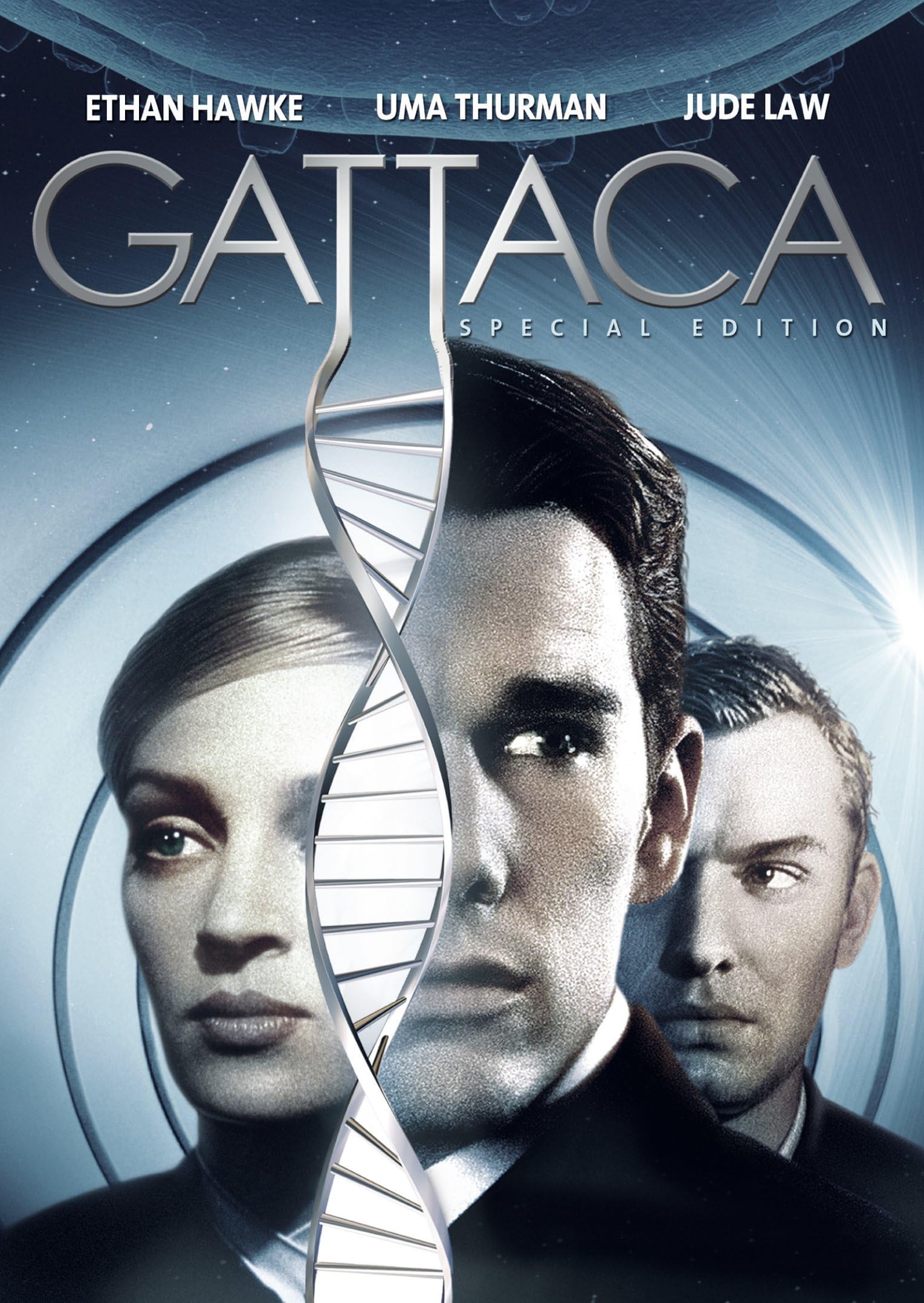
As one of the last "natural" beings born into a genetically engineered world, Vincent Freeman (Ethan Hawke) has none of the "pre-ordered" DNA that will guarantee him success. Desperate to realize his dream of exploring space, Vincent assumes the identity of a genetically superior athlete's genetic markers, Vincent becomes a rising star at Gattaca Aerospace, attracting the attention of a stunning co-worker (Uma Thurman). But when a flight director is brutally murdered, a clue left at the crime scene threatens to shatter Vincent's plans in this riveting sci-fi classic. Review: Perhaps one of the ten best films with an ethical orientation - Ultimately, the core of this film is human striving, human imperfection, and personal meaning. No matter where one finds oneself on the bell curve, there is always someone further to the right. If not, every friend, lover, relative and person one will ever know lies somewhere to the left. Only acceptance of this fact, over all metrics, will allow true equity to exist for everyone on the spectrum. Gattaca is a 1997 film written and directed by Andrew M. Niccol. It was his first feature film -- although he was an accomplished director of commercials -- and was followed by The Truman Show and In Time, among others. It falls into the genre of science fiction, and is set in the near future. Genetic technology is ubiquitous, but was just becoming accepted at the time of the protagonist's birth. Vincent is conceived and carried to term without intervention via genetic technologies that select or modify zygotes prior to cell division. The original script called this a "faith birth," although the term "IN-VALID," pronounced like the word "invalid" in "an invalid driver's license," is used more prominently in the movie. Vincent has varying propensities for genetically-influenced issues such as aggression, obesity, and attention-deficit disorder, which remain untreatable in an age where the obvious solution is for them to be eradicated by genetically selecting them out of existence. He has a genetic heart condition which results in a 99% chance of a 30.5-year life expectancy. His parents' awareness of this causes them to treat him as an invalid his entire childhood and to stress his limitations instead of his potential. Vincent's younger brother, Anton, is genetically enhanced, and therefore VALID. The process of his genetic selection is described in more detail in an earlier script, including the fact that his parents had to save every dime for two years in order to afford the process, but were unable to afford enhancements such as the "innate" ability to play the piano or understand higher mathematics. Anton and Vincent are rivals -- most tellingly at open ocean swimming -- with Anton's enhanced physicality and Vincent's heart condition leading to predictable results, at least during childhood. Anton stands indifferently by as Vincent leaves home at sixteen, disappearing into the genetic underclass of day laborers, housecleaners and sanitation workers. Anton is a child of privilege and an adult who displays many of the markers of childhood, perhaps because he never had to face adversity in his own life. As lead investigator of a murder committed at the corporation where Vincent, and later Jerome, is employed, these qualities surface. Due to an errant eyelash, Vincent (the IN-VALID) becomes a suspect. Anton searches for him, or any genetic traces of him, without revealing that they are related, and without initially suspecting that Vincent is posing as VALID. Society is divided into IN-VALIDs and VALIDs. The law outlaws overt discrimination based on genetics, but the reality of society is one similar to the Reconstruction South and Jim Crow. Tacit acceptance of a genetic underclass -- with diminishing demographics (and political power) due to the rapid adoption of genetic intervention -- but with subtle and not so subtle social "selection processes" inevitably at work. For example, Vincent works hard to improve his skills and knowledge so that he can become a celestial navigator. His attempts at employment are consistently foiled based on drug testing which also reveals his genetic status. A more "qualified" applicant is chosen. His only recourse is manual unskilled labor, thus his short stint of employment as a janitor at the Gattaca Aerospace Corporation. Selection occurs not just in employment, but in mate selection as well. Today women will run a background check on potential mates to determine their (criminal?) past or economic prospects. In the film, they do the same for unseen genetic qualities -- thus Vincent's dates eventually migrate to Anton based upon their surreptitious collection and testing of genetic material. Why would these women ever accept the economic consequences of an IN-VALID's prospects? Why would they opt for a reduced quality of life based on their spouse's potential susceptibility to untreatable ailments or reduced life expectancy? They want a quality partner with a comparable chance for a lengthy high quality life together, similar or better offspring and mitigation of risk. Any reasonable person would desire the same, with the vast majority willing to fudge a little with respect to the "means" in order to maximize the "ends." Vincent is marginalized in both his professional and personal life -- reduced to the permanent underclass, his dreams of space travel unrealized or unrealizable, alone and without prospects -- yet remains resolved. He is not defeated. He works, saves his money and spends every moment of free time educating himself or working out. He constantly goes without and always pushes himself. He resorts to a "borrowed ladder" in the form of Jerome Eugene Morrow, a paraplegic willing to provide skin, hair, blood and urine samples to Vincent on an ongoing basis so that Vincent might represent himself as Jerome, a VALID with "Eugene's" genetics and Vincent's hard earned knowledge and skills. Vincent's resolve is further demonstrated by his having both shin bones surgically severed and reset with titanium rods, increasing his height 2" to match Eugene's genetic profile for height. The scars are explained as being exactly the height of the front fender of a '99 Chrysler LeBaron. Vincent's heartbeat during tests is a recording of Eugene's, resulting in the lab tech Lamar's comment "Six miles later it's still beating like a Goddamn metronome. I could play piano by that heartbeat of his." Meanwhile Vincent's actual heartbeat is over 220 as he masks extreme fatigue, lactic acid buildup and oxygen deprivation by sheer force of will, confident in public but collapsing in private once it is over. Only extremes of discipline and training allow him to pull off this ruse. However his prowess as a celestial navigator is not faked, as evidenced by this assessment: "I reviewed your flight plan. Not one error in a hundred thousand keystrokes. Phenomenal. (placing a hand on Jerome's shoulder) It's right that someone like you is taking us to Titan." Note the "...like you..." instead of "...someone with your skills..." or "...someone with your knowledge..." This distinction is the critical take away of this exchange. The script is full of undercurrents as subtle and deep as this minor inflection. However as much as the film is at its surface about big ideas -- about institutional and societal discrimination -- it ultimately reveals itself to be about the relationships between its characters. About Vincent/Anton, Vincent/Irene, Vincent/Lamar, and Vincent/Eugene... and how their relationships are framed by these larger issues. Review: A beautifully artistic, futuristic, sci-fi love story - The most striking thing about this film is its artistic quality and "Hitchcock-esque" feel. This film is full of symmetry which makes it visually pleasing while at the same time exposing the inequality in imbalance of human existence in a society where only perfect people matter, and where "We now have discrimination down to a science". The story follows the life of Vincent, a young boy who dreams of going into space. One day he finds himself assuming the identity of Jerome (played by Jude Law), a genetically engineered person who, because of a tragic accident, is now crippled. Throughout the film, Vincent must use Jerome's DNA to continually fool others into believing that he is actually Jerome, thereby enabling him to secure a job with Gattaca, a space agency much like our NASA. Along the way Vincent meets Irene (Uma Thurman) and falls in love. As things progress, and Vincent nears the date of his launch, a murder takes place at the agency, and a sweep for DNA clues leads authorities to investigate Vincent as a possible suspect. Though he and Jerome are able to thwart the authorities, they remain suspicious of him and, just days before Vincent's launch into space, an eventual meeting takes place between Vincent and one of the investigators, who just happens to be a person from his past. Vincent also finds himself torn between his dream of becoming a space man and his newfound love for Irene. In the final scenes, the pieces of Vincent's life come together, and like a beautiful sonata, bring the story to a beautiful and moving conclusion. This film is clearly a work of art, and filled with quotes which will forever cement it in our hearts and memories. My favorite of all, "They say every atom in our bodies was once part of a star...Maybe I'm not leaving...Maybe I'm going home". Though this film didn't do very well at the box office, it has since become quite a cult classic, and for very good reason. If you appreciate fine art, photography and filmmaking, then you will love this film. This is definitely one to add to the movie library, and should be required viewing for anyone with a pulse.
| Contributor | Alan Arkin, Andrew Niccol, Blair Underwood, Chad Christ, Cynthia Martells, Danny DeVito, Dean Norris, Elias Koteas, Elizabeth Dennehy, Ernest Borgnine, Ethan Hawke, Gabrielle Reece, George Marshall Ruge, Gore Vidal, Jayne Brook, Jude Law, Ken Marino, Lindsey Lee Ginter, Loren Dean, Maya Rudolph, Michael Shamberg, R Scott Doran, Russell Milton, Stacey Sher, Tony Shalhoub, Uma Thurman, Una Damon, William Lee Scott, Xander Berkeley Contributor Alan Arkin, Andrew Niccol, Blair Underwood, Chad Christ, Cynthia Martells, Danny DeVito, Dean Norris, Elias Koteas, Elizabeth Dennehy, Ernest Borgnine, Ethan Hawke, Gabrielle Reece, George Marshall Ruge, Gore Vidal, Jayne Brook, Jude Law, Ken Marino, Lindsey Lee Ginter, Loren Dean, Maya Rudolph, Michael Shamberg, R Scott Doran, Russell Milton, Stacey Sher, Tony Shalhoub, Uma Thurman, Una Damon, William Lee Scott, Xander Berkeley See more |
| Customer Reviews | 4.6 out of 5 stars 6,896 Reviews |
| Format | Color, Dolby, Multiple Formats, NTSC, Subtitled, Widescreen |
| Genre | Science Fiction & Fantasy |
| Language | English |
| Runtime | 1 hour and 46 minutes |
H**R
Perhaps one of the ten best films with an ethical orientation
Ultimately, the core of this film is human striving, human imperfection, and personal meaning. No matter where one finds oneself on the bell curve, there is always someone further to the right. If not, every friend, lover, relative and person one will ever know lies somewhere to the left. Only acceptance of this fact, over all metrics, will allow true equity to exist for everyone on the spectrum. Gattaca is a 1997 film written and directed by Andrew M. Niccol. It was his first feature film -- although he was an accomplished director of commercials -- and was followed by The Truman Show and In Time, among others. It falls into the genre of science fiction, and is set in the near future. Genetic technology is ubiquitous, but was just becoming accepted at the time of the protagonist's birth. Vincent is conceived and carried to term without intervention via genetic technologies that select or modify zygotes prior to cell division. The original script called this a "faith birth," although the term "IN-VALID," pronounced like the word "invalid" in "an invalid driver's license," is used more prominently in the movie. Vincent has varying propensities for genetically-influenced issues such as aggression, obesity, and attention-deficit disorder, which remain untreatable in an age where the obvious solution is for them to be eradicated by genetically selecting them out of existence. He has a genetic heart condition which results in a 99% chance of a 30.5-year life expectancy. His parents' awareness of this causes them to treat him as an invalid his entire childhood and to stress his limitations instead of his potential. Vincent's younger brother, Anton, is genetically enhanced, and therefore VALID. The process of his genetic selection is described in more detail in an earlier script, including the fact that his parents had to save every dime for two years in order to afford the process, but were unable to afford enhancements such as the "innate" ability to play the piano or understand higher mathematics. Anton and Vincent are rivals -- most tellingly at open ocean swimming -- with Anton's enhanced physicality and Vincent's heart condition leading to predictable results, at least during childhood. Anton stands indifferently by as Vincent leaves home at sixteen, disappearing into the genetic underclass of day laborers, housecleaners and sanitation workers. Anton is a child of privilege and an adult who displays many of the markers of childhood, perhaps because he never had to face adversity in his own life. As lead investigator of a murder committed at the corporation where Vincent, and later Jerome, is employed, these qualities surface. Due to an errant eyelash, Vincent (the IN-VALID) becomes a suspect. Anton searches for him, or any genetic traces of him, without revealing that they are related, and without initially suspecting that Vincent is posing as VALID. Society is divided into IN-VALIDs and VALIDs. The law outlaws overt discrimination based on genetics, but the reality of society is one similar to the Reconstruction South and Jim Crow. Tacit acceptance of a genetic underclass -- with diminishing demographics (and political power) due to the rapid adoption of genetic intervention -- but with subtle and not so subtle social "selection processes" inevitably at work. For example, Vincent works hard to improve his skills and knowledge so that he can become a celestial navigator. His attempts at employment are consistently foiled based on drug testing which also reveals his genetic status. A more "qualified" applicant is chosen. His only recourse is manual unskilled labor, thus his short stint of employment as a janitor at the Gattaca Aerospace Corporation. Selection occurs not just in employment, but in mate selection as well. Today women will run a background check on potential mates to determine their (criminal?) past or economic prospects. In the film, they do the same for unseen genetic qualities -- thus Vincent's dates eventually migrate to Anton based upon their surreptitious collection and testing of genetic material. Why would these women ever accept the economic consequences of an IN-VALID's prospects? Why would they opt for a reduced quality of life based on their spouse's potential susceptibility to untreatable ailments or reduced life expectancy? They want a quality partner with a comparable chance for a lengthy high quality life together, similar or better offspring and mitigation of risk. Any reasonable person would desire the same, with the vast majority willing to fudge a little with respect to the "means" in order to maximize the "ends." Vincent is marginalized in both his professional and personal life -- reduced to the permanent underclass, his dreams of space travel unrealized or unrealizable, alone and without prospects -- yet remains resolved. He is not defeated. He works, saves his money and spends every moment of free time educating himself or working out. He constantly goes without and always pushes himself. He resorts to a "borrowed ladder" in the form of Jerome Eugene Morrow, a paraplegic willing to provide skin, hair, blood and urine samples to Vincent on an ongoing basis so that Vincent might represent himself as Jerome, a VALID with "Eugene's" genetics and Vincent's hard earned knowledge and skills. Vincent's resolve is further demonstrated by his having both shin bones surgically severed and reset with titanium rods, increasing his height 2" to match Eugene's genetic profile for height. The scars are explained as being exactly the height of the front fender of a '99 Chrysler LeBaron. Vincent's heartbeat during tests is a recording of Eugene's, resulting in the lab tech Lamar's comment "Six miles later it's still beating like a Goddamn metronome. I could play piano by that heartbeat of his." Meanwhile Vincent's actual heartbeat is over 220 as he masks extreme fatigue, lactic acid buildup and oxygen deprivation by sheer force of will, confident in public but collapsing in private once it is over. Only extremes of discipline and training allow him to pull off this ruse. However his prowess as a celestial navigator is not faked, as evidenced by this assessment: "I reviewed your flight plan. Not one error in a hundred thousand keystrokes. Phenomenal. (placing a hand on Jerome's shoulder) It's right that someone like you is taking us to Titan." Note the "...like you..." instead of "...someone with your skills..." or "...someone with your knowledge..." This distinction is the critical take away of this exchange. The script is full of undercurrents as subtle and deep as this minor inflection. However as much as the film is at its surface about big ideas -- about institutional and societal discrimination -- it ultimately reveals itself to be about the relationships between its characters. About Vincent/Anton, Vincent/Irene, Vincent/Lamar, and Vincent/Eugene... and how their relationships are framed by these larger issues.
D**S
A beautifully artistic, futuristic, sci-fi love story
The most striking thing about this film is its artistic quality and "Hitchcock-esque" feel. This film is full of symmetry which makes it visually pleasing while at the same time exposing the inequality in imbalance of human existence in a society where only perfect people matter, and where "We now have discrimination down to a science". The story follows the life of Vincent, a young boy who dreams of going into space. One day he finds himself assuming the identity of Jerome (played by Jude Law), a genetically engineered person who, because of a tragic accident, is now crippled. Throughout the film, Vincent must use Jerome's DNA to continually fool others into believing that he is actually Jerome, thereby enabling him to secure a job with Gattaca, a space agency much like our NASA. Along the way Vincent meets Irene (Uma Thurman) and falls in love. As things progress, and Vincent nears the date of his launch, a murder takes place at the agency, and a sweep for DNA clues leads authorities to investigate Vincent as a possible suspect. Though he and Jerome are able to thwart the authorities, they remain suspicious of him and, just days before Vincent's launch into space, an eventual meeting takes place between Vincent and one of the investigators, who just happens to be a person from his past. Vincent also finds himself torn between his dream of becoming a space man and his newfound love for Irene. In the final scenes, the pieces of Vincent's life come together, and like a beautiful sonata, bring the story to a beautiful and moving conclusion. This film is clearly a work of art, and filled with quotes which will forever cement it in our hearts and memories. My favorite of all, "They say every atom in our bodies was once part of a star...Maybe I'm not leaving...Maybe I'm going home". Though this film didn't do very well at the box office, it has since become quite a cult classic, and for very good reason. If you appreciate fine art, photography and filmmaking, then you will love this film. This is definitely one to add to the movie library, and should be required viewing for anyone with a pulse.
S**Z
GATTACA: Inspiration and art with deep religious themes (disguised as science fiction)
Gattaca is not science fiction. Sure, it wears that suit to impress the stiffs, but at its heart it is a movie about faith and the human spirit. Anyone training for a triathlon or marathon has got to love this movie. It is about not only overcoming the prejudice of others around you, but also about overcoming the prejudice within you about yourself. The movie has deep, deep layers of religious themes too. Natural births are called "God-childs" and are looked down upon. One scene that struck a chord with me is the one where Jerome slaps Vincent in the face with Gattaca's perversion of unconditional grace: "Don't you get it! When they see you, they don't see you anymore, they see me." Another profoundly religious parallel is seen in Jerome's parting gift. Here is a playboy at heart, who learns self sacrifice. He gives Vincent "two-lifetimes" worth of blood and flesh, that he (and in a sense they both together) might ascend into the heavens. As a Christian, this variation, this strange communion of souls, struck a chord with me. As Jerome put it; "I lent you my body. You lent me your dreams." This movie has so many rich themes. One is of course overcoming self doubt, and trying to be someone your aren't in order to please others. When "Jerome" is exposed to Irene as Vincent; he confronts her as well regarding what "they" have got her believing about herself. There are so many favorite scenes for me in this film. There is the scene, the final race in the open sea between Vincent and his brother, where he tells his brother the simple secret: "I saved nothing for the swim back." There's the scene where he must suffer brutal surgery in order to be the right height. And of course, throughout the movie, the constant tension of always having to be perfect, perfect, perfect--not even an eyelash out of place. As story telling and inspiring goes, they don't get too much better than Gattaca. And you have to give a thumbs up to the actors, and the music was spot on perfect too. The cast was well chosen, and all the scenes. It's not only great storytelling, it's a work of art.
J**R
Great movie
I thought it would have more action, but the story and the journey of the spirit kept me captivated. Definitely worth watching.
A**H
An exploration of an aspect of the Human Condition
Every so often, one sees a movie and says "this is the best movie I've ever seen---I probably won't see anything as moving as this. And sure enough, something comes along that is as good and many times better. The human condition is so varied and multi-faceted that one may never exhaust all the permutations of artistic expression that can be shown. For example, when the TV science fiction hit "Star Trek" came out I thought it was so fantastic. But when "ST The Next Generation" came along, I had serious doubts that it could match the original. Then, as I marveled at the story lines and the extra dimension of character interactions, I felt that TNG is better and can't be topped. With each iteration something new was introduced that explored the vastness of human interaction and inter-species interactions. Etc., Etc. GATTACA is yet another example of plumbing the depths of humanity, including out obsession with categorizing humans along the lines of artificial inventions like "Race", "Caste System", "Colorism". GATTACA is a haunting and beautifully conceived expression of the insanity that has had humanity in its grips for centuries and has made us into a species exemplified in the title of a book "Homo Hierarchicus"(by Louis Dumont) One phrase that implies how illusory and meaningless these artifices is the one on the DVD cover that says---"There is no gene for the human spirit". Unfortunately, those of us who've become cynical about that inner essence of a human that makes us unique and gives expression to us being more than an accidental collection of sophisticated chemicals. Without that recognition of the "soul" oh humans, we become prey to seeing each other simply in terms of genes and eventually slide into the dark philosophies and practices of eugenics, racism, nihilism, and skepticism concerning the existence of an "Unknowable Essence" who is beyond the ken and comprehension of finite minds. Nonetheless, this Unknowable Essence has created laws of mathematics and sciences that fashion and determine actions in the physical realm, and laws and principles that govern the "Spiritual Realm". One such spiritual law is "Love" which can't be measured and which has an analogue in the physical world called gravitational attraction and particle interactions. It is this force "Love" which allows humans to see past the need to relegate people to various categories based on tribal, racial, color, religious preference, and ethnicity. Other limitations have arisen to join the mix which we need not go into now. Baha'u'llah, the most recent of God's Messengers, has infused into the realm of human experience on the planet a new consciousness when in the 19th Century hw declared that the time has come for the forging of humankind into "A New Race" exemplified, among other places in his Writings the following: "O CHILDREN OF MEN! Know ye not why We created you all from the same dust? That no one should exalt himself over the other. Ponder at all times in your hearts how ye were created. Since We have created you all from one same substance it is incumbent on you to be even as one soul, to walk with the same feet, eat with the same mouth and dwell in the same land, that from your inmost being, by your deeds and actions, the signs of oneness and the essence of detachment may be made manifest. Such is My counsel to you, O concourse of light! Heed ye this counsel that ye may obtain the fruit of holiness from the tree of wondrous glory." This is a sample of a new Paradigm which when fully explored, accepted, and implemented in our private and daily lives and policies, will protect us from falling prey to the miseries of apartheid, "Jim Crow Society", The Caste System, racist attitudes so clearly and chillingly portrayed in America, and elsewhere, and in our tendencies towards being religiously fanatical in our interpretations and applications of Religious principles.
M**S
One of the finest sci-fi movies I've ever seen
I don't know why I waited so long to see Gattaca, the blurb on the box just didn't reach out and grab me, but after seeing Dark City, I decided to take a chance on this movie too, and I'm glad I did. Gattaca is like the thinking man's sci-fi, some of the possible mixed with some of the improbable, but wrapped up in such a way that you find yourself just accepting it, because you're drawn along on the story, and you don't really want to quibble over all the details. Ethan Hawke plays an in-valid(a natural born), who desires to go to space, but never will because he wasn't born a valid, one whose genes have been altered so that he will be perfect. This setback doesn't stop him though, and through the help of a valid, portrayed by Jude Law, who was paralzyed by a car accident, he sets out to fool the top of the elite at the space company Gattaca, into thinking he is one of them. The premise is an unusual one, but it works, because we are able to believe in the ability of Hawke to carry this masquerade off. Most of all the actors do a fine job here, I was impressed by Ethan Hawke's portrayal of the main character. Jude Law, an actor I usually don't care for, also does an impressive job as the valid who doesn't really believe Hawke can carry this off, since he himself, a genetically altered man slated to win the gold medal in swimming at the olympics, could only win the silver. It wouldn't be fair to mention the two men without also mentioning Uma Thurman, an actress I generally don't care for either, but who does a very good job in this movie. While I followed the flow of most of the movie, and could see the possibility of gene altering becoming feasible in the near future, the biggest problem I had with the movie was the investigation that took place after the murder take place in Gattaca. The police seemed to be able to do whatever they wanted, stop anyone anywhere, and test their DNA. It was never stated that in addition to science progressing so far that citizens had also lost some of their basic rights, and that the authorities were allowed to go anywhere they wanted and test anyone they felt like. This seemed like the only real weak link in the story to me, but I let it slide since I was enjoying the overall aspect of the movie. So, at the very least I recommend that you rent this movie, and see for yourself how good it is. I ended up buying it after I saw it, and if you're anything like me, I think you'll do the same.
J**S
It is more a mystery than a science fiction and the good one, also the warning about surveillance
This thrilling movie from 1997 was giving us glimpses of how we could be checked when genetics' benefits and manipulations would continue at a fast pace as it was trending at that time. Would you like to let yourself be warned about your genetical shortcomings and then take a risk to be genetically modified? Check the movie and ponder about it. Now the so called artificial intelligence overtook that baton. But it is actually the thrilling mystery more than anything else. The future environment and science fiction are just the frame. For me it was quite coincidental and ironic, that my wife and I decided to see this movie in the day when US House of Representatives voted to kill the bill requiring to stop warrantless surveillance and searches of our homes by security agencies in the bipartisan action. So the FISA act shall continue. This visionary movie is for me about not so distant future, perhaps even about present, when all about us is already digitalized, known and ready for use by the powerful, often not even elected. So you all rather behave, people! But this wonderful movie picture is also about the determination, persistence and the life dream manifestation of a man whose genetics predisposed him to have no chance. That is what I loved about this, because I can deeply relate to the story. I also manifested and lived my life dream. I have to admit that I was thinking in the middle of it that it was a story about a cheater. My wife is both, puzzles and mysteries aficionado and she help me to get out of it. The exciting story twists accelerate toward the end. She again impressed me by correctly predicting perhaps the biggest one.
B**A
Good movie
Good movie if you can keep up. Very in depth and have to pay attention. A little romantic thriller.
Trustpilot
1 week ago
1 day ago