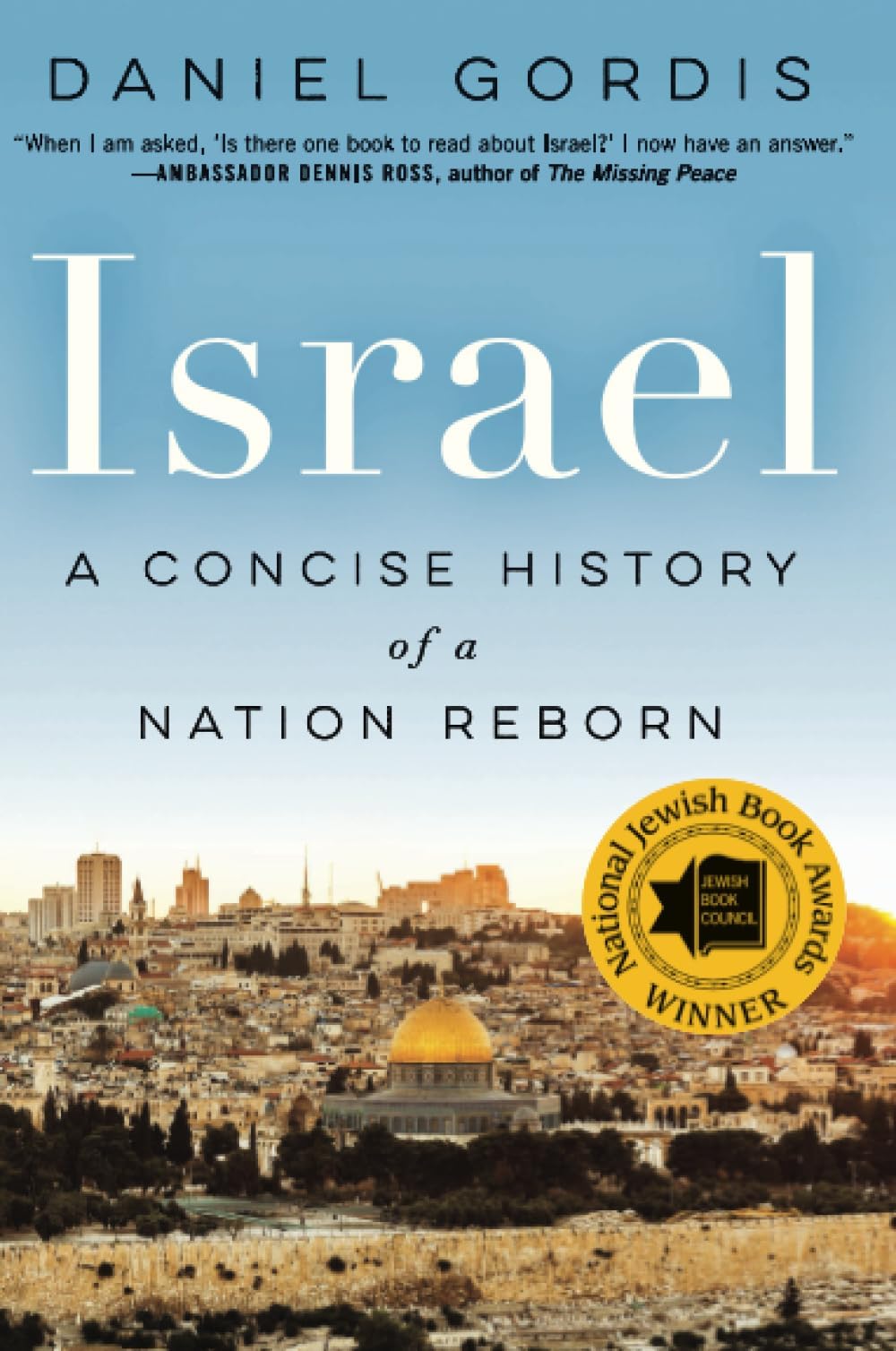
Israel: A Concise History of a Nation Reborn
Product ID: 46885341
Buy anything from 5,000+ international stores. One checkout price. No surprise fees. Join 2M+ shoppers on Desertcart.
Desertcart purchases this item on your behalf and handles shipping, customs, and support to Congo.
Winner of the Jewish Book of the Year Award The first comprehensive yet accessible political history of the state of Israel from its inception to present day, from Daniel Gordis, "one of the most respected Israel analysts" ( The Forward ) living and writing in Jerusalem. In the landscape of Middle East history, Israel is a tiny state, and yet it has captured the world’s attention, aroused its imagination, and lately, been the object of its opprobrium. Why does such a small country speak to so many global concerns? More pressingly: Why does Israel make the decisions it does? And what lies in its future? We cannot answer these questions until we understand Israel’s people and the questions and conflicts, the hopes and desires, that have animated their conversations and actions. Though Israel’s history is rife with conflict, these conflicts do not fully communicate the spirit of Israel and its people: they give short shrift to the dream that gave birth to the state, and to the vision for the Jewish people that was at its core. Guiding us through the milestones of modern Israel, Gordis relays the drama of the Jewish people’s story and the creation of the state. Clear-eyed and erudite, he illustrates how Israel became a cultural, economic and military powerhouse―but also explains where Israel made grave mistakes and traces the long history of Israel’s deepening isolation. With Israel , public intellectual Daniel Gordis offers us a brief but thorough account of the cultural, economic, and political history of this complex nation, from its beginnings to the present. Accessible, levelheaded, and rigorous, Israel sheds light on the Israel’s past so we can understand its future. The result is a vivid portrait of a people, and a nation, reborn. This thorough and riveting account illuminates the pivotal events and complex questions at the heart of the nation’s story: Zionism and the Birth of a Nation: Explore the dream that gave birth to the state and the drama of the Jewish people’s story, guided by one of the most respected Israel analysts writing from Jerusalem. The Arab-Israeli Conflict: Trace the long history of Israel’s deepening isolation and understand why the nation makes the decisions it does through a clear-eyed look at its gravest mistakes and greatest military triumphs. A Nation Reborn: Go beyond the headlines to see how a tiny state became a cultural, economic, and military powerhouse while navigating the hopes, desires, and conflicts that animate its people. Comprehensive Israeli History: Follow the milestones of the state from its inception to the present day in a rigorous, accessible, and levelheaded account of this complex nation's past and future. Review: A Masterpiece of Clarity, Depth, and Truth - Israel: A Concise History of a Nation Reborn is one of the most thorough, engaging, and illuminating books I have ever read about the Jewish people and the rebirth of the State of Israel. It is rare to find a historical work that is both academically rigorous and emotionally resonant, but this book achieves that balance effortlessly. The author tells Israel’s story with honesty, nuance, and humanity — from ancient roots to modern challenges. Every chapter is rich with context yet incredibly readable. Whether you are well-versed in Jewish history or just beginning to learn, this book gives you a deep and meaningful understanding of how a nation, scattered and persecuted for centuries, rebuilt itself in its ancestral homeland against all odds. What stands out most is how respectfully and comprehensively the author presents the complexities of Israel’s past and present. It is neither propaganda nor revisionism — it is simply a truthful, beautifully told account of resilience, identity, faith, and survival. For anyone who cares about Jewish history, Middle Eastern politics, or the incredible story of a people who refused to disappear, this book is essential reading. I finished it feeling more informed, more grounded, and deeply moved. A brilliant work — and a must-have for every library. Review: Concise history of the creation and growth of Israel - Daniel Gordis tells the story of Israel, from the early Zionists to the mid-2010s. The book is subtitled “A Concise History of a Land Reborn”. Due to the complexity of Israel’s history, Gordon’s’ book is not short but it is written in a concise readable style. Gordis explains the origins of the Zionist political movement. It was interesting to learn that not all Zionists agreed with the Herzl’s goal of creating a Jewish nation state, and there was at least one serious alternative location to Palestine. The turbulent period of British rule from 1918 - 1947 is well covered. The War of Independence and the subsequent major wars and peace negotiations with neighboring Arab nations and the PLO are discussed at a high level. Gordis provides great insight into the clashes between major Israeli leaders, including one clash during the War of Independence that almost resulted in a civil war. The book includes a set of excellent color maps that show the shifts in the territory that resulted from the various wars, as well as proposed territorial divisions in the peace proposals which were not implemented. There is also an excellent glossary. Gordis is writing from the perspective of an American who emigrated to Israel, and he is unabashedly proud of his country. He details the remarkable growth of Israel beginning with immigration at the beginning of the 20th century, and the influences of multiple waves of immigrants on its culture and politics. He devotes significant attention to leading cultural figures in literature and music. The critical role of foreign financing of Israel, beginning with the controversial war reparations received from Germany, is also discussed. The increasing influence of Orthodox Jews is discussed. Gordis acknowledges the great suffering of the Palestinian Arabs, and he does not shy away from critiquing Israel’s mistakes. In summary, I recommend “Israel” to readers seeking to learn about the country’s fascinating history, and the challenges it continues to face domestically and internationally.


| Best Sellers Rank | #30,601 in Books ( See Top 100 in Books ) #18 in History of Judaism #24 in Israel & Palestine History (Books) #33 in Middle Eastern Politics |
| Customer Reviews | 4.7 out of 5 stars 1,537 Reviews |
A**E
A Masterpiece of Clarity, Depth, and Truth
Israel: A Concise History of a Nation Reborn is one of the most thorough, engaging, and illuminating books I have ever read about the Jewish people and the rebirth of the State of Israel. It is rare to find a historical work that is both academically rigorous and emotionally resonant, but this book achieves that balance effortlessly. The author tells Israel’s story with honesty, nuance, and humanity — from ancient roots to modern challenges. Every chapter is rich with context yet incredibly readable. Whether you are well-versed in Jewish history or just beginning to learn, this book gives you a deep and meaningful understanding of how a nation, scattered and persecuted for centuries, rebuilt itself in its ancestral homeland against all odds. What stands out most is how respectfully and comprehensively the author presents the complexities of Israel’s past and present. It is neither propaganda nor revisionism — it is simply a truthful, beautifully told account of resilience, identity, faith, and survival. For anyone who cares about Jewish history, Middle Eastern politics, or the incredible story of a people who refused to disappear, this book is essential reading. I finished it feeling more informed, more grounded, and deeply moved. A brilliant work — and a must-have for every library.
L**R
Concise history of the creation and growth of Israel
Daniel Gordis tells the story of Israel, from the early Zionists to the mid-2010s. The book is subtitled “A Concise History of a Land Reborn”. Due to the complexity of Israel’s history, Gordon’s’ book is not short but it is written in a concise readable style. Gordis explains the origins of the Zionist political movement. It was interesting to learn that not all Zionists agreed with the Herzl’s goal of creating a Jewish nation state, and there was at least one serious alternative location to Palestine. The turbulent period of British rule from 1918 - 1947 is well covered. The War of Independence and the subsequent major wars and peace negotiations with neighboring Arab nations and the PLO are discussed at a high level. Gordis provides great insight into the clashes between major Israeli leaders, including one clash during the War of Independence that almost resulted in a civil war. The book includes a set of excellent color maps that show the shifts in the territory that resulted from the various wars, as well as proposed territorial divisions in the peace proposals which were not implemented. There is also an excellent glossary. Gordis is writing from the perspective of an American who emigrated to Israel, and he is unabashedly proud of his country. He details the remarkable growth of Israel beginning with immigration at the beginning of the 20th century, and the influences of multiple waves of immigrants on its culture and politics. He devotes significant attention to leading cultural figures in literature and music. The critical role of foreign financing of Israel, beginning with the controversial war reparations received from Germany, is also discussed. The increasing influence of Orthodox Jews is discussed. Gordis acknowledges the great suffering of the Palestinian Arabs, and he does not shy away from critiquing Israel’s mistakes. In summary, I recommend “Israel” to readers seeking to learn about the country’s fascinating history, and the challenges it continues to face domestically and internationally.
T**Y
Well written and concise, but short on details and perspective
Since I was a kid, I've seen countless news stories about Israel, most of which have involved Palestinians, the PLO, Hamas, Hezbollah, battles, border skirmishes, and/or peace attempts. I have a vague understanding of the region's major problems, but I purchased this book because I wanted to take a deeper dive into the conflicts, to explore the complexities--and I was certain there were many to explore. If there weren't, surely the issues would've been resolved long ago, right? Gordis does a great job of explaining how Israel got its start. I enjoyed learning about the World Zionist Congress; about the array of factors driving Jews to move to Palestine, forsaking their homes in Europe, Africa, and elsewhere in the Middle East; and about Israel's zig-zagging path to independence. For the first eight chapters, Gordis manages to put all of that neatly in perspective. Unfortunately, Gordis loses his way in the second half of the book, as he races through high points and low points of the last 70 years. He still tries to put things in context, but the narrative moves so quickly that there's little time for him to do so. It feels like a lost opportunity. A more significant problem--and frankly, the biggest issue I had with this book--is the lack of outsider perspective. Gordis was born in America but emigrated to Israel over 20 years ago. In his introduction, he admits that he is a proud Israeli citizen and that that has perhaps colored his analyses. I give Gordis credit for his honesty. I also give him credit for a solid overview of Israeli history told from an Israeli point of view. However, I feel like a Palestinian would've had a very different story to tell. I'm not saying that Gordis avoids the issue of Palestinian refugees--in fact, he spends a fair bit of time addressing it. I'm only saying that I'd like to hear the same history told from a Palestinian perspective. Both POVs would be biased, of course, but at least I'd be able to compare and contrast the two sides. In sum: If you're looking for an overview of Israeli history from the 19th century through independence, this is a great book to read. If you're looking for a recap of important moments in Israeli history post-independence, it's still pretty good. If you're looking for a discussion of Israel and the Palestinian conflict--how it began, how it evolved, and where it stands today--this will do in a pinch, but you may want to look elsewhere.
T**A
Super book
Fantastic book about their secular history. I do wish there was more info about the religious aspect
T**T
Excellent modern history of Israel
Before reading this book, I realized that I knew essentially nothing about the modern state of Israel. I was under the impression that the events of WWII pricked the heart of the world who, out of guilt, decided to carve out a piece of Palestine and set up the state of Israel. That is far from the truth and Daniel Gordis does an excellent job of explaining the roots of the Zionist movement (which was secular in nature rather than religious). One of the unexpected parts of the story is how Gordis weaves the poetry, storytelling and music of Jews into the history and how they influenced the hearts of the Jewish people along the way (and still today). He recounts the role of principle world leaders (both plitical and otehrwise) who made an impact in how events unfolded. For example, I had no idea that from the beginning of the 20th centruy through to the beginning of WWII, Jewish businessmen (including the Rothschilds) were buying land in Palestine under the noses of the Ottomans and that Jewish people (mainly from Europe) were emmigrating there. Part of the Zionist movement was not just to find a homeland but to reclaim the Hebrew language. Until the early 20th century, Hebrew was essentially dead as a spoken language. But just like in the old Testament when the remnant of Jews returned to Judah from Bablylon, the people had to be retaught how to speak and read it. Jews would eventually emigrate to Israel from over 60 different countries and would have to learn a whole new language and culture. Many were expelled from their native countries and many had to excape them. One of the first significant laws passed by the new Israeli goverment was that any Jew who wanted to immigrae was allowed to, no matter where they came from or what they brought with them (which often was the clothes on their backs). We in the west often misunderstand the heart of Israel because of their troubled relationship with their Arab neighbors. What we have to understand is that no matter where the Jews have lived in the world, they have suffered greatly. They have been hated, attacked, discriminated against, expelled, and murdered. Because their numbers were so few and they were so spread out, they were easy targets. But the early Zionist leaders decided it was time for the new Jew who no longer had to take what they were given. Having their own land, even as small as it is, gave them a chance to create a life free from the pogroms and discrimination of the past and place their collective energy, talent, and brilliance to work on behalf of the Jewish people to prosper and defend themselves. Gordis explains that the process had been fraught with problems (especially with the Arabs). But they have not only survived but have become one of the most influential nations in the world. Gordis explains that Israel is not perfect. They are attacked from without and struggle from within about how to manage their country and their collective soul. I recommend you read this book for an excellent overview of the history and direction of the state of Israel.
J**J
Well writen - an easy read!
Well written, map and photos are very helpful! National Jewish Book Awards Winner!
A**I
Excellent overview
I was familiar with the history going in but I still learned some new things. This is a great resource.
B**E
Great book. Audio narrator not too bad.
Great book. (Would have been nice if the audiobook narrator had bothered to ask a Hebrew speaker how to pronounce the Hebrew words & names.)
M**O
Fascinating story
Fascinating book, rich, propaganda-free and very instructive. To my experience. best book available on the subject
O**.
Incredibly interesting and insightful
I'm always wary of reading books about politics and/or history due to bias, but although written by a Jewish author, I found this book to be as neutral as can be expected. It thoroughly explains rights and wrongs on both sides. It was written very well making an incredibly complex history very digestable and interesting.
A**N
good book
tells the modern history of Isreal and also the origins of Isreal in ancient times
E**S
Provides a Warts and All History of Zionism and Creation of Israel
This was an informative read which provided great insight into the formation of modern Israel. It traces that history back to the Zionist Congress in the 1890s and Herzl's vision of Jews coming together. It discusses pogroms in Europe, particularly one I Russia which is referred to regularly. It traces the events through WW1, the end of empires and the politics of the Jews and Arabs and European powers over the Middle East carve up. It moves through the rise of Nazism, the Holocaust and the flight to Palestine by Jews from Europe. Great insights I to the role Jewish culture played in appealing to Jews throughout and writing. Post WW2 we learn of the opposition by American Jewry to the formation of a Jewish state, which had support amongst religious Jews in Palestine. A review of the development of Israel, tensions between secular and religious Jews, the three conflicts which could have destroyed the new nation and the determination of a people 3000 years old to find safe haven in their historic lands. Finally a synopsis of Israel today. The police of occupation, the fear of threats from hostile neighbours and it's achievements beyond its size I science, medicine and the arts. A great insight into Israel and the complexity of the Middle East. WARNI NG: For Christians who read the end times involving Israel, this book is not for you. Israel is a secular state and few Jews see the return to their ancient land through Biblical lenses.
C**F
Excellent Historical outline of the transfer of the Ottoman Empire ...
Excellent Historical outline of the transfer of the Ottoman Empire to the British Mandate and to the declaration of independence by the UN in 1948.The reviews of the various wars started by its neighbor nations with the first one within days of May 15th 1948. The author vividly describes the intolerance of the Arab nations in general and the Muslims in particular for the continued existence of Israel and the Jewish homeland. Because the author is Jewish some bias maybe expected, however that does not negate the history and struggles he describes. A good and concise history written in a fluent manner that keeps the reader interested and involved throughout the book.
Trustpilot
3 days ago
1 month ago