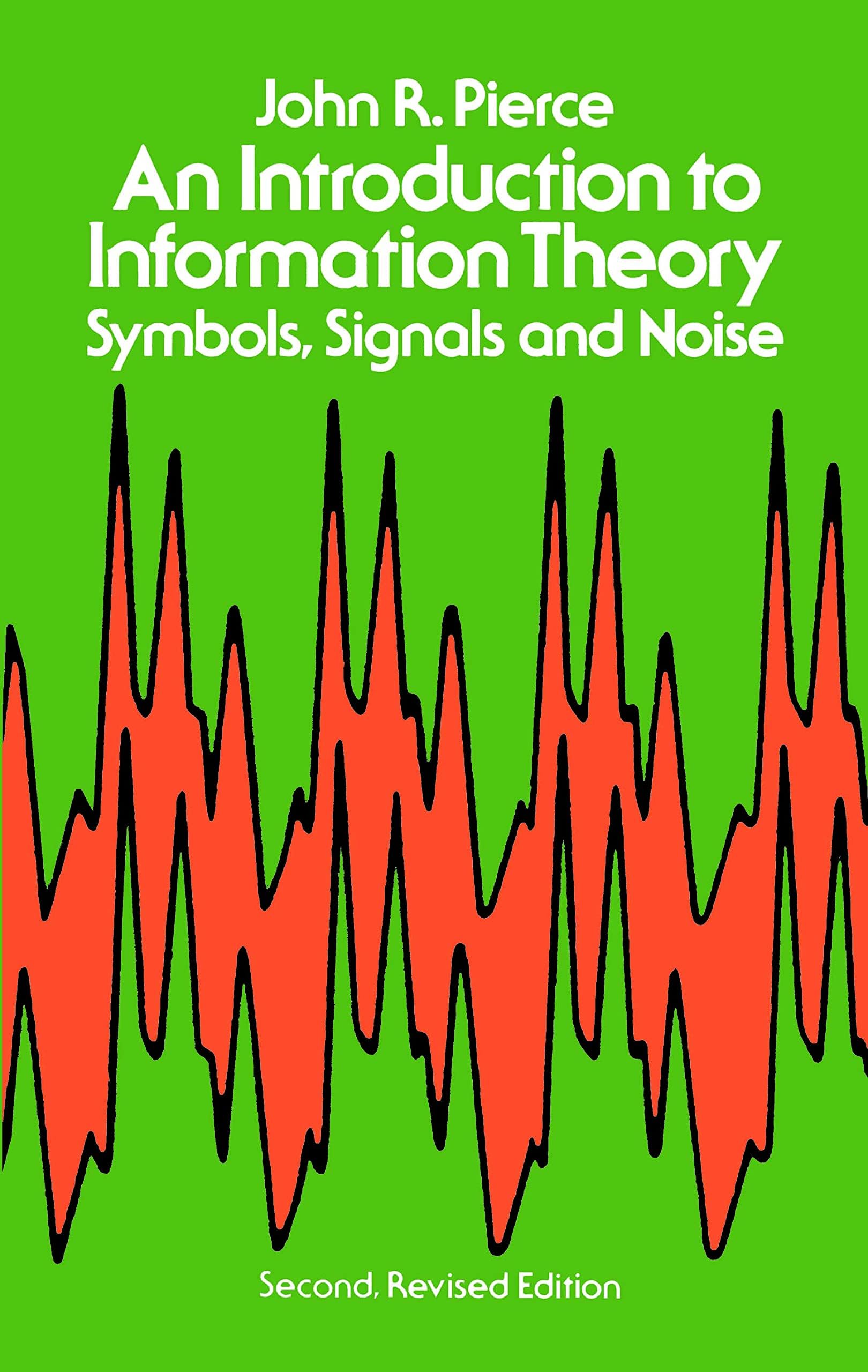
An Introduction to Information Theory: Symbols, Signals and Noise (Dover Books on Mathematics)
Product ID: 4850862
Buy anything from 5,000+ international stores. One checkout price. No surprise fees. Join 2M+ shoppers on Desertcart.
Desertcart purchases this item on your behalf and handles shipping, customs, and support to Congo.
"Uncommonly good...the most satisfying discussion to be found." — Scientific American. Behind the familiar surfaces of the telephone, radio, and television lies a sophisticated and intriguing body of knowledge known as information theory. This is the theory that has permitted the rapid development of all sorts of communication, from color television to the clear transmission of photographs from the vicinity of Jupiter. Even more revolutionary progress is expected in the future. To give a solid introduction to this burgeoning field, J. R. Pierce has revised his well-received 1961 study of information theory for a second edition. Beginning with the origins of the field, Dr. Pierce follows the brilliant formulations of Claude Shannon and describes such aspects of the subject as encoding and binary digits, entropy, language and meaning, efficient encoding, and the noisy channel. He then goes beyond the strict confines of the topic to explore the ways in which information theory relates to physics, cybernetics, psychology, and art. Mathematical formulas are introduced at the appropriate points for the benefit of serious students. A glossary of terms and an appendix on mathematical notation are proved to help the less mathematically sophisticated. J. R. Pierce worked for many years at the Bell Telephone Laboratories, where he became Director of Research in Communications Principles. His Introduction to Information Theory continues to be the most impressive nontechnical account available and a fascinating introduction to the subject for lay readers. Review: Brilliant and thought provoking - I wish every topic had a book like this one to introduce newcomers. Information theory is itself fairly interesting, but I found that the author used intriguing examples from a broad variety of disciplines to capture the reader's attention. He also has something of a self-deprecating writing style that will bring a smile to your face once or twice in each chapter. I loved the discussion of language and letter frequency, and it was even more interesting since now easily accessible tools exist (like Google's ngram) which allow you to explore some of the data and concepts first hand. I've explored various error correction/detection schemes online to gain a cursory understanding - this book did far more for me thanks to the simple and straightforward examples. I feel confident I could write my own (albeit basic) error correction code now, thanks solely to this book. I admit that the n-dimensional hypersphere-based code correction is somewhat beyond an easy implementation for me, but still, the explanation is engaging and I feel confident that I can explain the basics of geometrical error correction codes on a high level, which will be useful to me in my course of work. Anyhow, this kind of book, with enough depth to be challenging for someone with a basic science background yet still casual enough to read a bit here and there without getting lost, is a rare find. Well worth the very reasonable price. I wager that even someone with little interest in science or math could find some very interesting gems here. Have a deamy day. Review: Very good book on complex topic - Very good book on complex topic. I feel, the book can be interesting both for specialist in fields like IT, telecom, signal processing etc. and laymen interested in mathematical background of communication. For me, the book was very good refresher of my knowledge I gained at university (I studied mathematics, computer sciences and economics). Moreover, despite my backgroud, I learned many new interesting things about natural languages and especially connection between information theory and thermodynamics. The author starts the book a litte bit philosophically, discussing what is a theory and how to construct it, then he switches to history of information theory and starts to describe basics concepts like a information source, basics of coding and finite state machine. Then he explains entropy, the metric of information content (I appreciated very friendly explanantion of this sometimes tricky concept). After it, he goes to more difficult parts like error correction and noise. In chapter called "Information Theory and Physics", the author brings derivation of minimal amount of energy needed to transmit some amount of information (here the reader can find above mentioned connection between information theory and thermodynamics). Escpecially this part I found extremelly interesting. In following chapters, the author discusses relation between information theory and cybernetics (this part is more or less about programming and using computers, however, because of publishing year 1980 this part is out of date), psychology (experiments related to ability of human beings to share and transmit information are described) and art (the author describes possibilities of producing music and paintings by computers, again this part is little bit out of date but it could be interesting for reader dealing with computer history). What, from my point of view, does the book down is large number of typos, even in formulas (e.g. 1+P/N is interchanged with (1+P)/N etc.). Overall, despite the typos, the book is worth reading. Moreover price around $5 is nice as well.


| Best Sellers Rank | #512,803 in Books ( See Top 100 in Books ) #55 in Information Theory #283 in Reference (Books) #467 in Probability & Statistics (Books) |
| Customer Reviews | 4.4 out of 5 stars 358 Reviews |
A**N
Brilliant and thought provoking
I wish every topic had a book like this one to introduce newcomers. Information theory is itself fairly interesting, but I found that the author used intriguing examples from a broad variety of disciplines to capture the reader's attention. He also has something of a self-deprecating writing style that will bring a smile to your face once or twice in each chapter. I loved the discussion of language and letter frequency, and it was even more interesting since now easily accessible tools exist (like Google's ngram) which allow you to explore some of the data and concepts first hand. I've explored various error correction/detection schemes online to gain a cursory understanding - this book did far more for me thanks to the simple and straightforward examples. I feel confident I could write my own (albeit basic) error correction code now, thanks solely to this book. I admit that the n-dimensional hypersphere-based code correction is somewhat beyond an easy implementation for me, but still, the explanation is engaging and I feel confident that I can explain the basics of geometrical error correction codes on a high level, which will be useful to me in my course of work. Anyhow, this kind of book, with enough depth to be challenging for someone with a basic science background yet still casual enough to read a bit here and there without getting lost, is a rare find. Well worth the very reasonable price. I wager that even someone with little interest in science or math could find some very interesting gems here. Have a deamy day.
M**Y
Very good book on complex topic
Very good book on complex topic. I feel, the book can be interesting both for specialist in fields like IT, telecom, signal processing etc. and laymen interested in mathematical background of communication. For me, the book was very good refresher of my knowledge I gained at university (I studied mathematics, computer sciences and economics). Moreover, despite my backgroud, I learned many new interesting things about natural languages and especially connection between information theory and thermodynamics. The author starts the book a litte bit philosophically, discussing what is a theory and how to construct it, then he switches to history of information theory and starts to describe basics concepts like a information source, basics of coding and finite state machine. Then he explains entropy, the metric of information content (I appreciated very friendly explanantion of this sometimes tricky concept). After it, he goes to more difficult parts like error correction and noise. In chapter called "Information Theory and Physics", the author brings derivation of minimal amount of energy needed to transmit some amount of information (here the reader can find above mentioned connection between information theory and thermodynamics). Escpecially this part I found extremelly interesting. In following chapters, the author discusses relation between information theory and cybernetics (this part is more or less about programming and using computers, however, because of publishing year 1980 this part is out of date), psychology (experiments related to ability of human beings to share and transmit information are described) and art (the author describes possibilities of producing music and paintings by computers, again this part is little bit out of date but it could be interesting for reader dealing with computer history). What, from my point of view, does the book down is large number of typos, even in formulas (e.g. 1+P/N is interchanged with (1+P)/N etc.). Overall, despite the typos, the book is worth reading. Moreover price around $5 is nice as well.
J**N
Great book on information theory
After reading Claude Shannon's 1948 paper laying out the foundations of information theory, I found myself wanting to know more about the subject. I purchased this book because it is very cheap and had great reviews. I was hoping for something a bit more technical to help me understand Shannon's paper more thoroughly but this book was not what I was looking for. For a very well written and much more mathematical treatment, I would suggest picking up Information Theory, Inference and Learning Algorithms by MacKay, which also covers many interesting and related topics. With this being said, I still loved this book. The author does a good job of presenting the material, some of which follows Shannon's original paper and some if which is original work, in a very clear and interesting way. Even though this book is rather old it is still relevant to the field it covers. Best of all, it would be interesting to someone of any mathematical maturity from those who have not done any since high school to those who use it everyday in their work. This is a rare feat in my opinion and makes this book a very good read.
M**N
Great introduction to messages, encoding and the nature of what we call information
Great introduction to the nature of information, communication and language. The author also does a great job discussing the challenges of taking a message, encoding it in a way that will minimize errors in transmission / reception and discussing the impact of the message among all possible messages from a given source. It is a little tedious to read through at times, but only because I believe the author is trying to balance mathematical rigor / precision and relating it to common experience. There is a great review of the telegraph and the initial difficulties that Morse and others encountered that is generally not discussed elsewhere. Pierce also does a great job discussing the nature of language in terms of how you could teach a machine to create English prose, very prophetic since it relates strongly to machine learning and text mining efforts in IT today. Overall, I enjoyed it and would recommend it as a starting point for anyone interested in the mathematical theory of information.
H**D
Good book
This is the first book I read about information theory. It is a good introduction explaining all the basic concepts and driving the reader through several examples to make you understand it, however it lacks some formality. I consider myself someone with a really good mathematical and physical background which probably drive me to prefer more formality and hard definitions. I recommend this book to most readers, be careful the ones that doesn't like to read a lot to grasp few concepts.
K**G
A gentle yet solid introduction to information theory
The potential applications of information theory are endless, since just about everything in this world reaches us at varying levels of density, and varying levels of entropy, i.e. some events are highly predictable, others not. In language, for example, you have dense content words like "bird" and "wash" and low information-density function words like "the" and "in". Sometimes you can easily guess the next word in an utterance, sometimes you're totally surprised by it. The problem is that many liberal arts types who could use the ideas of information theory in their work may be scared off by the math. This book overcomes this problem by keeping the math very simple and completely transparent. The only real mathematical operation involved beyond simple arithmetic is logarithms, which are truly not difficult. Every formula is explained in prose, with all the terms explicitly identified. Pierce even tells you how to read each equation aloud, something that not everybody automatically knows how to do, e.g. when it comes to summation signs and such. Pierce also launches a few fanciful forays into information theory and music, art, and psychology, which I found engaging and thought-provoking. Other books of this type tend to be much heavier on the math and lighter on the explicit explanations and definition of terms. This book is highly recommended for anyone - of any comfort level with math - who is interested in the basics of information theory and its possible applications in your own areas of interest.
G**Z
A good read
After reading this book, I am torn between deciding if I would recommended it. Let me begin by stating that I have a very broad background in mathematics - from analysis to algorithms. I enjoy reading books that are highly formal and/or technical in nature. With that stated, this book is far from being either. It does give you insight and introduce information theory, but it accomplishes this goal through presenting an informal discussion of the historical background and development which contributed to the theory. Personally, I would sometimes consider this method and presentation redundant (again, if you are not strict about rigor or abstractions, then you may find a this very attractive). For people in the engineering or science disciplines, there were just too many occurrences where information was presented that was common knowledge even when one takes the time period into consideration. However, the information and insight regarding information theory was phenomenal. It was presented much better than most professors or articles on the subject; it was more like watching a historical documentary with commentary to help explain the significance of every major detail. Overall, I can only say that I would still prefer a book that is much more rigorous and formal, but this is not a book that should be disregarded. It does a great job of explaining information theory in simple terms.
P**E
Marker For The Information Paradigm Shift
I became interested in Information Theory after reading Fortune's Formula: The Untold Story of the Scientific Betting System That Beat the Casinos and Wall Street . This story resonated with me after I read articles about the physical and psychological problems that people who bet against Wall Street in 2008. This book allows you to look at the applications for information theory in Physics, Biology, and Psychology in ways that are still germane to presentations in Scientific American magazine. The book also covers information with respect to Cybernetics which I believe morphed into systems theory. I believe the book covers Benoit Mandelbrot and power laws before they became Chaos Theory. Dover has several other books on Information Theory. I plan on reading Information Theory (Dover Books on Mathematics) (which looks to be slightly over my head) and then re-reading this book. An additional factor driving my interest in this book is the fact that James Gleik wrote The Information: A History, a Theory, a Flood . In the eighties I read Chaos: Making a New Science and then spent three years trying to understand Fractals and Chaos Theory. This time I am trying to approach the subject from fundamentals. I believe I enjoy reading Feynman more The Pleasure of Finding Things Out: The Best Short Works of Richard P. Feynman (Helix Books) because I discovered him before Gleik's book came out Genius: The Life and Science of Richard Feynman . I plan on reading Gleik's book as a review after I've had my fill of more rigorous sources.
い**の
情報理論つまみ食い
ノイズのある伝送路における情報伝達の研究等を行い、情報理論の父と 呼ばれるシャノンが残した業績を、アメリカで初期の人工衛星開発に 携わった著者が、素人が知ったかぶりを出来る程度にとても平易に解説。 後半の「情報理論と心理学」、「情報理論とアート」等の章では、情報 理論とわれわれに身近な事柄との関連性について、著者独自の考察が なされていて興味深い。 なにも知らない門外漢が読んでも、シャノンの仕事(をわかったつもり にさせてくれて、そ)の凄さを感じさせてくれる本でした。 [...]
V**E
Ok, probably not my first choice
This book was at the time very good for introduction in the field of information theory. From this point of view it is still very valuable. However, the filed has much evolved and possibly one might want to start reading some more modern introductory textbook.
K**E
Dense, but informative
Very interesting deep dive into information theory for beginners. The author includes tons of examples, equations, and illustrations that help drive home core concepts of information theory. A must read for anyone interested in the field.
C**E
Livro em condição de acordo com o informado.
Excelente experiência.
L**R
Instigativo
O livro faz uma excelente ponte entre teoria da informação, aplicações digitais e até algumas áreas das humanidades (artes, psicologia, semiótica). Após lê-lo tive interesse na Engenharia de Informação oferecida em minha universidade atual, tamanho foi o impacto da leitura, que é leve e muito instrutiva (como um professor paciente da época do Ensino Médio).
Trustpilot
2 weeks ago
2 days ago