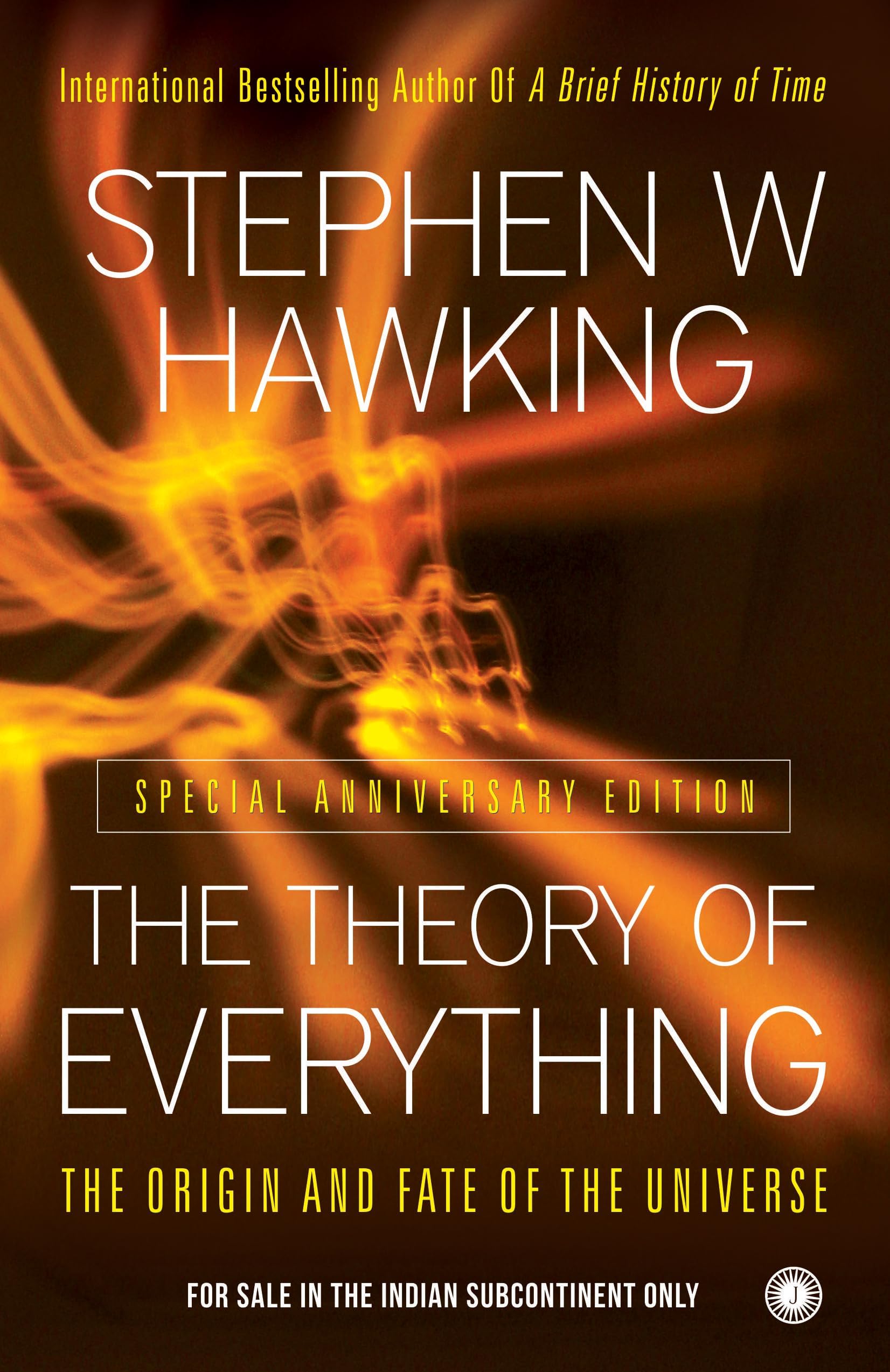
The Theory of Everything: The Origin and Fate of the Universe
Product ID: 69318680
In this series of lectures Stephen W.Hawking tries to give an outline of what we think is the history of the universe from the big bang to black holes.The first lecture briefly reviews past ideas about universe and how we got to our present picture.One might call this the history of the universe. The second lecture describes how both Newton s and Einstein s theories of gravity led to the conclusion that the universe could not be static:it had to be either expanding or contracting.This,in turn,implied that there must have been a time between ten and twenty billion years ago when the density of the universe was infinite.This is called the big bang.It would have been the beginning of the universe. The third lecture talks about the black holes.these are formed when a massive star or an even larger body collapses in on itself under it s own gravitational pull.According to Einstein s general theory of relativity,any one foolish enough to fall into a black hole will be lost forever.they will not be able to come out of the black hole again.Instead,history,as far as they are concerned.will come to a sticky end at a singularity.However,general relativity is a classical theory that is,it does not take into account the uncertainity principle of quantum mechanics. The fourth lecture describes how quantum mechanics allows energy to leak out of black holes.Black holes are not as black as they are painted. The fifth lecture shall apply quantum mechanical ideas to the big bang and the origin of the universe.This leads to the idea that space-time may be finite in extent but without boundary or edge.It would be like the surface of the earth but with two more dimensions. The sixth lecture shows how this boundary proposal could explain why the past is so different from the future,even though the laws of physics are time symmetric. Finally,in the seventh lecture Stephen W.Hawking describes how we are trying to find a unified theory that will include quantum mechanics,gravity,and all oth ...Shrink Review: Whow. Look what is out there - A thoroughly interesting read of developments in space knowledge over the last 50 years. Easy to read with detail explained in simply. Facinating Review: Just the fate of the universe - "One evening in November ... I started to think about black holes as I was getting into bed." (P 75) As one does. He points out that, with his disability, getting into bed takes a long time. This is typical of the way Hawking mixes biographical details and scientific, astro-physical thinking of the rarest kind in this little book, but "little" only in the physical sense as it opens the mind to the vastness of the universe. The notion of the widely-accepted expanding universe led him to consider (with Roger Penrose) the reversing of time and to what it would lead, i.e. a big-bang, singularity. This was his work until 1970 and that November evening. Since then his pioneering thinking on black holes has provided some startlingly original ideas. The "theory of everything" is the physicists' Aladdin's Cave, Holy Grail or, in Hawking's case, tomorrow's desk job. Disappointing in some ways, i.e. its brevity and (for Hawking's followers) its repetition but it is worth the investment in time and, short as it is, that is not long.
| Best Sellers Rank | 669,396 in Books ( See Top 100 in Books ) 43 in Astronomy & Cosmology References 188 in Astronomy (Books) 240 in Popular Science Physics |
| Customer Reviews | 4.6 out of 5 stars 15,886 Reviews |
P**E
Whow. Look what is out there
A thoroughly interesting read of developments in space knowledge over the last 50 years. Easy to read with detail explained in simply. Facinating
R**R
Just the fate of the universe
"One evening in November ... I started to think about black holes as I was getting into bed." (P 75) As one does. He points out that, with his disability, getting into bed takes a long time. This is typical of the way Hawking mixes biographical details and scientific, astro-physical thinking of the rarest kind in this little book, but "little" only in the physical sense as it opens the mind to the vastness of the universe. The notion of the widely-accepted expanding universe led him to consider (with Roger Penrose) the reversing of time and to what it would lead, i.e. a big-bang, singularity. This was his work until 1970 and that November evening. Since then his pioneering thinking on black holes has provided some startlingly original ideas. The "theory of everything" is the physicists' Aladdin's Cave, Holy Grail or, in Hawking's case, tomorrow's desk job. Disappointing in some ways, i.e. its brevity and (for Hawking's followers) its repetition but it is worth the investment in time and, short as it is, that is not long.
M**E
Cosmology, stars, black holes and time travel
A good read if you want to understand the history of the universe within a short volume. Each chapter (lecture) starts off capturing your interest, but soon gets very deep in technical and scientific jargon that seem to repeat the same words and phrases for page after page. I ended up skipping about half of each lecture just to jump to the last page.
L**A
Stephen Hawking makes it easy to understand the physics behind his theories and how ...
An interesting read so far. Stephen Hawking makes it easy to understand the physics behind his theories and how the theories and science have developed over the hundreds of years. I am looking forward to the second half of the book which should be covering quantum mechanics etc..
A**S
very good
verry good
A**R
The theory of everything
Happy with this book interesting topic
K**T
A worthwhile read
Very interesting but very complex. Well written and diagrams are very helpful. One needs to have a good foundation in the understanding of science.
P**A
A Brief History of Time light version
This book is what I would call a light version of his "A Brief History of Time". Even took the book and started comparing the texts. The Theory of Everything is actually a watered Down version of "A Brief History of Time". If you want to know more about Hawking's writing, then get "A Brief History of Time" or the newer / updated version "A Briefer History of TIme". But what this book version actually do, which I like, is, it has a CD audiobook, where Hawking himself reads this book. Thumbs up for that.
P**M
A Trigger for the Curious Mind
The Theory of Everything feels like a quiet invitation into the mind of someone who spent a lifetime asking the biggest questions of the universe. It carries the weight of years of knowledge, yet the way Hawking explains things feels surprisingly gentle and approachable. Instead of satisfying your curiosity, this book multiplies it. The more you read, the stronger the urge to understand, question, and explore becomes. What I liked most is that this book doesn’t make you feel small for not knowing enough. If you’re someone who is curious about science but also slightly intimidated by it, this is a safe and beautiful place to begin. The fear slowly fades, and curiosity takes its place. For readers from a non-science background, a few sections may take re-reading, but that effort feels rewarding rather than exhausting. Talking about the physical quality of the book, it is up to the mark considering the price it is being sold at. The overall build feels decent and readable for regular use. This isn’t just a book about physics or the universe — it quietly reshapes the way you look at questions themselves. And once that shift happens, there’s no going back.
M**N
Book review
Bought it as a gift. Smaller in size than expected
M**R
I only rate the book as a physical product here!
First of all: The book is a great read, but my 1 star rating is aiming at the quality of the book, not at the content. When I got the book it was brand new and still shrink-wrapped. Nevertheless the cover just fell of as soon as I opened the book for the very first time. Next thing is, that there are plenty of missprints, sometimes there is even glue and dirt between some pages. Once I was done reading it, the book fell off completely and I decided to just dump it... IMO that's unacceptable for a 20€ book!
J**E
Great Stephen Hawking's essays on astronomy and cosmology.
I have always been fascinated with everything to do with astronomy, cosmology, quantum physics and anything to do with time and the universe. This is why when I saw this 176-page hardcover book (The theory of everything: The origin and fate of the universe by Stephen w. Hawking) I decided to purchase it. I had read his book “A brief history of time” many years ago but I had not read this book which was published back in 2002. This volume has seven lectures Stephen Hawking made over the years. They include “Ideas about the universe, the expanding universe, black holes, black holes ain’t so black, the origin and fate of the universe, the direction of time and the theory of everything.” I found this book to be very interesting and informative even though I have read his theories in other publication over the years. If you are curious about how this great scientist views some of the mysteries of the cosmos you should check out this book. Still a great read even though it was published more than twenty years ago. Rating: 5 Stars. Joseph J. Truncale (Author: The Samurai Soul: An old warrior’s poetic tribute to warriors).
A**Z
asombroso
Me encantó el libro, una obra de arte. sobre los materiales del libro tambien son buenos.
Trustpilot
3 weeks ago
2 months ago