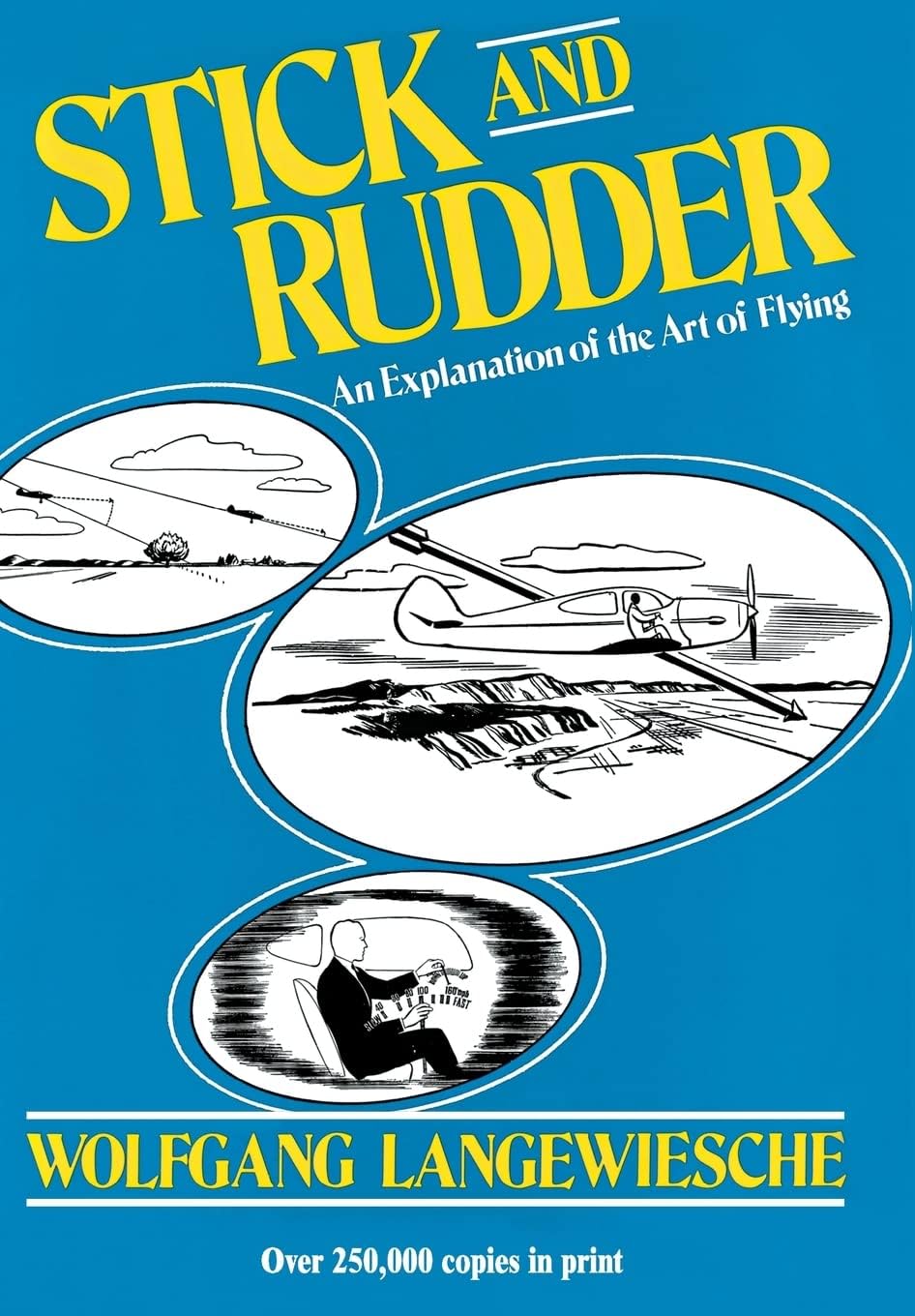
Stick and Rudder: An Explanation of the Art of Flying:
Product ID: 52059015
Buy anything from 5,000+ international stores. One checkout price. No surprise fees. Join 2M+ shoppers on Desertcart.
Desertcart purchases this item on your behalf and handles shipping, customs, and support to Congo.
Publisher's Note: Products purchased from Third Party sellers are not guaranteed by the publisher for quality, authenticity, or access to any online entitlements included with the product. WHAT'S IN STICK AND RUDDER: The invisible secret of all heavier-than-air flight: the Angle of Attack. What it is, and why it can't be seen. How lift is made, and what the pilot has to do with it. Why airplanes stall How do you know you're about to stall? The landing approach. How the pilot's eye functions in judging the approach. The visual clues by which an experienced pilot unconsciously judges: how you can quickly learn to use them. "The Spot that does not move." This is the first statement of this phenomenon. A foolproof method of making a landing approach across pole lines and trees. The elevator and the throttle. One controls the speed, the other controls climb and descent. Which is which? The paradox of the glide. By pointing the nose down less steeply, you descend more steeply. By pointing the nose down more steeply, you can glide further. What's the rudder for? The rudder does NOT turn the airplane the way a boat's rudder turns the boat. Then what does it do? How a turn is flown. The role of ailerons, rudder, and elevator in making a turn. The landing--how it's made. The visual clues that tell you where the ground is. The "tail-dragger" landing gear and what's tricky about it. This is probably the only analysis of tail-draggers now available to those who want to fly one. The tricycle landing gear and what's so good about it. A strong advocacy of the tricycle gear written at a time when almost all civil airplanes were taildraggers. Why the airplane doesn't feel the wind. Why the airplane usually flies a little sidewise. Plus: a chapter on Air Accidents by Leighton Collins, founder and editor of AIR FACTS. His analyses of aviation's safety problems have deeply influenced pilots and aeronautical engineers and have contributed to the benign characteristics of today's airplane. Stick and Rudder is the first exact analysis of the art of flying ever attempted. It has been continously in print for thirty-three years. It shows precisely what the pilot does when he flies, just how he does it, and why. Because the basics are largely unchanging, the book therefore is applicable to large airplanes and small, old airplanes and new, and is of interest not only to the learner but also to the accomplished pilot and to the instructor himself. When Stick and Rudder first came out, some of its contents were considered highly controversial. In recent years its formulations have become widely accepted. Pilots and flight instructors have found that the book works. Today several excellent manuals offer the pilot accurate and valuable technical information. But Stick and Rudder remains the leading think-book on the art of flying. One thorough reading of it is the equivalent of many hours of practice. Review: Everything I hoped it would be.... - I had been promising myself this book for a long time. One of those aviation classics you feel you should read but perhaps never get around to. Well this time I did get around to it when I saw it on desertcart for a sensible price, so many times it has come up at silly money I just couldn't entertain the idea of buying it but finally a sensibly priced copy appeared from a seller in the States and even with postage it was the chance to get the book I had promised myself. It is packed full of excellent information for the pilot, whether starting out or experienced. It is written in a style which explains the concepts being discussed in a very informative way without using jargon and thus paints the images in the minds eye with clarity. A book I would thoroughly recommend. Furthermore my copy arrived very quickly from America and so purchasing internationally was as easy as buying fro a UK supplier. Review: Great choice :) - My son loves it!


| Best Sellers Rank | 21,925 in Books ( See Top 100 in Books ) 3 in Air Sports 3 in Commercial Aviation 7 in Aviation History |
| Customer Reviews | 4.7 out of 5 stars 1,480 Reviews |
D**D
Everything I hoped it would be....
I had been promising myself this book for a long time. One of those aviation classics you feel you should read but perhaps never get around to. Well this time I did get around to it when I saw it on Amazon for a sensible price, so many times it has come up at silly money I just couldn't entertain the idea of buying it but finally a sensibly priced copy appeared from a seller in the States and even with postage it was the chance to get the book I had promised myself. It is packed full of excellent information for the pilot, whether starting out or experienced. It is written in a style which explains the concepts being discussed in a very informative way without using jargon and thus paints the images in the minds eye with clarity. A book I would thoroughly recommend. Furthermore my copy arrived very quickly from America and so purchasing internationally was as easy as buying fro a UK supplier.
K**.
Great choice :)
My son loves it!
S**A
really helpful
So much fun to read.
S**D
Every pilot should read this!
The trainng that every pilot goes through when they start to learn to fly teaches them how to fly... but this book teaches you the art of flying.. it teaches you to aviate! The language is quite antiquated as the book was written many years ago, so that can take some getting used to, but once you get past that, this book really does make things make sense! Thoroughly recommended for every pilot, budding or bloomed!
A**R
Very good graphics
This is written as ' an explanation of the art of flying ' I bought this for my husband who has spent the last 6 years building a VANS RV7 airplane and has a keen interest in flying - obviously as he also has his PPL. The book is well written and simply wants to instil a knowledge of the most important fundamental aspects of flying e.g. 'The wing keeps the airplane up by pushing the air down.' There are countless black pencil drawings explaining each point simply so is good if you are a visual learner. There are chapters on Wind drift;that thing called torque etc etc...
I**S
Brilliant reading, entertaining and highly informative.
Really loved this book, explains everything so well and is written in the 1940s style that is frequently amusing. Warning for some readers, you may not like the references to the pilot as ALWAYS male, and the only reference to women in this book are as wives or girlfriends.
J**.
Timeless
This is "thee" go to book for any aviation enthusiast and current or future pilot to get the very basics nailed in the art of aviation. All content in this book is as relevant today in the 21st century as it was when it was first penned. One of the must haves in any pilot's library.
K**R
Easy to read
Nice book, haven't finished it yet but even as a non-pilot I found it simple to understand. Judging by other pilot's comments on here this is a highly respected manual.
F**S
Un classico
Cosa dire di nuovo su questo libro? Un testo che, per quanto datato, continua a fornire delle informazioni che devono fare parte del bagaglio culturale di chi vuole capire COME vola un aereo e non solo quali comandi muovere per farlo volare in sicurezza. Se si sa perché succedono le cose a bordo di un velivolo, si può anche reagire meglio ai suoi comportamenti e alle situazioni difficili. Lettura istruttiva e piacevolissima.
F**Q
Great book
An interesting book that gives the lay man an in depth understanding of what flying really is..
M**G
Der Beweis, dass Didaktik keine Erfindung der letzten 20 Jahre ist
Ich habe mir das Buch geholt, weil ich noch ziemlich am Anfang der Flugausbildung stehe. M.E. ist das eine ideale Ergänzung zum Theoriekurs und den deutschen Theoriebüchern (kein Ersatz, will es auch gar nicht sein). Während sich die Theorie und auch die Theorieprüfung mit allen das reine Fliegen umgehenden Faktoren beschäftigen (Metereologie, Aerodynamik, Menschliches Leistungsvermögen, Navigation, Sprechfunk, Flugplanung u.a.), die alle unerlässlich und wichtig für den sicheren Flugbetrieb sind, aber eben eher das Gesamtbild vermitteln, konzentriert sich dieses Buch einzig und allein auf das praktische Fliegen an sich. Das Buch beschäftigt sich damit, wie man zu fliegen hat, warum man im Anflug die Höhe mit dem Gas und die Geschwindigkeit mit dem Höhenruder steuert (und nicht anders herum), warum man den Anstellwinkel immer beachten muss, wie man landet, und wie der Wind relativ zum Flugzeug zu verstehen ist. Also eine theoretische Anleitung zum praktischen fliegen, nicht mehr, und nicht weniger. Die essentiellen Basics werden dabei dauernd wiederholt, bis man sie verinnerlicht hat. Sprachlich trotz des hohen Alters gut verständlich und ohne moralischen Zeigefinger, hebt sich dadurch auch wohltuend ab von den manchmal arg verwissenschaftlichten deutschen Büchern, bei denen man dazu neigt, diverse Fachbegriffe einfach um ihrer selbst willen zu verwenden (ich sage nur feuchtadiabatischer Hebungsgradient). Erstaunlich auch, dass das Buch noch nicht veraltet ist, obwohl es schon fast 80 Jahre alt ist. An einigen Stellen merkt man das Alter zwar (so wird an einer Stelle an die Gewichtsabnahme eines Flugzeugs nach dem Abwerfen von Bomben erinnert, was der Zeit 1944 geschuldet ist), auch die Illustrationen sind etwas Retro, aber das hat keinerlei Auswirkungen auf die praktische Relevanz des Buchs. Englisch muss man allerdings schon können, wenn man das Buch liest. Es ist zwar bewusst einfach geschrieben, aber trotzdem nicht ganz einfach zu verstehen.
T**S
Re: A well known classic
A must-read for an aspiring pilot, Stick & Rudder gives a hands on 'how to' guide to flying light (and not so light) aircraft. A remarkably contemporary book given that it was written at the beginning of last century.
E**E
La biblia de la aviación
Es el libro básico para aprender a volar
Trustpilot
3 weeks ago
2 weeks ago