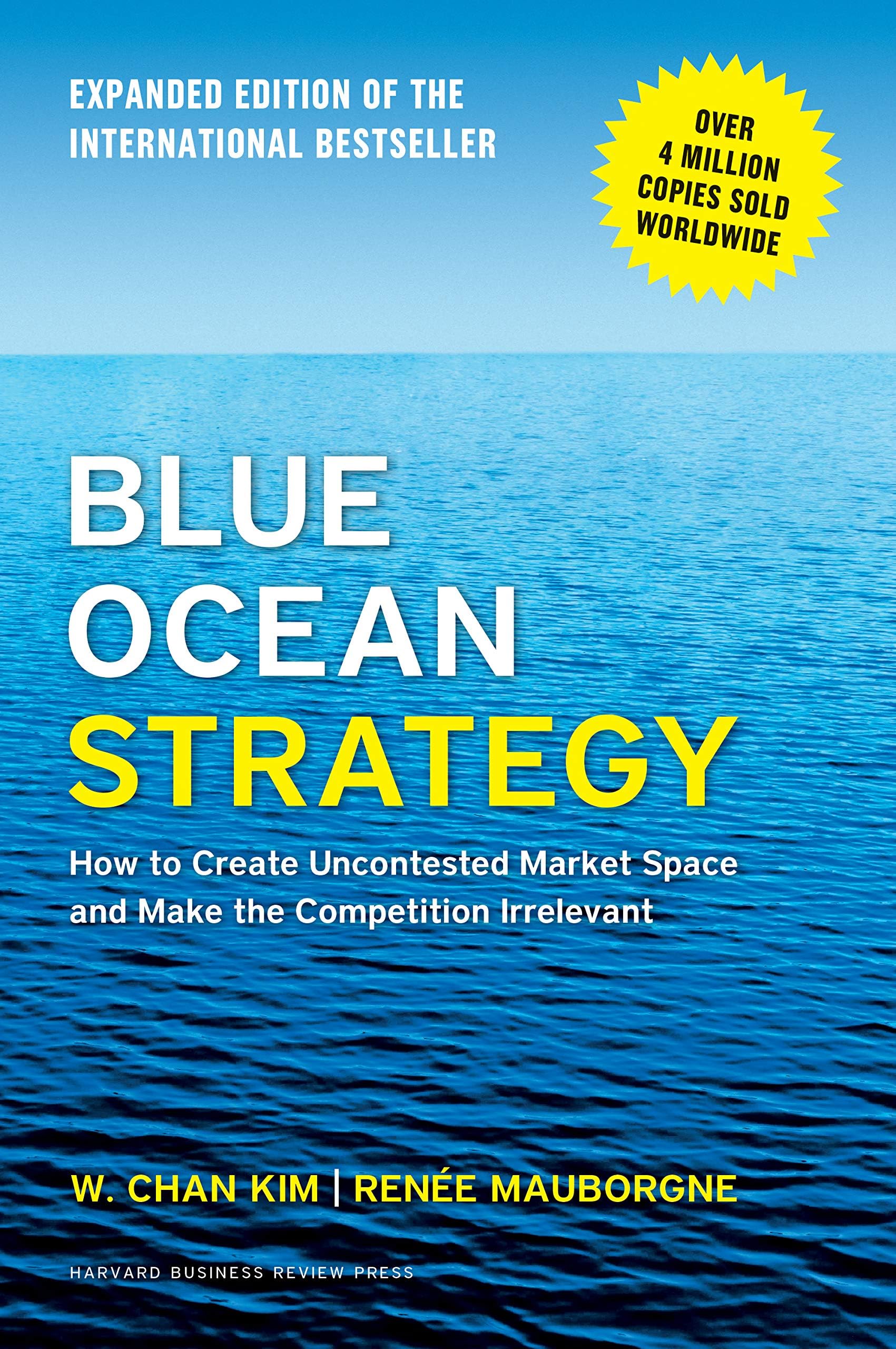
Blue Ocean Strategy, Expanded Edition: How to Create Uncontested Market Space and Make the Competition Irrelevant
Product ID: 52232693
Buy anything from 5,000+ international stores. One checkout price. No surprise fees. Join 2M+ shoppers on Desertcart.
Desertcart purchases this item on your behalf and handles shipping, customs, and support to Congo.
OVER 4 MILLION COPIES SOLD WALL STREET JOURNAL AND BUSINESSWEEK BESTSELLER RECOGNIZED AS ONE OF THE MOST ICONIC AND IMPACTFUL STRATEGY BOOKS EVER WRITTEN The global phenomenon that has sold over 4 million copies, is published in a record-breaking 49 languages and is a bestseller across five continents—now updated and expanded with new content. Named by Fast Company as one of the most influential leadership books in its Leadership Hall of Fame. A strategy classic. In this perennial bestseller, embraced by organizations and industries worldwide, globally preeminent management thinkers W. Chan Kim and Renée Mauborgne challenge everything you thought you knew about the requirements for strategic success. Recognized as one of the most iconic and impactful strategy books ever written, BLUE OCEAN STRATEGY , now updated with fresh content from the authors, argues that cutthroat competition results in nothing but a bloody red ocean of rivals fighting over a shrinking profit pool. Based on a study of 150 strategic moves (spanning more than 100 years across 30 industries), the authors argue that lasting success comes not from battling competitors but from creating "blue oceans"—untapped new market spaces ripe for growth. BLUE OCEAN STRATEGY presents a systematic approach to making the competition irrelevant and outlines principles and tools any organization can use to create and capture their own blue oceans. This expanded edition includes: A new preface by the authors: Help! My Ocean Is Turning Red Updates on all cases and examples in the book, bringing their stories up to the present time Two new chapters and an expanded third one—Alignment, Renewal, and Red Ocean Traps—that address the most pressing questions readers have asked over the past 10 years A landmark work that upends traditional thinking about strategy, this bestselling book charts a bold new path to winning the future. Consider this your guide to creating uncontested market space—and making the competition irrelevant. To learn more about the power of BLUE OCEAN STRATEGY , visit blueoceanstrategy.com. There you'll find all the resources you need—from ideas in practice and cases from government and private industry, to teaching materials, mobile apps, real-time updates, and tips and tools to help you make your blue ocean journey a success. Review: Great book - Great book to read! Review: Blue Ocean strategy: Decoding Creative Destruction! - Before I start ranting about this book, the reason I gave the first four stars is because it is well written, full of interesting examples, and, above all, thought-provoking book. If you are among those of us, who chose to implement someone else's dreams, this book will equip you with most of the reasons with which you should get your employer to understand why it is imperative to grow out of the current competition and start new Blue Ocean. In this case, if you were working with companies like KODAK, Xerox, Sony and many others that got drowned within the quagmire of Red Ocean, you may have already failed. Hence, this book will just help you to relive the reason the ship you were working with sunk. If you are among those of us, who chose to implement their own dream, then this book will equip you with the right strategy Canvas that will assist you to comprehend the current situation of what you want to do and then create your own strategy that will add value innovation to what is already there in a different form. You will understand why you do not have to fight raising-barriers to entry, when you can easily create your own camp outside the well defended Red Ocean Camp that you may have wanted to get into. Why, then, the fifth Star? The more you read this book with its additions, the more you think about two thought-provoking ideas: Point 1: the authors of this book will give you an interesting answer to Pro Micheal Porter's five Competitive Advantages and the interesting way of creating well defended castle of Red Ocean, where you have to think about how to raise the barrier to new entrants and the art of ensuring the switching cost keeps the customer within the highly contested bloody Red Ocean, while making costly for the competitors to even entertain the idea of getting your customers. The authors of this book will simply tell you that you do not need to break into a bloody Red Ocean; or think about defending an existing bloody Red Ocean. Instead, use the Blue Ocean strategy canvas to discover the best way to come up with a better alternative - though they will never mention the work alternative, nor will you hardly note the Creative Destruction mentioned - though you will here a lot about the Value Innovation! However, what you will like about their argument is that, instead of being product centred, think more about the customer. In other words, the customer should be the centre of interest rather than the actual castle that Porter thought us to defend with all we have! Good example of this will be their case about how Bloomberg did well, as they focused on the actual user, but not the procurement mangers, who hardly use the product! Point 2: where you may find so difficult to reason with this book is their lack of respect for what was once quipped as "Gale of Creative destruction" by Joseph Schumpeter. In their example, they used great examples such as the Horse-drawn carriage vs Ford's Model-T. In their world, Ford created Blue Ocean. However, in this endeavour, they overlook at the fact that the poor horse was taken out of the equation by the Internal Combustion Engine (ICE). Hence, an entire industry was turned upside. In this case, one may argue the interesting fact that their is a blurred line between Blue Ocean Strategy an the Gale of Creative Destruction. You may also be forgiven, if you assume that the former is simply decoding the latter. This thought-provoking argument may even become more interesting when one argues Schumpeter was talking about a revolutionary process that is incessant to the industry. In other words, the Gale of Creative Destruction is a process of industrial mutation that incessantly revolutionised the economic structure within, incessantly destroying the old one, incessantly creating new one (Wikipedia,https://en.wikipedia.org/wiki/Creative_destruct ); where the authors are basing their argument on something that may appear to be an external drive rather than within or internal drive within the existing transposition industry of that time. But Ford and the horsemen were both operating within the same industry and a part of the actual thing that takes a passenger from one place to another place was replaced with ICE. Remember, still the wheels, seats, driver and other parts are there. Hence, an internal mutation had taken place. There are many examples from the competition within the Wine industry to the carnage that took place within the computing industry that may appear to be based on the Gale of Creative Destruction cloaked within Blue Ocean strategy! As we are in for an interesting era, where computing algorithms are slowly overtaking most of the manually work that we do, the concept of Blue Ocean strategy/Gale of Creative Destruction will become part of our daily thinking. The authors of this book and their associated articles, which they had been writing, I think, have done one great deal of job for us: they decoded the art of Creative Destruction rather than creating a getaway through which cowards can scape from the quagmire of the bloody Red Ocean. Hence, they deserve the fifth Star.



| Best Sellers Rank | #6,826 in Books ( See Top 100 in Books ) #14 in Systems & Planning #74 in Business Management (Books) #130 in Leadership & Motivation |
| Customer Reviews | 4.6 out of 5 stars 6,356 Reviews |
A**R
Great book
Great book to read!
M**D
Blue Ocean strategy: Decoding Creative Destruction!
Before I start ranting about this book, the reason I gave the first four stars is because it is well written, full of interesting examples, and, above all, thought-provoking book. If you are among those of us, who chose to implement someone else's dreams, this book will equip you with most of the reasons with which you should get your employer to understand why it is imperative to grow out of the current competition and start new Blue Ocean. In this case, if you were working with companies like KODAK, Xerox, Sony and many others that got drowned within the quagmire of Red Ocean, you may have already failed. Hence, this book will just help you to relive the reason the ship you were working with sunk. If you are among those of us, who chose to implement their own dream, then this book will equip you with the right strategy Canvas that will assist you to comprehend the current situation of what you want to do and then create your own strategy that will add value innovation to what is already there in a different form. You will understand why you do not have to fight raising-barriers to entry, when you can easily create your own camp outside the well defended Red Ocean Camp that you may have wanted to get into. Why, then, the fifth Star? The more you read this book with its additions, the more you think about two thought-provoking ideas: Point 1: the authors of this book will give you an interesting answer to Pro Micheal Porter's five Competitive Advantages and the interesting way of creating well defended castle of Red Ocean, where you have to think about how to raise the barrier to new entrants and the art of ensuring the switching cost keeps the customer within the highly contested bloody Red Ocean, while making costly for the competitors to even entertain the idea of getting your customers. The authors of this book will simply tell you that you do not need to break into a bloody Red Ocean; or think about defending an existing bloody Red Ocean. Instead, use the Blue Ocean strategy canvas to discover the best way to come up with a better alternative - though they will never mention the work alternative, nor will you hardly note the Creative Destruction mentioned - though you will here a lot about the Value Innovation! However, what you will like about their argument is that, instead of being product centred, think more about the customer. In other words, the customer should be the centre of interest rather than the actual castle that Porter thought us to defend with all we have! Good example of this will be their case about how Bloomberg did well, as they focused on the actual user, but not the procurement mangers, who hardly use the product! Point 2: where you may find so difficult to reason with this book is their lack of respect for what was once quipped as "Gale of Creative destruction" by Joseph Schumpeter. In their example, they used great examples such as the Horse-drawn carriage vs Ford's Model-T. In their world, Ford created Blue Ocean. However, in this endeavour, they overlook at the fact that the poor horse was taken out of the equation by the Internal Combustion Engine (ICE). Hence, an entire industry was turned upside. In this case, one may argue the interesting fact that their is a blurred line between Blue Ocean Strategy an the Gale of Creative Destruction. You may also be forgiven, if you assume that the former is simply decoding the latter. This thought-provoking argument may even become more interesting when one argues Schumpeter was talking about a revolutionary process that is incessant to the industry. In other words, the Gale of Creative Destruction is a process of industrial mutation that incessantly revolutionised the economic structure within, incessantly destroying the old one, incessantly creating new one (Wikipedia,https://en.wikipedia.org/wiki/Creative_destruct ); where the authors are basing their argument on something that may appear to be an external drive rather than within or internal drive within the existing transposition industry of that time. But Ford and the horsemen were both operating within the same industry and a part of the actual thing that takes a passenger from one place to another place was replaced with ICE. Remember, still the wheels, seats, driver and other parts are there. Hence, an internal mutation had taken place. There are many examples from the competition within the Wine industry to the carnage that took place within the computing industry that may appear to be based on the Gale of Creative Destruction cloaked within Blue Ocean strategy! As we are in for an interesting era, where computing algorithms are slowly overtaking most of the manually work that we do, the concept of Blue Ocean strategy/Gale of Creative Destruction will become part of our daily thinking. The authors of this book and their associated articles, which they had been writing, I think, have done one great deal of job for us: they decoded the art of Creative Destruction rather than creating a getaway through which cowards can scape from the quagmire of the bloody Red Ocean. Hence, they deserve the fifth Star.
A**R
A solid book on strategy
Well considered and expertly crafted, this book is digestible and practical. I did find it a bit slow to warm up and it had a long tail that I abandoned, but the core centrepiece was highly insightful and full of useful tactics that can be deployed straight from the pages into your business.
A**N
Nice and Quick, instant delivery good quality.
Nice and Quick, instant delivery good quality.
N**M
A Challenging Perspective of Strategy
For me Blue Ocean Strategy provided a challenging perspective of strategy, albeit one that I embraced quite readily. The colour metaphor that characterised this perspective of strategy, was what attracted my interest and drew me to this book in the first place. And I was not disappointed. It was different from anything I had read and have been taught about strategy before. And it made sense in hindsight, seeing why companies like Dell, despite being small was able to compete, sorry not compete, but survive and thrive in the same product market as the mighty IBM without necessarily being in the same market space, if you get the pun. The premise on which the Blue Ocean Strategy thesis is built, is a simple one. Create a new market space through innovating on the value you give to the customer. This, the authors refer to as the cornerstone of the Blue Ocean Strategy. I must confess that value innovation on a first read sounds counter intuitive to the twin principles of either competing on being different and expensive (differentiation), or being like everyone else and selling cheaper (cost leadership). But once you get your head around it as they say in England, then it is quite straight forward following the formulation principles outlined so beautifully in the book. The first principle of reconstructing market boundaries can sound very daunting to a new comer to the field of strategy, since in standard red ocean strategy arena, market boundaries come as given. And yet it is the very act of thinking about reconstructing the existing market boundaries that gives birth to thoughts and strategies for creating your value innovation. It is this reconstruction that allows you to focus on the big picture, instead of the numbers, which is the next formulation principle in your Blue Ocean Strategy toolkit. The next two principles ; reaching beyond existing demand and getting the strategic sequence right are just plasters that hold your reconstructed market boundaries and value innovation together. So also are the four action framework of eliminate, reduce, raise and create industry factors in order to create this new value for your customer. In addition, the authors provide three characteristics of a good strategy to guide your journey. You are advised to ensure that your value curve has a focus, it diverges from other industry players, and finally, that you need a compelling tagline. Creating strategies could not be simpler. If only someone had told me this when I first started out trying to do strategies. There are plenty of examples of companies that have wittingly or unwittingly created strategies that the authors have identified as Blue Ocean and provided a theoretical underpinning for them and most importantly demonstrated that it possible to systematically recreate them or indeed create new ones. So, go ahead jump into the blue ocean and start creating some Blue Ocean Strategies. The world of crafting strategies as Henry Mintzberg prefers to put it can never be the same again.
L**S
Good knowledge in this book
I found this to be an amazing read. it's a good book to help you to drive innovation or to be different and the perspectives it gives you is an eye opener. Lots of value to be gained from this book, great stories and examples that you can take on and implement. It has a lot of great insight here, great book to read regardless. Hope you found my review helpful.
P**E
One of the Most Important Works on Innovation
This is a highly influential and important book in the field of innovation and business strategy. Most markets are crowded with me-too companies fighting each other with cut-throat discounts and special offers. Kim and Mauborgne show how you can move out of this bloody 'red ocean' into a different and more profitable 'blue ocean.' I found the most useful part of the book was the description of company 'value curves' which compare the values that you offer in different aspects of your product or service with those of your competitors. It is an invaluable starting point in searching for ways to gain competitive advantage through innovation. There are some good case studies and examples. The later parts of the book on implementing the strategy are a little weaker but overall it is highly recommended.
F**I
Overall Recommended
The concept of Blue Ocean strategy is absolutely ace. This is a must-read for every entrepreneur. I love the various business cases discussed in the book. It is written with quite an academic style, so does require some concentration to understand. Overall recommended!
V**I
Blue Ocean Strategy - A ripple effect
Blue Ocean strategy “Blue Ocean Strategy” by W. Chan Kim and Renee Mauborgne is definitely a good read for imminent strategists. What is Blue Ocean's strategy? – It is all about - a) Creating uncontested market space. b) Making competition irrelevant c) Creating and capturing new demand d) Breaking the value–cost trade-off e) Aligning the entire system in pursuit of differentiation and lost cost. It turns on the head the erstwhile principle that states high pricing and high cost only create value The four-legged principle of a Blue Ocean strategy is eye-opening: 1. Eliminate 2. Reduce 3. Raise 4. Create All the principles need to work together for the new path-breaking strategy to be implemented. The sequence of the Blue Ocean strategy revolves around the below four steps: 1. Buyer utility 2. Strategic pricing 3. Target costing 4. Adoption hurdles It is good to wrap your head around the contents, it will certainly give a ripple effect.
A**R
Ubiquitous
This book is an absolute must-have for anyone in a startup or really small or medium sized business. There is nothing that disturbs me more than people who struggle in business with their fingers in their ears swimming in a red ocean. In Canada we have a lot of monkey-see-monkey-do businesses that rely on continuous rounds of big government money and meandering from one tech bubbles to the next to survive and it drives me nuts. This book is the solution.
N**I
Great
Great Book for Bussiness
C**N
Excelente libro
Excelente libro para mejorar las ventas Crea una nueva visión de cómo vender en estos tiempos modernos. No solo se enfoca en lo convencional, también le da importancia al trabajo interno en la empresa
I**E
Blue Ocean Strategy
Ottimo libro con buoni spunti. un MUST da leggere.
Trustpilot
2 weeks ago
1 week ago