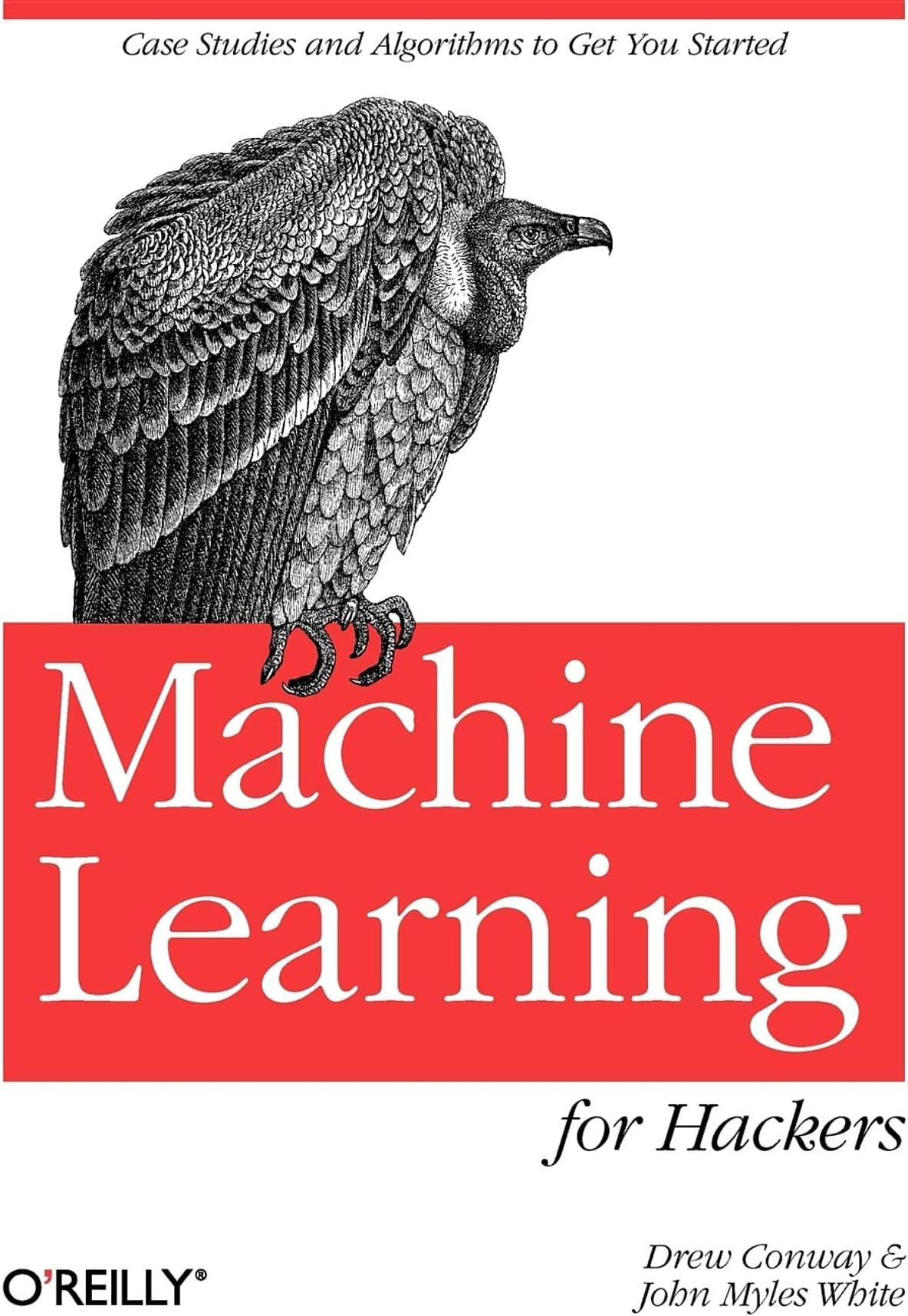
Machine Learning for Hackers: Case Studies and Algorithms to Get You Started
Product ID: 5754950
Buy anything from 5,000+ international stores. One checkout price. No surprise fees. Join 2M+ shoppers on Desertcart.
Desertcart purchases this item on your behalf and handles shipping, customs, and support to Congo.
If you’re an experienced programmer interested in crunching data, this book will get you started with machine learning―a toolkit of algorithms that enables computers to train themselves to automate useful tasks. Authors Drew Conway and John Myles White help you understand machine learning and statistics tools through a series of hands-on case studies, instead of a traditional math-heavy presentation. Each chapter focuses on a specific problem in machine learning, such as classification, prediction, optimization, and recommendation. Using the R programming language, you’ll learn how to analyze sample datasets and write simple machine learning algorithms. Machine Learning for Hackers is ideal for programmers from any background, including business, government, and academic research. Develop a naïve Bayesian classifier to determine if an email is spam, based only on its text Use linear regression to predict the number of page views for the top 1,000 websites Learn optimization techniques by attempting to break a simple letter cipher Compare and contrast U.S. Senators statistically, based on their voting records Build a “whom to follow” recommendation system from Twitter data Review: An interesting and easy read - I enjoyed reading this book. Pro's: The text is parsimonious. The examples are interesting. The coding is clever. The book is less expensive and easier to understand than most Springer texts. Con's: A substantial part of the code is peripheral tasks; this can be skipped. Some of the code is out of date. These Con's are trivial. The book is great. I would buy any other books written by these authors. Review: Ok introduction to R but with bad code - This book is more of an introduction to R then anything to do with Machine Learning.. as a R introduction it's not bad minus the horibad sample code ... which won't even work if you copy and paste it, my advice find a different book there any many, many more accurate and detailed books on R and machine learning





| Best Sellers Rank | #3,245,934 in Books ( See Top 100 in Books ) #482 in Machine Theory (Books) #1,087 in Natural Language Processing (Books) #7,787 in Internet & Social Media |
| Customer Reviews | 3.6 out of 5 stars 63 Reviews |
W**N
An interesting and easy read
I enjoyed reading this book. Pro's: The text is parsimonious. The examples are interesting. The coding is clever. The book is less expensive and easier to understand than most Springer texts. Con's: A substantial part of the code is peripheral tasks; this can be skipped. Some of the code is out of date. These Con's are trivial. The book is great. I would buy any other books written by these authors.
A**Y
Ok introduction to R but with bad code
This book is more of an introduction to R then anything to do with Machine Learning.. as a R introduction it's not bad minus the horibad sample code ... which won't even work if you copy and paste it, my advice find a different book there any many, many more accurate and detailed books on R and machine learning
C**S
Learned something new
I learned a little about the R language and how a lot of scientist of physicist use it the write functions to dynamically create graphs to analyze the data they compiled. It also encompasses a lot of the same math you learn in statistics classes which makes sense. I even ended up downloading an R language reference app from the Apple app store to have an object reference of the language.
V**R
Machine Learning for Non-Hackers
By page count, this is primarily a book on R, with some additional time spent on machine learning. There is way too much time spent on R, dedicated to such things as parsing email messages, and spidering webpages, etc. These are things that no-one with other tools available would do in R. And it's not that it's easier to do it in R, it's actually harder than using an appropriate library, like JavaMail. And yet, while much time is spent in details, like regexes to extract dates (ick!), more interesting R functions are given short shrift. There's some good material in here, but it's buried under the weight of doing everything in R. If you are a non-programmer, and want to use only one hammer for everything, then R is not a bad choice. But it's not a good choice for developers that are already comfortable with a wider variety of tools. I'd recommend Programming Collective Intelligence by Segaran, if you would describe yourself as a "Hacker".
R**E
Excellent and immediately practical, if you already know some R
I started my journey in the machine learning / data mining field thanks to curiosity generated by Toby Segaran's classic Programming Collective Intelligence: Building Smart Web 2.0 Applications . The book by Drew Conway and John White continues in the same excellent tradition. It presents case studies which are interesting enough that you can appreciate them without too much domain knowledge and without getting too deep into technical nitty-gritty. At the same time, the case studies are meaty enough that you can adapt them to real life problems and hack together a quick working prototype in your practice. By many estimates (and my own experience), 80% of time in machine learning is spent in data cleaning and exploratory data analysis. This book has very good coverage of both areas. Authors use Hadley Wickham's excellent packages viz. ggplot2, plyr and reshape2. If you are doing serious exploratory data analysis in R, these packages are a must and the book does a great job in showing them in action. The reason I suffixed the review with 'if you know a little R' is that data cleansing requires one to be fairly comfortable with somewhat arcane R syntax. If you don't know any R at all, it would be helpful to get a more gentle introduction - such as R Cookbook (O'Reilly Cookbooks) - before you tackle this book. In summary, this is an excellent 2nd book on R to have as you try to deploy machine learning in real life. BTW, if you are looking for 3rd R book, my vote is Data Mining with R: Learning with Case Studies (Chapman & Hall/CRC Data Mining and Knowledge Discovery Series)
S**8
Buy this book
Buy this book. I got one for free via the O'Reilly review program, but I'll probably buy a paper copy, just so that I can mark it up and loan it out to others. This book is everything it is advertised to be. It has enough of a statistics refresher to to bring the average hacker up to speed, and then it dives right in, using R as the language of choice to cover several common machine learning tasks. It's not a gentle introduction to R, but code samples are carefully explained (be prepared to look at R's documentation if you aren't familiar with R, though). The book doesn't teach R programming, but it does cover several useful libraries for machine learning (including mining textual data). The authors give good presentation advice, though (e.g., they point out that a little extra time given to the presentation can make the difference between an amateurish presentation versus a professional one, and they show the difference). Two items deserve special note: first, while the book was in press, the API used to generate the data for the chapter on analyzing social graphs was removed, and the authors had to make a decision to either go with the existing data, or wait and see what new APIs were made available. The authors chose to provide their sample data and go with their example rather than wait. That was a great choice, as developers have to deal with the real world, where vendors remove and change APIs. I was impressed at how they handled that issue. The second item is not-so-great: the section on the Support Vector Machine was too cursory. It read like an editor or reviewer had said "hey, you should mention SVM," and so the authors added a section. But that material was not given the same level of treatment as other contents, and, as a result, the book stops on a somewhat off note. A better choice would have been to simply skip that chapter completely. Overall, though, this is a great book. It's hands-on, filled with useful and interesting examples and advice, and it will get you moving towards solving your own machine learning problems. [Disclaimer: I got this book for free as part of the Oreilly blogger review program I was not required to write a positive review. The opinions I have expressed are my own. I am disclosing this in accordance with the Federal Trade Commission's 16 CFR, Part 255 : "Guides Concerning the Use of Endorsements and Testimonials in Advertising."]
B**R
Glad to see I'm not the only one...
... who found this book difficult to work through. I was really looking forward to working through this book as a way to get hands-on experience with some machine learning examples and learn R as well. Unfortunately, I ran into issues that others mentioned regarding the heavy focus on data manipulation in R rather than machine learning. I happened to buy an R book along with this one as part of a 2 for 1 promotion, and it was a good thing I did. I'm now having to basically take a break from the MLFH book to read a few chapters of the R book so that I can follow along without having to break my concentration so much to figure out why my R code isn't working the way it's supposed to (Update: According to some of the other reviewers, the problem may be that the code in the book is simply buggy. Talk about a recipe for frustration!). Also, since the companion code is stored on Github, which I had not used before, I wasted a lot of time learning Github, especially when it came time to update my versions of the code with the author's updated versions. At the very least, the authors could have included a simple set of instructions on how to fork, pull, merge, etc. for this specific repository. Don't even get me started on the issues with Chapter 11. In my eagerness, I skipped from Chapter 3 to Chapter 11 because I wanted to learn about working with social network data. They might as well remove the chapter if they're not going to update it to reflect the changes (little warning boxes in the book are not sufficient). I tried to plow through it even though I couldn't run all of the examples due to the changes in the Google and Twitter data services, but so far have given up. I really can't recommend this book at all.
M**L
Short, concise and not scary at all.
As I consider myself a hacker rather than a coder I was delighted to find a title aimed for directly at me as "for Hackers". The topic of machine learning is both generally hot and personally interesting to me as I try to mangle recommendation approaches in the music domain and just finished with all worthwhile heuristics-based methods. I thought that this book could provide me with a good entry and could be a newer, more up-to-date approach than the classic Programming Collective Intelligence by Toby Segaran. Nonetheless I was a bit surprised to realize that the hackers' language should be R instead of Python - so this meant that the book would also serve me as an intro to R. As learning R is also on my long to-do list, I was hoping that I could kill two birds with one stone. The book has a solid structure, the first quarter is covering basic statistics showcasing the capabilities of R. Typical starter exercises of ML are well versed: Bayesian spam filtering, weighting schemes for ranking, regression, overfitting and optimization is explained and demonstrated with a down-to-earth and hands-on approach. The authors also touch some of the more complex topics: principal components analysis, multidimensional scaling and the k-nearest neighbours algorithm are introduced with real world data. I was really delighted to see a longer chapter dedicated to social graph analysis and I totally give kudos for the inclusion of Gephi, the powerful open source graph visualization and manipulation software that I also enjoy using more and more. The authors come from a social science background and although this book seems to be avoiding 'programming' or providing code that could be incorporated in a runtime environment, I believe the goal they set, to provide machine learning tools for tinkering, has been reached with great success. It's short, concise and not scary at all.
C**O
Esauriente
Un buon libro per chi si vuole avvicinare al Machine Learning, il taglio della spiegazione è americano quindi con esempi significativi.
W**G
book...
If I knew it's for hackers, I would not buy it For beginning ,I want buy a book for learning . But I can't return the item for this book,I think it's a good book at least
B**B
Titel ist vorsätzliche Täuschung
Kann ich nur dringend von abraten. Klare vorsätzliche Täuschung der Titel. Es wir einem nicht erklärt was Machine Learning ist, es wird nur R benutzt die Algorithmen zu berechnen oder zu visualisieren und es wird weder R noch maschinelles Lernen erklärt.
S**H
The book is real good but I wouldn't prefer it if you are new ...
The book is real good but I wouldn't prefer it if you are new to machine learning. You would find it to be real good if have basic knowledge of the subject
M**A
Temas acordes
Excelente libro
Trustpilot
1 month ago
2 days ago