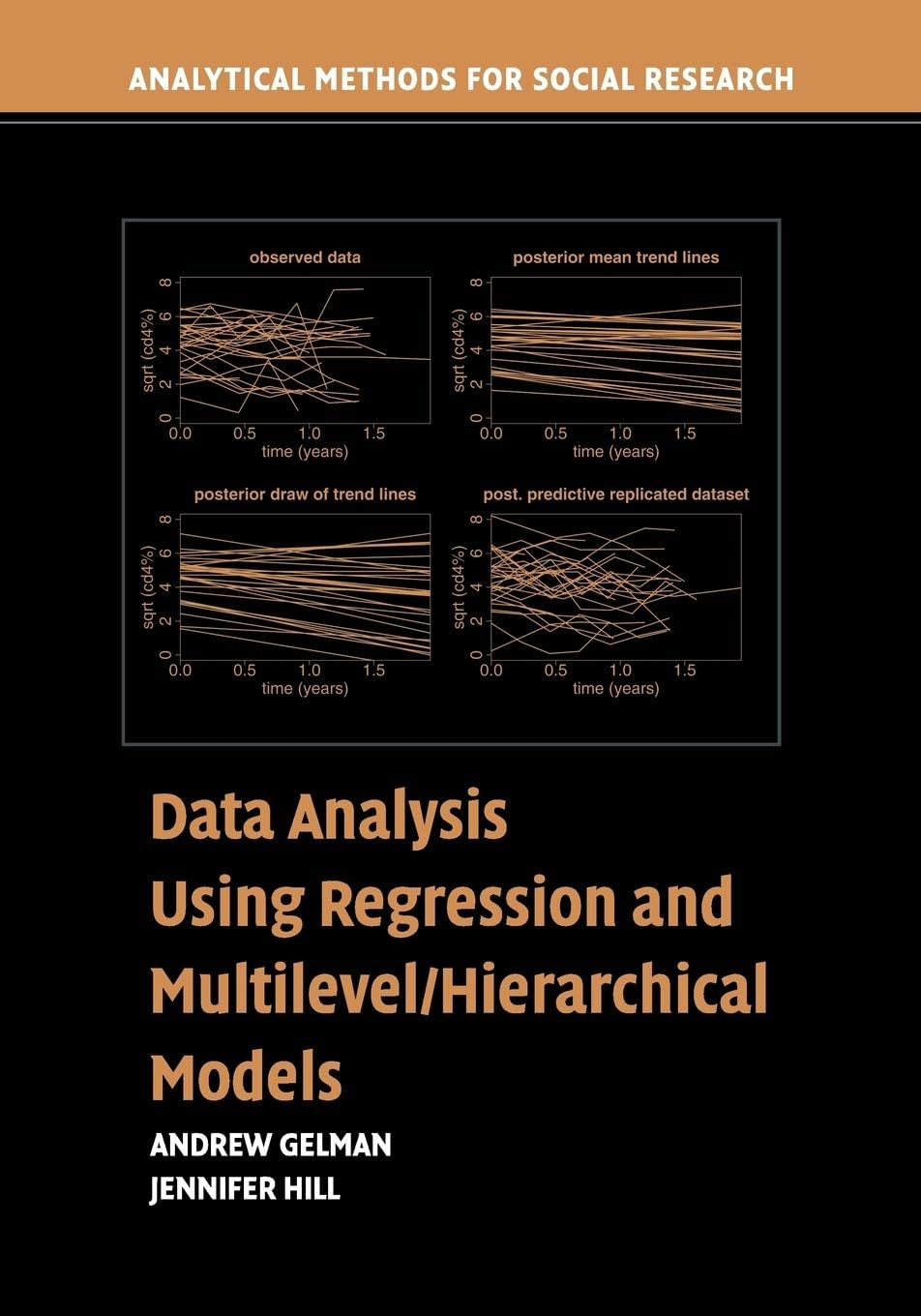
Data Analysis Using Regression and Multilevel/Hierarchical Models
Product ID: 5853984
💻Practical R & BUGS software integration
📊Comprehensive regression & multilevel models
📚Rich, diverse real-world examples
Buy anything from 5,000+ international stores. One checkout price. No surprise fees. Join 2M+ shoppers on Desertcart.
Desertcart purchases this item on your behalf and handles shipping, customs, and support to Congo.
📈 Unlock the power of data with clarity and confidence!
This used book offers a clear, practical guide to regression and multilevel modeling, blending rigorous theory with diverse examples and hands-on software tutorials. Ideal for social scientists and data professionals seeking to deepen their statistical toolkit with Bayesian insights and real-world applications.
| Best Sellers Rank | #830,944 in Books ( See Top 100 in Books ) #350 in Statistics (Books) #507 in Probability & Statistics (Books) #47,304 in Politics & Social Sciences (Books) |
| Customer Reviews | 4.4 out of 5 stars 173 Reviews |
P**A
If I were shipwrecked ...
If I were shipwrecked and had only one statistics book with me,* this would be the one. Why? 1. For most applied uses of multi-level (mixed effects) regression in the social sciences, this book is appropriately comprehensive. You will want for little. 2. The book is R oriented. Though R might not be sufficient for all your needs, it is necessary. R has become the coordination point. 3. The book deals with basic concepts in probability, simulation, inference, and causation. The focus is on understanding what you are doing, not simply applying standard recipes. That's important because you can't competently apply the tools you will learn from this book without understanding these basic concepts. There are no shortcuts. 4. Nevertheless, the book contains a bunch of recipes, which I found helpful, for example, when learning how to simulate in R. Also, the authors write using a compact coding style. I'm grateful to have learned some simplifying tricks. 5. The authors focus on graphical tests and visualizing data. That's how you ought to be exploring data and testing/interpreting your results. 6. The book is oriented to generalized linear mixed effects (multi-level) modelling. When you learned ordinary regression you learned a special case. If you haven't learned ordinary regression, start with GLMMs. 7. The book is oriented to Bayesian statistics. Whether you use Bayesian statistics is up to you, however you owe it to yourself not to make embarrassing objections. Gelman and Hill do a fine job of explaining the motivations. Downsides 1. The individual sentences of this book are clear, however I felt that some sections could have had fuller explanations. Perhaps I'm a slow learner, but I had to move even slower than usual in some places, not because there was a thicket of mathematical detail (there's refreshingly little extraneous maths) but because the explanations were brief. For example, the sections on simulating data took me a couple of reads. 2. Software development is moving fast, and this book is already a little stale. That said, it is far from outdated. All the tools still work, and *most* are the same you'd be using now. That said some very good new statistical and graphical packages are available now (such as MCMCglmm, ggplot2, Rstan, blme, and others) and many will want to be running and interpreting their models using these. Note Gelman is involved in developing the latter two, and a bunch of others. No matter. This book is all most applied researchers will ever need, and again, you need to know the conceptual underpinnings. The tools will always be changing. *.. and with me: my compute, power, the motivation to work, abundant coffee, a fine cafe to work in... & etc.
M**Y
Statistics in a box
I'm a social sciences PhD student and this is the book I keep going back to. There are a huge number of texts that you will find useful, but this one stands out for being particularly useful from cover to cover. A few of the advantages: - theoretically rigorous, but done by example and counter-example vs. mathematical proofs - tremendous number of examples with code and interpretation - didactic approach yet organized for quick reference - oriented toward practice vs. theory Some other things I like that others might not: Gelman is not a big fan of NHST inference and so he does not emphasize it. Nor does he stress jargony interpretation of tables of regression coefficients. Rather he emphasizes interpretation by simulation and counterfactuals. In that way he lays the groundwork for Bayesian analysis. Gelman is one of the developers of the R package lmer which estimates multilevel models. As such, it is the best reference for doing multilevel models in R. But realize that it is so much more. They spend the first half of the book reviewing single-level (?) regression and so the transition to multilevel is intuitive. You will understand it as an extension of what you already know. And (I keep saying this) you will find yourself going back to reference their coverage of regression when you have a question. The book is brilliant.
J**S
An excellent contribution but . . .
Pros: They tackle a complex topic from many different angles. They present enough code and theory to get people up and running with the techniques, assuming some prior familiarity with likelihood based inference and R. Otherwise you might need to dig through some of the references to understand everything. Regardless, this book is a valuable reference to keep in your library. They use matrix notation sparingly and this helps the reader focus on the important concepts of multilevel modeling. I am not even remotely a statistician so my attention would have been lost if I had to sort through a bunch of matrix transpositions and inversions in addition to all of the multilevel notation. The authors provide many useful references that help reinforce difficult ideas/concepts and that elaborate on topics that are not explored in depth. I had no prior experience using WinBUGS and the authors provided enough information for me to successfully execute some models that integrate R and WinBUGS. That is no small feat and the authors should be commended because somehow I understood what was going on. Cons: The organization of the book seems scattered and could be a little more consistent. On pp 245-246, the authors go on a diatribe about "fixed" and "random" effects terminology, claim that much of the literature that applies these terms does so inconsistently, disown these terms by saying they will avoid using them entirely, and then continue using these terms throughout the book. The website needs some work. You need to already know how to use R to open different types of files (and maybe some basics of variable assignment)in order to reproduce all of their examples. This book will not hold your hand through the steps like many R books.
J**Y
Clear, comprehensive, and practical.
All too frequently, statistics books are dense and difficult to understand. Gelman and Hill are wonderfully clear and helpful writers. This book makes hierarchical modeling and regression analysis very clear and they structure the book to facilitate the reader working through their examples and thinking about the decisions they make. This book is a pure pleasure to read and the diversity of the examples (from the geology of radon concentrations to patterns of voting) gives the reader a good introduction to the breadth of problems the ideas and techniques presented here can be applied to. The book covers both theoretical considerations and also practical matters of how to effectively use software tools (R and BUGS, although the material is easily adapted to JAGS and the new STAN tool).
N**B
I know why everyone said to buy this book
I do a lot of multi-level modeling but am new to R. Everyone said to buy this book. I looked through it. Often I buy a stats book and glance through it but don’t really dig in. This one is PHENOMENAL. Great examples. Clear. Easy to follow. I can tell I’m going to be really using this deeply. I have already started scribbling in it.
A**R
So many errors in examples! Difficult to follow along
The good: If you want to delve into the theory behind multilevel and hierarchical models, this is a solid book, and less dense than other statistics book. I found the examples interesting, even though it was outside of my subject area. HOWEVER, as others have noted, this book is not a useful guide for programming these models in R (though it attempts to be). Following along the examples in R would be incredibly illustrative, if the code worked, but unfortunately the programming examples appear to not have been proofread or de-bugged. The book is rife with errors to this extent. Many of the sample datasets require data clean up--the authors don't even post the final datasets online! Workable example code is nowhere to be found. The examples at the end of each chapter are nice too, but no solutions anywhere! Thus, I find following along to this book really frustrating. I had considered using this in teaching, but there is not nearly enough support to do so--as it is, I find it a solid book for someone with a good grasp of statistics, and will only be useful when used in concert with supplementary reading (e.g. Statistical Rethinking by McElreath) In short, it is really hard to grasp the concepts without running the examples in R, but the book does not provide accurate code or data to do so.
L**V
It covers almost everything - great job!
This is an introductory text that covers a very wide range of statistical analysis methods - from exploratory analysis to causal inference to multi-level analysis. Some people probably thought it would have been impossible. Many codes are also included along with nice graphics. For <$50, that's also an unbelievable price (thanks to the publisher). So if you are looking for a reference that covers almost everything at an applied level, this is a great one. If you are looking for more detailed understanding of any topic, then there're many other texts. For example, for causal inference, I would recommend Morgan and Winship as a companion text to this one. But this one would give you a good intro.
K**U
Excellent resource for a social scientist
High quality text from the well respected Gelman and Hall. Topics range from probability, linear models, logit model, generalized linear models (eg. Poisson), multilevel linear, multilevel generalized linear, causal inference, and Bayesian. Each chapter covers these topics with a description of a social problem that the duo have encountered and analyzed. The dataset is described with enough detail for me to data wrangle my own data into a similar form. The assumptions to statistical equations are explicitly described and shown in their development in statistical equations. The third development is the R programming syntax that helps me apply their syntax to my own analysis. This section lacks descriptions of broader function options because it is an inappropriate place to talk about them. Other resources such as UCLA's statistical website, PennState statistical website, RBloggers, RDocumentation, etc will help in that regard. Lastly comes the analysis of the output. Both the correct graphical output and flawed ways of thinking about the problem are presented in order to demonstrate "What To Do" and "What Not To Do". I have not had a chance to use this as a learning text. Thus, I cannot comment on how well it teaches the concepts. It's been my go-to reference for programming a multilevel poisson model. Gelman and Hill do have section devoted to Causal Inference and Bayesian analysis. The WinBUGS model syntax is presented for the Bayesian modeling. I don't recall seeing a description of JAGS syntax, like that found in Kruschke's Doing Bayesian Data Analysis.
M**O
excelent book
This an excelent book for getting the concepts behind fitting "standard" and multilevel models without diving directly into equations. Perfect for biologists unfamiliar with math like me.
D**L
Great book!
Excellent book, covers all of the bases for mixed effect models, Bayesian modelling in Bugs and even general statistical concepts and pointers. Intermediate-advanced but in addition to being very thorough it's well written and not excessively technical.
M**M
excellent book
bought the book to refresh my regression analysis skills and was positively surprised. It offers more than a normal textbook would offer. I can only recommend it
J**Z
Comprehensible and very didactic
This book walks you through regression models one step at a time, starting from the very basics of classical regression, thus making it easy to follow. It presents a lot of examples that are accessible to public from any scholarly discipline, and offers tips and ready-to-use code for the statistical package R. The book focuses on methodological caveats to bear in mind in research design and result interpretation. Ideal for anybody who wants to study and model relationships between variables, whether causal or not.
T**L
Very good
Thorough and accessibly written.
Trustpilot
2 months ago
5 days ago