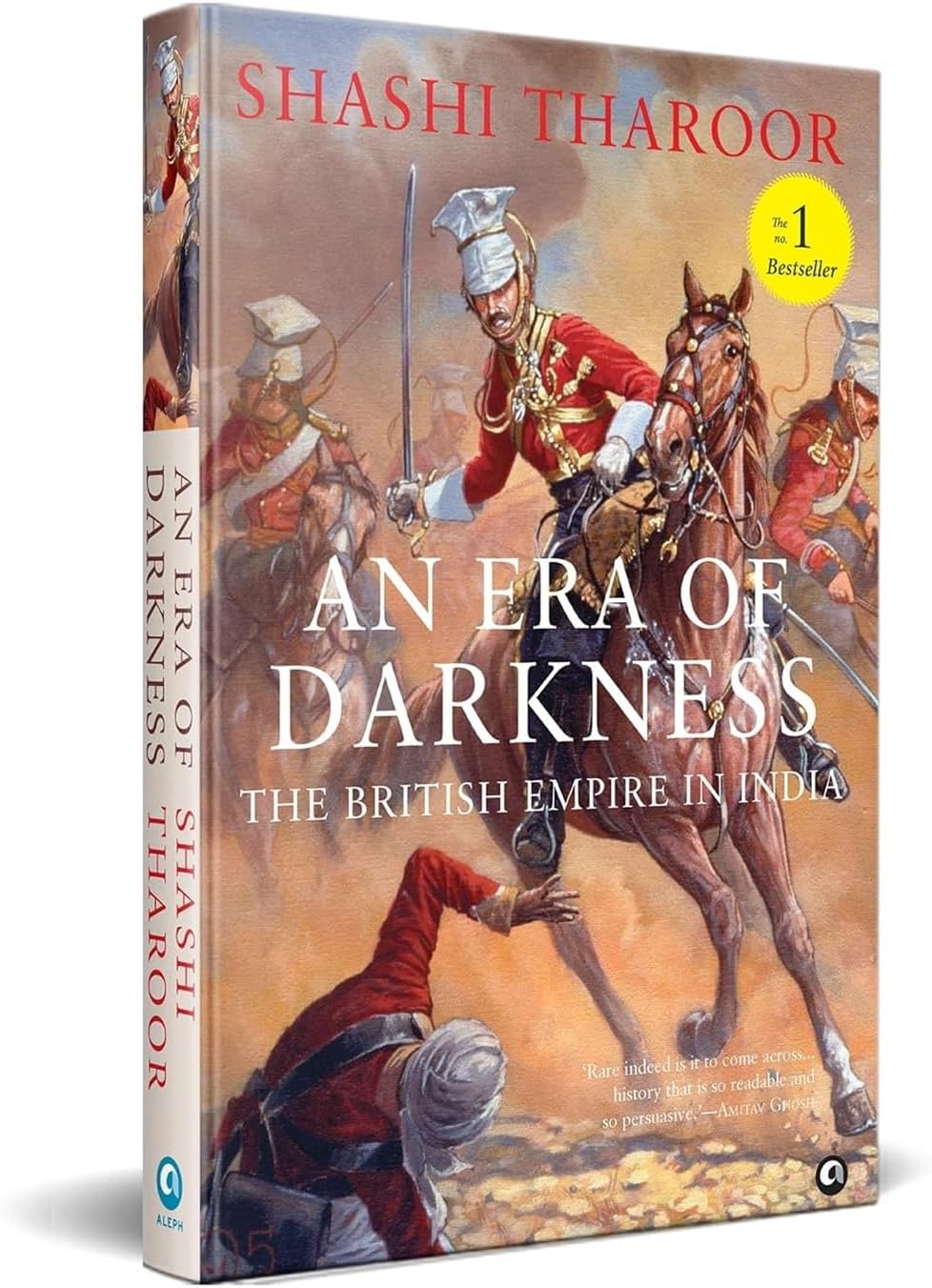
An Era of Darkness: The British Empire in India
Product ID: 64725014
🎤Viral Oxford Union debate origin
📈Top 15 bestseller in Colonialism & Imperialism
📚300+ meticulously sourced quotes
Buy anything from 5,000+ international stores. One checkout price. No surprise fees. Join 2M+ shoppers on Desertcart.
Desertcart purchases this item on your behalf and handles shipping, customs, and support to Congo.
📖 Illuminate the untold truths of empire — don’t miss the book that’s reshaping history!
An Era of Darkness by Shashi Tharoor is a rigorously researched, bestselling critique of British colonialism in India. Originating from Tharoor’s viral Oxford Union debate, this book uses over 300 sourced quotes to challenge the narrative of colonial 'gifts' like railways and governance, exposing the economic exploitation and social damage inflicted over two centuries. With a 4.5-star rating and top rankings in colonial history categories, it’s a must-read for anyone seeking a passionate, well-documented perspective on India’s colonial past.
| Best Sellers Rank | #6,425 in Books ( See Top 100 in Books ) #8 in Colonialism & Imperialism History #11 in Political Structure & Processes #42 in Indian History (Books) |
| Customer Reviews | 4.5 out of 5 stars 4,207 Reviews |
S**K
Shining light on an Era of Darkness
Shashi Tharoor whose brilliance enchanted over 3 million people on YouTube with his debating skills at an Oxford Union debate continues in the same vein in his new book "An era of darkness". Essentially the debate was about whether colonialism was good or bad. It may seem anachronistic and even cruel for the victims of Colonialism in Asia, Africa and Latin America that such thing can even be debated. But anything can be debated in public school debating clubs of UK ! In the English tradition all these schools prepare you for a legal or a parliamentary career where you could argue either way on any issue depending on the context. Many of our own parliamentarians are trained in the same tradition and argue brilliantly in Indian courts as well as in the Indian Parliament and we can see them hold forth brilliantly on the pro of a policy and equally brilliantly on the cons of it depending on whether they are in the treasury benches or in the opposition, inducing inevitable cynicism. However the sincerity of Tharoor in arguing that British colonialism did inestimable all sided harm to India shows through this tome where he marshals literally hundreds of facts (well organised quotes run into nearly 300). His passion for the subject comes through every page, his sardonic tone and twist of the English phrase even while cursing the power that imposed English language with "Tommy jackboots" hits the reader with a genuine force. Along with accolades from Indians in all walks of life, including PM, Narendra Modi, Tharoor got some feeble criticism as well after his short Oxford Union talk. That has prepared him for much more disdainful and patronising vitriol from apologists of British colonialism. All his arguments and quotes seem to be in preparation of that assault. He does not leave any leaf unturned in his endeavour including the Tea leaves of Assam, Bengal and Oooty. In fact the topics he chooses to argue include the whole gamut of issues which are normally quoted as "gifts" of two centuries of British rule over India: good governance, English sense of fairplay, Austinian judicial system, Railways, social reform of Hindu society, Cricket, Tea and even the English language. He tears them up one by one with profuse facts and anecdotal quotes from largely British and other Western sources. Some of the insights he provides are important for colonial studies. He points out that the public finance in pre-colonial India was based on taxing trade where as the British themselves being traders made a drastic change and made agriculture and land revenue the focus, (and even called their chief district level representative: Collector) thereby causing immense hardship to peasantry. He traces the creation of the landless peasant and the increased dependence of large segment of the population on agriculture for livelihood due to the destruction of artisans and manufacture and also large scale man made famines under colonialism. In these days when corruption, its roots and elimination often becomes a matter of public discussion he narrates its massive rise due to the practices of the East India Company and its officers. He makes an astute observation that despite historical animosities between England and Scotland a compact was established to include Scotland into the United Kingdom ( though initiated by a fudged parliamentary vote in 1707) by promising plum positions for Scots in colonial India. That explains the unusually large proportion of Scots in the administration and the army in India. Twisting the knife further he adds that perhaps the loss of this income from India into Scottish homes is leading to disenchantment and fueling separatism in Scotland ! His remarks on the creation of a decadent gentry of Rai Bahadurs and Diwan Bahadurs and even the more abhorrent profligate and promiscuous Princes replacing the older far more grounded aristocracy are insightful. Besides going into the financing of Indian Railways and how gold plating was done by many an English investor assured of guaranteed returns and how Railways during construction and later were used to drain the Indian economy and increase the national debt, Tharoor makes an important point that in the operational finances of Railways it was the third class passengers traveling in sub human conditions that subsidised freight and the first class ! His discussion of British communal divide and rule as well as re-imposition of caste inequalities through the Gentoo Code under Warren Hastings and in the post-1857 construction of colonial state are extremely important but often forgotten in the modern Indian discourse on communalism and casteism. It is an enjoyable read, passionately written smooth in flow while being richly cross referenced. The blemishes are few. Note worthy ones are his quoting Marx completely out of context to show purportedly that Marx supported British colonialism in India which is contrary to facts; and frequent comparisons of genocidal massacres under British with unsubstantiated figures of deaths caused supposedly by Stalin etc. Perhaps we can ascribe it to his anxiety towards taking a swipe at his leftist political rivals in his parliamentary constituency in Kerala. Other weakness of the "Era of Darkness" is total neglect of the role of Ghadar revolutionaries, Bhagat Singh and his comrades and even the war of Independence --the Great Ghadar of 1857, chronicled as the biggest war of 19th century world, and the colonial tactics of chicanery and brutality employed by British, while Tharoor does bring out such facets from the rest of colonial history. I would recommend every young Indian to read this book to get a perspective of our colonial past in the present day mesmerising euphoria of the global village in spite of Trump.
S**N
A simple line like “Nadir Shah stole it fair and square” does it
4.5 rating I can’t seem to recall the exact quote by John Oliver which went something along the line that most, if not all, international problems of the world today can be traced back to a the last 100 years with A few white men in a room with a map and drawing lines. Believe me I spent almost a day searching for it. Haven’t found it yet but I am sure it’s there. I digress. The reason for the publishing of this book is quite a well known fact. Shashi Tharoor (former diplomat, current politician and a Member of Parliament) made an impassioned speech at the Oxford University during a debate on British colonisation of India back in 2015. There, he highlighted the degradations of Indian society at the hands of the British, and their long-lasting after effects (hint: they’re not good). Once the video got online and took a viral life of its own, earning praise from most of the Indians, irrespective of their own political stance. People came forward to support him and asked him to write a book on the subject. This book is a detailed version of that talk. It starts with the comparison of Indian economy’s percentage in the world to that of British and other European nations. From there, it moves through the 200 year rule the British maintained in the subcontinent, first the company and then the Crown rule. The rule wasn’t benign or even mostly harmless (as some people choose to describe). It was out and out exploitation of resources, both human as well as material. All the ‘gifts’ the empire imparted to the subcontinent, including education, the English language, railways, parliamentary system of government, and even cricket, were incidental and not an objective. This can clearly be seen by comparing the statistics the country had right after the independence and the current numbers. Although the book covers quite extensively covers all the major events in the struggle, some points are misrepresented or simplified for the sake of the narrative (I’m not sure if it was intentional or just glossed over to fir the author’s political stance). For example, Jinnah’s retreat to London and his change of attitude towards secularism is attributed to Gandhi’s fame whereas it was a little more complex. Also, there seems to be no mention of backstabbing by INC (Indian National Congress) when they chose not to honour the agreement the party had with the Muslim League post election. Furthermore, it is mentioned that Tagore gave up his Knighthood and Gandhi his title Kaiser-i-Hind to protest the Jallianwalla Bagh Massacre, when the reality is that they gave up their titles because the British, instead of punishing the perpetrator General Dyer, chose to honour him. This little change in the reason of giving up the title and protesting help in understanding that they weren’t irrational in their protests, but gave a chance to the other party to accept their fault. On a side note, the release year of the movie Lagaan is erroneously mentioned as 2003 instead of 2001, but that’s just nitpicking. The book treads some slippery slopes and becomes quite self-aware when it comes to discuss the author’s own command over English language and his fondness for a sport the empire gave to the country, cricket. But somehow, it manages to not sound hypocritical and still be engaging and informative. Apart from all the seriousness of the book and the subject, it somehow manages to squeeze in a few moments where you would chuckle, or at the very least put a smile on the face. A simple line like “Nadir Shah stole it fair and square” does it. Also, when talking about a certain Mr. Nirad C Chaudhuri, the author choosing the most eloquent of words manages to say something on lines of “the ill-informed scholar had his nose up the colonial ass”. If I had my way, I’d recommend this as a compulsory read in all the schools of India, in whatever language possible. It not only gives an objective outlook of the 200 history during the British Empire, but also a subjective point of view to comprehend the scale. Although, that somehow becomes slightly biased however hard the author tries to maintain to not be so. However, the writing and the language are again top notch. Definitely worth a read
D**B
An amazing work by Dr. Tharoor
This book depicts the immense and deep knowledge of author on Pre Independence era. His exhaustive research and the way he garlands the points into a meaningful lecture, binds the reader to the very last page. However, there happens to be some incidents, where it would have been more useful to get some reference. For example the railway accident in 1861 between Connogor and Bally, or why Brits chose Darjeeling, Assam and Nilgiris for the tea plantation, etc. Inspite of that this book gives an insight into how Brits mere exploited this land for their own benefits and later manipulating us to believing they did a greater favour to us rather than being unconditionally apologetic. Its a shame that 80 percent of the current Brits still have a racial outlook towards Indians, and that they did a great job in uplifting the Indians, rather than oppressing them. Anyways, this book is extremely insightful and that must be read by every Indians across the globe.
A**A
COGENT ARGUMENTS AGAINST BRITISH EMPIRE IN INDIA
This book, as the author informs us in the Preface, began with a speech. A very famous speech, in fact - Dr Shashi Tharoor's Oxford Union debate of 2015, one of his most widely shared videos in recent years, in which he argues that Britain owes reparations to India. This book is a detailed presentation of the ideas and cogent arguments put forth by Dr Tharoor in the debate, including topics like the looting of India by the East India Company, the "divide and rule" policy and counter-arguments to those arguing in favour of the empire. The author digs up little-known facts to buttress his case, for example - "A rare Cambridge-educated Indian judge appointed on the bench of the Allahabad High Court in 1887, Justice Syed Mahmud, suffered daily discrimination and prejudice, especially from Chief Justice Sir John Edge, who Mahmud felt treated him like a conquered subject rather than a judicial equal. As a young man freshly returned from England enthusiastic about Empire, Mahmud had dreamt of a day when 'the English people are known to us more as friends and fellow subjects, than as rulers and foreign conquerers'. That was not to be... Mahmud... resigned in 1892, unable to reconcile his faith in British law with his exclusion from the high table at the institutions administering it, turned to drink and depression, and died a broken man at the age of just fifty-three." "The British left a society with 16% literacy, a life expectancy of 27, practically no domestic industry and over 90% living below what today we would call the poverty line. Today the literacy rate is up at 72%, average life expectancy is nearing the Biblical three score and ten, and 280 million people have been pulled out of poverty in the twenty first century." Much of the book is written with the author's characteristic wit, for instance - "And as for aid, British aid amounts to less than 0.02 per cent of India's GDP, and somewhat less than the Government of India spends on fertilizer subsidies - an appropriate metaphor, perhaps, for the aid argument." "This was all part of the policy of divide and rule: no one in any responsible position in Britain as late as 1940 had any serious intention whatsoever of relinquishing the Empire or surrendering the jewel in His Majesty's Crown to a rabble of nationalist Indians clad in homespun. But the devastation of World War II meant that only one half of the phrase could survive: bled, bombed and battered for six years, Britain could divide but it could no longer rule." On the whole, a great book and an important contribution to the growing literature about the British Raj. The only shortcoming I could find is poor proofreading, for example, "restrained" is mis-spelt as "retrained" on page 101. A more glaring example of the printer's devil is on page 126, which tells us that William Jones founded the Asiatic Society in Calcutta in 1797. In fact, Sir William Jones had died in 1794; but he had become the founder president of the Asiatic Society much earlier, in 1784.
L**.
Historical account
A must read by all.
T**L
Dark Colonisation History
Tharoor shows with acuity, impeccable research, and trademark wit just how disastrous British rule for India was. It examines the many ways in which colonizers exploited India, from draining national resources to British imperialism to destroying Indian textiles, steel, and shipping industries, as well as negatively transforming agriculture. His argument demolishes the claims that British rule provided democracy, political freedom, the rule of law, and railways for Western and Indian apologists of the Empire. The few unarguable benefits - English, tea, and cricket - were not introduced for the benefit of the colonized, but rather for the benefit of the colonizers. Brilliantly narrated and passionately argued, An Era of Darkness will serve to correct many misconceptions about one of the most contested periods of Indian history.
A**T
Nice read
The book is of good quality and worth the money. The photos and the actual product matches. Recommended!
R**I
TAKE IT WITH A PINCH OF SALT
Though I paid for a hard cover edition all I received a photocopied paperback. A very informative book though some of the author's assertions may be contended. Though INDIA existed as a concept but it was never unified apart from the conquests of the Mauryas, Guptas, Mughals. That was ephemeral & the map varied each time. This concept was just like Arab world or Europe & see none of them is unified so mere concept cannot be cited as reason that India is what it is now, but coming together for a common cause of obtaining freedom from colonial power is. Hence, it is undeniable that colonial occupation had the syncretic effect. Were anything known of the N-E, apart from some mention in epics. Nothing much was known. According, to author number of Englishmen never exceeded 0.05% of Indians still the former could take over the country & rule it for 200 years is a testimonial of the moral fabric of the people of the region in those times, let alone unity. Indians lagged far behind the technical sophistication in armaments which was big handicap also. In the second millennia India was rich but the advancements in learning was at an ebb. All the glories described of learning & institutions were of preceding millennia. So the colonialists did not change white to black. It will be oversimplification to mention that the two communities lived in perfect harmony in the eras of Jijiya & jingoism of the some muslim rulers. Otherwise a fantastic read, erudite & widely researched.
A**S
Viel gelernt
Sehr detailreich und gut belegt wird der britische Kolonialismus in seiner ganzen Scheinheiligkeit entlarvt.
J**I
An eye-opener
Coming from Pakistan, former India, this book hit particular chords in me. Shashi Tharoor writes brilliantly and has done his research well, he smashes the gods of clay on which the British built their mythology...that I grew up learning in my British History and Indian history lessons. I like to pencil in notes and mark passages of special note; this book is now replete with my annotations. He talks about the British policies of "divide et impera"...divide and rule, that created the massive chasms between Hindus and Muslims where they once lived in peace, cooperation and harmony, By infusing race hate in all newspapers that were then in their (exclusive) possession. Where once race and classes were almost indistinguishable, they created a classification system of religion, caste or tribe based in imprecise assumptions. He continues with how the British literally destroyed Indian industry (going so far as to chop off the thumbs of skilled fabric artisans who made better material than the British in Britain) so India could become a captive market for Britain with raw material brought in from India. The "Brown ceiling" where Indians were not permitted to positions above the bare minimal. How they looted and pillaged India without check, so much so that while in 1CE, Indian GDP was 33% of global GDP, by the time the British left, it was down to a paltry 4%. The ultimate marks of British averice are in his listing of over half a dozen famines caused by the British taking charge of what farmers were allowed to cultivate (Products needed in Britain). Last but not the least of which was the 1945 Famine where under Churchills direct orders, hundreds of thousand of tons of food grain was shipped off the hungry troops and to Britain. Tragically, the British BANNED organizations to bring in food supplies to the famine-struck areas, saying the people should be able to cultivate and earn their own living and in any case, they had bred too many people to be sustainable. There are so many tales of British fantasy that Tharoor shatters that the reader is left in a state of shock. The only smudge on this otherwise excellent work of scholarship is his deep bias against the partition-demanding Muslims and against Pakistan. I wish he could have omitted those few passages that actually did not add to the contribution of his book!
B**Z
The Rape and Murder of India
The Bristish Empire has killed more people than Hitler could ever hope to do. This book gives a glimpse into the evil that is the Bank of England, and The British Royal Family
A**I
Ottimo libro! Consigliato!
Libro letto e riletto almeno una dozzina di volte, offre una visione spesso trascurata dell’ era imperiale inglese. Consigliatissimo per tutti gli appassionati.
J**S
Acknowledgment, Not Vengeance: The Call for Recognition of Colonial Impact
We often say, "Whatever is done is done," but we cannot allow the suffering to be in vain. If we fail to understand how the legacy of colonization affects current global issues, we will be unable to resolve conflicts and build a better future together. Colonization has inflicted tremendous destruction on cultures and destabilized regional harmony. Its go-to method of "divide and rule" has created friction among races that were once good neighbors rather than enemies. We must ensure that the mistakes of the past are not replaced by neo-imperialism, which continues to torment developing countries even today. As Dr. Tharoor wisely stated, the world is not seeking vengeance against former colonizers; rather, it yearns for acknowledgment of the destruction, pain, and suffering they inflicted. Recognizing this history is vital for fostering reconciliation and understanding, allowing us to move forward together.
Trustpilot
2 weeks ago
2 weeks ago