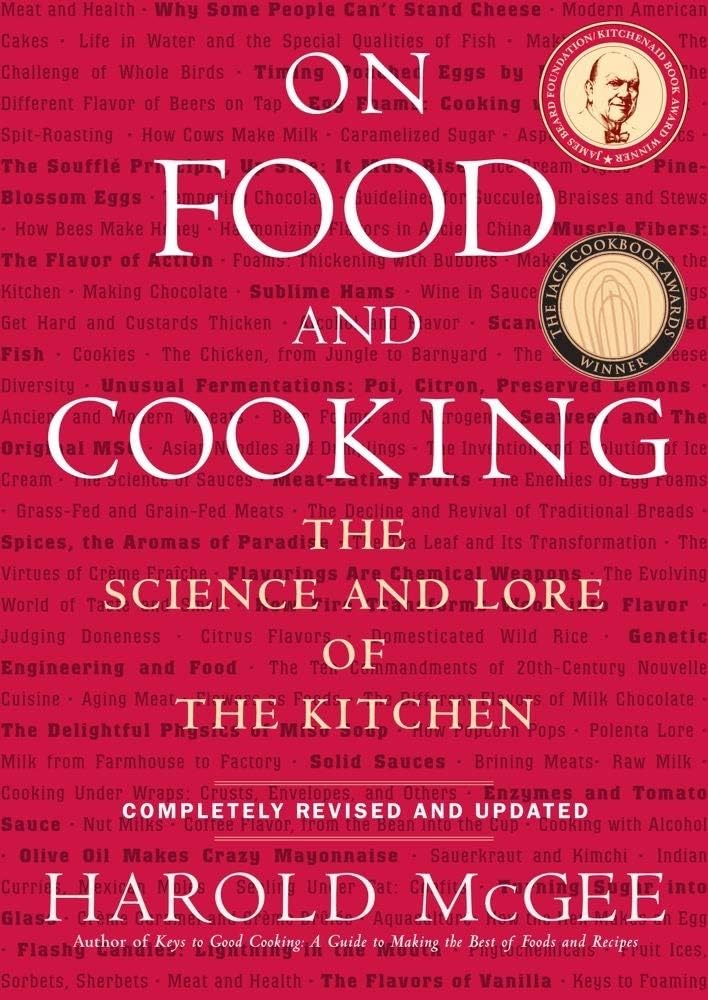
On Food and Cooking: The Science and Lore of the Kitchen
Product ID: 76172650
Buy anything from 5,000+ international stores. One checkout price. No surprise fees. Join 2M+ shoppers on Desertcart.
Desertcart purchases this item on your behalf and handles shipping, customs, and support to Congo.
A kitchen classic for nearly 35 years. Hailed by Time magazine as "a minor masterpiece" when it first appeared in 1984, On Food and Cooking is the bible to which food lovers and professional chefs worldwide turn for an understanding of where our foods come from, what exactly they're made of, and how cooking transforms them into something new and delicious.For its twentieth anniversary, Harold McGee prepared a new, fully revised and updated edition of On Food and Cooking. He has rewritten the text almost completely, expanded it by two-thirds, and commissioned more than 100 new illustrations. As compulsively readable and engaging as ever, the new On Food and Cooking provides countless eye-opening insights into food, its preparation, and its enjoyment. On Food and Cooking pioneered the translation of technical food science into cook-friendly kitchen science and helped birth the inventive culinary movement known as "molecular gastronomy." Though other books have been written about kitchen science, On Food and Cooking remains unmatched in the accuracy, clarity, and thoroughness of its explanations, and the intriguing way in which it blends science with the historical evolution of foods and cooking techniques. Among the major themes addressed throughout the new edition are: · Traditional and modern methods of food production and their influences on food quality · The great diversity of methods by which people in different places and times have prepared the same ingredients · Tips for selecting the best ingredients and preparing them successfully · The particular substances that give foods their flavors, and that give us pleasure · Our evolving knowledge of the health benefits and risks of foods On Food and Cooking is an invaluable and monumental compendium of basic information about ingredients, cooking methods, and the pleasures of eating. It will delight and fascinate anyone who has ever cooked, savored, or wondered about food. Review: Four Stars - Excellent book, my daughter loved it Review: Worst packaging for a book. Atleast respect books - Such a good informative bible and you guys have so disrespectfully packaged it atleast put it in a box. A box is pretty resonable for a 3k book the just plastic packaging is so careless do better. The oter covering was so damaged i removed it and kept it aside till i complete it so it doesn't damage further


| Best Sellers Rank | #77,143 in Books ( See Top 100 in Books ) #468 in Food, Drink & Entertaining (Books) #793 in Encyclopaedias & Reference Works (Books) #4,362 in Sciences, Technology & Medicine (Books) |
| Customer Reviews | 4.8 out of 5 stars 2,746 Reviews |
A**R
Four Stars
Excellent book, my daughter loved it
C**F
Worst packaging for a book. Atleast respect books
Such a good informative bible and you guys have so disrespectfully packaged it atleast put it in a box. A box is pretty resonable for a 3k book the just plastic packaging is so careless do better. The oter covering was so damaged i removed it and kept it aside till i complete it so it doesn't damage further
A**R
Four Stars
Good
A**R
Exactly what I wanted and hoped for
An amazing book. Exactly what I was looking for because it talks about why we do certain things to certain ingredients, in a technical but easy to access manner.
C**N
Nice
REally nice book, really interesting, good paper quality and came fast and in good conditions!
C**S
There is not a single book about cooking better than this
This is like the bible of Cooking. Every single thing you read will make you a better cook and will give you a push to research some things more.
B**D
Definitive Text on Food Science AND Lore. Buy It.
This red `On Food and Cooking, The Science and Lore of the Kitchen' by Harold McGee is a new edition of what is the most widely quoted culinary work in English. It may be almost as influential on the thinking of culinary professionals as Julia Child's `Mastering the Art of French Cooking' was on attitudes of American home cooking. The testimonials from the likes of Thomas Keller, Paula Wolfert, Jacques Pepin, and Rose Levy Beranbaum just begins to tell you how important McGee's volume has become. I was immensely pleased to see the exchange of acknowledgments between McGee and Keller to see how much the academic can learn from the professional chef. I can devote my thousand words on how good this book has been to the culinary world, but most of you already know that. What I will do is to list all the reasons one may wish to read this book. First, the book is simply interesting to amateur foodies and culinary professionals. This is the serendipity principle. If you prospect in a rich land, you will invariably find something of value. The `lore' in the subtitle is not an afterthought. The book includes history, linguistics and cooking practice in addition to simple science. In over 800 pages of densely packed narrative, one will invariably find something of interest, especially since the book covers such a broad range of topics, including: Milk and Dairy Eggs Meat Fish and Shellfish Fruits and Vegetables Seeds, Cereals, and Doughs Sauces Sugars and Chocolate Alcohol (Wine, Beer, and Distilled Spirits) Cooking Methods Cooking Utensil Materials `The Four Basic Food Molecules' Basic Chemistry This is the perfect book in which to jump around to those subjects that interest you. I just wish the author would have put the last two subjects first so that more readers would stumble across them to gain a better understanding of what appears in the chapters on specific foods. A quick example of how this would help in practical terms is that the characteristics of alcohol, which stand halfway between water and oils explains why vodka is such a great flavor enhancing addition to pasta sauces. Second, professional and amateur bakers should read all of the chapters on grains, doughs, chocolate, alcohol, basic molecules, and the chemistry primer, as this is the one area of culinary practice where knowledge of science can make the biggest difference between good and great results. Both Shirley Corriher and Alton Brown have books which include baking science and Rose Levy Beranbaum's books all cover practical baking science in depth, but McGee puts all of this is a broader context which, to use Alton Brown's great metaphor about science and cooking, gives a roadmap covering a much broader area, to a finer scale of detail. Third, all culinary professionals who have anything whatsoever to do with teaching should read this book from cover to cover, twice. There is absolutely nothing more annoying than having a person in the role of teacher make a patently false statement in their area of expertise. The number of times a Food Network culinary celeb misuses the term `dissolve' when they really mean `emulsify' or simply `mix' would fill volumes. It is still a common mistake to say that searing protein seals in juices. There are many good reasons for searing. Preventing the escape of liquid is not one of them. Even Brown himself has made some gaffs in print and on `Good Eats' such as when he described a very corrosive compound as a strong acid rather than a strong base. He confused one end of the pH scale with the other. Fourth, anyone who has ambitions to develop their own recipes should read those chapters which deal with the major foods such as dairy, meats, fish, fruits, and vegetables, with a premium on the material on milk and eggs. Two defining characteristics of science are that it explains things and it predicts things. Most people understand the first but may not appreciate the second. One can predict, for example, that if you use too little fat in a milk or cream based gratin, the dairy will curdle, so, if you are playing around with your favorite mac and cheese recipe, do not be so quick to reach for that skim milk, as you are likely to be very disappointed with the result. Similarly, if you crave some Saturday morning buttermilk biscuits and the nearest carton of buttermilk is a 30 minute drive away, AND, you have no vinegar, AND you have no citrus, there is just a chance that your aging cream of tartar dissolved in milk will save the day, since this is an acidic salt which will stand in for the acidity in the buttermilk. As a former professional chemist, I can assure you that pure inorganic salts like cream of tartar simply do not go bad. I would have loved to hear the exchanges between author McGee and Thomas Keller, as Keller is probably the contemporary epitome of how the culinary professional uses experimental techniques in cooking. The constant tasting which every cook does is nothing more than a practical application of the chemical technique of titration, where materials are combined slowly until the desired result is achieved. What separates good from great cooks is using this technique to test raw materials. This is the truest marriage of science and cooking, following the maxim of Daniel Boulud who stated that to be really great, the journeyman cook must repeat the same procedure thousands of times to the point where the result is utterly reproducible and the cook can detect the desired endpoint easily by eye, nose, and mouth. Sounds like science to me. The author's introduction presents an excellent case for rereading the book in its second edition as he cites the great changes in food culture over the last twenty years. This is also a great case for anyone who is interested in any aspect of food. A very important book indeed.
M**E
love it
Purchased for a friend who adores it!!
Trustpilot
2 weeks ago
5 days ago