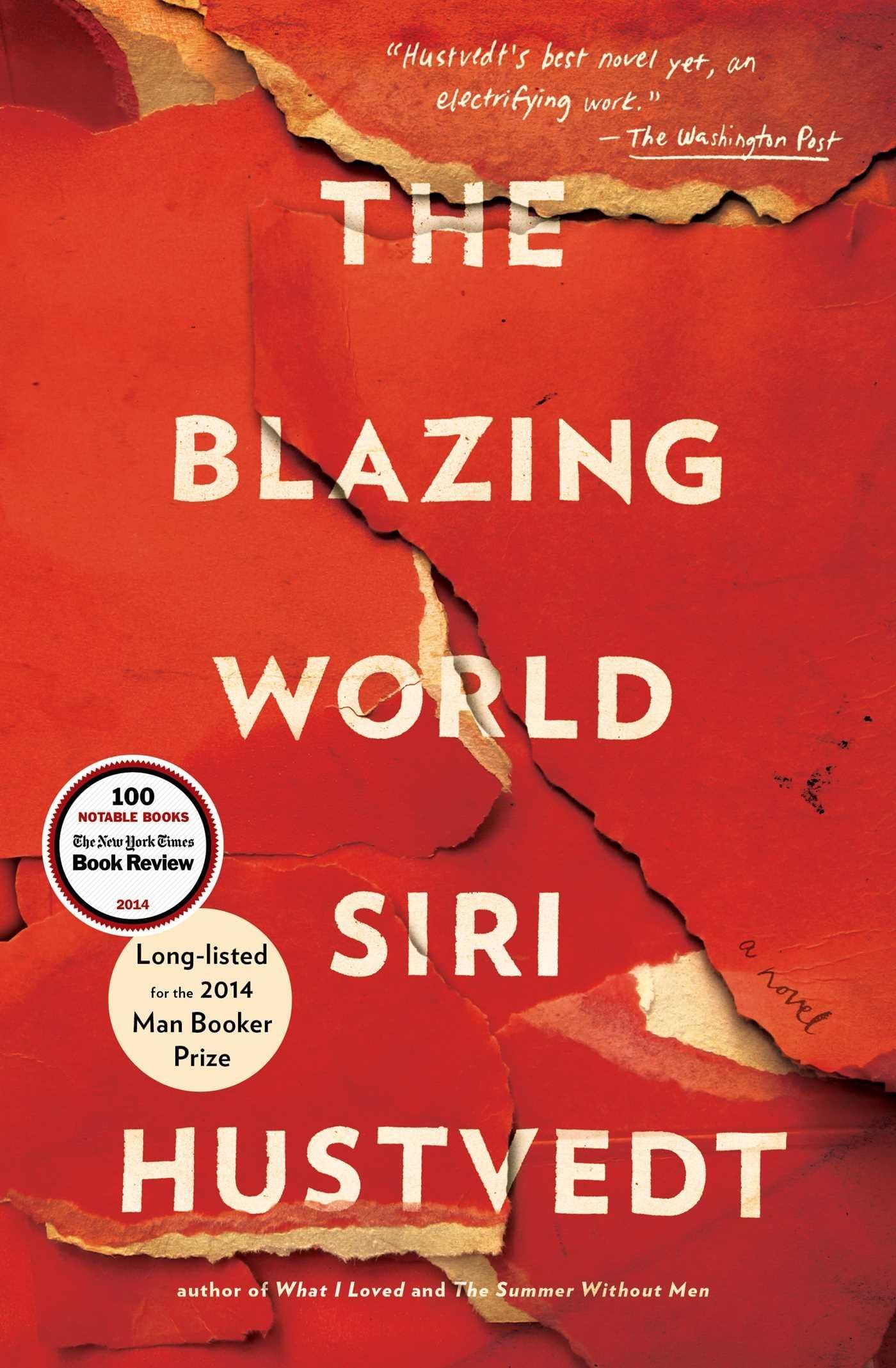
The Blazing World: A Novel
Product ID: 8361411
Buy anything from 5,000+ international stores. One checkout price. No surprise fees. Join 2M+ shoppers on Desertcart.
Desertcart purchases this item on your behalf and handles shipping, customs, and support to Congo.
“A spectacularly good read...feminism in the tradition of Simone de Beauvoir’s The Second Sex or Virginia Woolf’s A Room of One’s Own : richly complex, densely psychological, dazzlingly nuanced.” — Slate From the internationally bestselling author of The Summer Without Men comes “an electrifying work” ( The Washington Post ) about the lengths one woman will go for artistic recognition amid the deceptive powers of prejudice, money, fame, and desire. After years of having her work ignored or dismissed by critics, artist Harriet Burden decides to conduct an experiment: she presents her own art behind three male masks, concealing her female identity. Yet when the shows succeed and Burden steps forward for her triumphant reveal, she is betrayed by the third man, Rune, who claims the work as his own. After critics side with him, Burden and Rune suddenly find themselves in a charged and dangerous game—one that ends in his bizarre death. An intricately conceived, diabolical puzzle presented as a collection of texts, including Harriet’s journals assembled after her death, this “glorious mashup of storytelling and scholarship” ( San Francisco Chronicle ) unfolds from multiple perspectives as Harriet’s critics, fans, family, and others offer their own conflicting opinions of where the truth lies. Review: Perfect for theory-heads who still have a heart - Brilliant, brilliant, brilliant. I am heartbroken at the ending and in love with this book. It is raw and deeply emotional on the one hand and urbane and intellectual on the other. I want more books like this. I read it slowly just so that I could savor it a little longer. Hustvedt blends PhD-level theoretical analysis with an engrossing tale populated by wonderfully and grotesquely human characters. I identified with Harriet, with her lumpy old lady body, churning emotions, her constant grasping for more, and a brain too canny for her own good. I loved to hate that insufferable moron Oswald Case. I adored Rachel Briefman and Phineas Q. Eldridge and Bruno. I came to appreciate the central importance of the characters who seemed simple and marginal but who were really essential to the lived reality of the main characters all along - the Kirstens and Sweet Autumns of the world, and the Maisies suspended indefinitely between the ordinary and the artistic. Most of the book had an eerie, ominous vibe as the novel meandered towards Rune's peculiar death - but towards the end, the story veered suddenly into the gnawing brutality of Harriet's all-too-recognizable end. I sobbed through the final chapters. Earlier, I laughed. I raged. I analyzed. I was moved, emotionally and intellectually. This book and its characters will stay with me for a very long time. I believe it is the best book I have ever read, to date. It is perfect for readers like me, and a book like this only comes around very rarely. Of course, if you're not into contemporary critical theory, maybe you won't like this book very much. But for me, a PhD student in political theory who still harbors a full-hearted reader of fiction inside me, this book fit just right. Review: Fictionalized Non-Fiction at its Best - This is a novel that defies all conventions about novel writing. Its format is quite literally like no other novel ever written (that I know of), which is why I bought it and read it. I love it when someone has the courage to break down all the rules. It's wonderful to find yourself in unknown, undiscovered territory. Very refreshing. The novel is different in both form and structure. To begin with, it presents itself like non-fiction. It pretends to be the work of an "editor" who has put together a biography/portrait of a recently deceased contempory artist, Harriet Burden. The (fictitious) editor uses, as is always done in this kind of work, testimonials from art critics, family and friends and extracts from the artist's personal diary. This format enables the author to tell Harriet Burden's story from various points of views. I was struck by the novelist's remarkable ability to change "voice" and convincingly draw a highly sensitive portrait, as Harriet is differently perceived by the people who knew her. From the start, you are told that she has recently shaken the New York art scene, putting on highly successful shows using male artists as "screens" or pseudonyms for her work. She has used three artists, two unknowns and one well-known, for this bizarre project that she has called "maskings" - a project intended to "prove" that one's perception of the art one sees is governed by one's knowledge of the artist. In particular, she wants to show that art made by a man sells better than art made by a woman; that there is a diffuse gender bias in the art world. Harriet Burden's art had never attained prominence when it was shown under her own name but now it suddenly achieves success simply because it is seen by the public as the work of a man. Harriet Burden's plans go awry when Rune, the third artist who is a celebrity in his own right, refuses to reveal that she is the author of the show. He takes on all the critical acclaim, leaving her in the dirt. She smarts from the injustice and as a reader, you smart along with her - which shows how effective the author's writing is. No spoilers and I won't give out more of the plot, except to say that the story is practically known from the start. That's another peculiarity of this novel: there is next to no suspense. You know from the first page that Harriet is dead and you know very soon what happens to the man who betrayed her (the third artist in her "maskings" project). So why do you keep reading? Because of the superb writing of course, and because of something else too. Questions are asked that you never thought of asking. The book is filled with gems - insights into life and art and the human condition. The sort of thing that gives you arresting moments of self-revelation and a deeper understanding of the world around you. To give you an idea: - "...it is not what is said that makes us who we are. More often, it is what remains unspoken" (this came up in connection with Harriet's upbringing and difficult relationship with her father); - "It is my time, and I will not let them take it away from me. The Greeks knew that the mask in the theater was not a disguise but a means of revelation. And now that I have started, I can feel the winds behind me...(Harriet, commenting on her "maskings" project); - "Mostly, the art business has been about men. And when it has been about women, it has often been about correcting past oversights. It is interesting that not all, but many women were celebrated only when their days as desirable sexual objects had passed." - "Human beings are the only animals who kill for ideas." - "Celebrity is life in the third person." Is there anything wrong with this novel? Yes, for anyone looking for suspense. There is none. There is even a slowdown in the middle of the book when it becomes a little too "academic". There's a little too much about art, perception and gender. To a large extent - you're warned! - this is a feminist book. Harriet Burden makes a lot of allusions to philosophers in her diaries, allusions that would get lost or misunderstood without (very academic) footnotes. So you find yourself reading the footnotes. Actually, there's a certain, perverse pleasure in reading them but at times, it does become heavy-going. And perhaps, while the footnotes make sense in a book that pretends to be non-fiction, they certainly detract from the pleasure of reading the book as a novel - in principle, a form that never has any footnotes (unless it's a classic for school use). Hence the 4 stars though I had set out to give it five. My conclusion? It is well worth reading and I highly recommend it. But it really isn't a novel as such - more an intellectual joy ride. Many of the same questions that animate "The Blazing World" recur in Hustvedt's essays, notably in "Living, Thinking, Looking": How do we see, remember, and feel? How do we interact with other people? What does it mean to sleep, dream, and speak? What is "the self"?
| Best Sellers Rank | #730,229 in Books ( See Top 100 in Books ) #1,952 in Fiction Satire #11,102 in Literary Fiction (Books) #12,184 in Suspense Thrillers |
| Customer Reviews | 4.0 out of 5 stars 819 Reviews |
B**E
Perfect for theory-heads who still have a heart
Brilliant, brilliant, brilliant. I am heartbroken at the ending and in love with this book. It is raw and deeply emotional on the one hand and urbane and intellectual on the other. I want more books like this. I read it slowly just so that I could savor it a little longer. Hustvedt blends PhD-level theoretical analysis with an engrossing tale populated by wonderfully and grotesquely human characters. I identified with Harriet, with her lumpy old lady body, churning emotions, her constant grasping for more, and a brain too canny for her own good. I loved to hate that insufferable moron Oswald Case. I adored Rachel Briefman and Phineas Q. Eldridge and Bruno. I came to appreciate the central importance of the characters who seemed simple and marginal but who were really essential to the lived reality of the main characters all along - the Kirstens and Sweet Autumns of the world, and the Maisies suspended indefinitely between the ordinary and the artistic. Most of the book had an eerie, ominous vibe as the novel meandered towards Rune's peculiar death - but towards the end, the story veered suddenly into the gnawing brutality of Harriet's all-too-recognizable end. I sobbed through the final chapters. Earlier, I laughed. I raged. I analyzed. I was moved, emotionally and intellectually. This book and its characters will stay with me for a very long time. I believe it is the best book I have ever read, to date. It is perfect for readers like me, and a book like this only comes around very rarely. Of course, if you're not into contemporary critical theory, maybe you won't like this book very much. But for me, a PhD student in political theory who still harbors a full-hearted reader of fiction inside me, this book fit just right.
C**E
Fictionalized Non-Fiction at its Best
This is a novel that defies all conventions about novel writing. Its format is quite literally like no other novel ever written (that I know of), which is why I bought it and read it. I love it when someone has the courage to break down all the rules. It's wonderful to find yourself in unknown, undiscovered territory. Very refreshing. The novel is different in both form and structure. To begin with, it presents itself like non-fiction. It pretends to be the work of an "editor" who has put together a biography/portrait of a recently deceased contempory artist, Harriet Burden. The (fictitious) editor uses, as is always done in this kind of work, testimonials from art critics, family and friends and extracts from the artist's personal diary. This format enables the author to tell Harriet Burden's story from various points of views. I was struck by the novelist's remarkable ability to change "voice" and convincingly draw a highly sensitive portrait, as Harriet is differently perceived by the people who knew her. From the start, you are told that she has recently shaken the New York art scene, putting on highly successful shows using male artists as "screens" or pseudonyms for her work. She has used three artists, two unknowns and one well-known, for this bizarre project that she has called "maskings" - a project intended to "prove" that one's perception of the art one sees is governed by one's knowledge of the artist. In particular, she wants to show that art made by a man sells better than art made by a woman; that there is a diffuse gender bias in the art world. Harriet Burden's art had never attained prominence when it was shown under her own name but now it suddenly achieves success simply because it is seen by the public as the work of a man. Harriet Burden's plans go awry when Rune, the third artist who is a celebrity in his own right, refuses to reveal that she is the author of the show. He takes on all the critical acclaim, leaving her in the dirt. She smarts from the injustice and as a reader, you smart along with her - which shows how effective the author's writing is. No spoilers and I won't give out more of the plot, except to say that the story is practically known from the start. That's another peculiarity of this novel: there is next to no suspense. You know from the first page that Harriet is dead and you know very soon what happens to the man who betrayed her (the third artist in her "maskings" project). So why do you keep reading? Because of the superb writing of course, and because of something else too. Questions are asked that you never thought of asking. The book is filled with gems - insights into life and art and the human condition. The sort of thing that gives you arresting moments of self-revelation and a deeper understanding of the world around you. To give you an idea: - "...it is not what is said that makes us who we are. More often, it is what remains unspoken" (this came up in connection with Harriet's upbringing and difficult relationship with her father); - "It is my time, and I will not let them take it away from me. The Greeks knew that the mask in the theater was not a disguise but a means of revelation. And now that I have started, I can feel the winds behind me...(Harriet, commenting on her "maskings" project); - "Mostly, the art business has been about men. And when it has been about women, it has often been about correcting past oversights. It is interesting that not all, but many women were celebrated only when their days as desirable sexual objects had passed." - "Human beings are the only animals who kill for ideas." - "Celebrity is life in the third person." Is there anything wrong with this novel? Yes, for anyone looking for suspense. There is none. There is even a slowdown in the middle of the book when it becomes a little too "academic". There's a little too much about art, perception and gender. To a large extent - you're warned! - this is a feminist book. Harriet Burden makes a lot of allusions to philosophers in her diaries, allusions that would get lost or misunderstood without (very academic) footnotes. So you find yourself reading the footnotes. Actually, there's a certain, perverse pleasure in reading them but at times, it does become heavy-going. And perhaps, while the footnotes make sense in a book that pretends to be non-fiction, they certainly detract from the pleasure of reading the book as a novel - in principle, a form that never has any footnotes (unless it's a classic for school use). Hence the 4 stars though I had set out to give it five. My conclusion? It is well worth reading and I highly recommend it. But it really isn't a novel as such - more an intellectual joy ride. Many of the same questions that animate "The Blazing World" recur in Hustvedt's essays, notably in "Living, Thinking, Looking": How do we see, remember, and feel? How do we interact with other people? What does it mean to sleep, dream, and speak? What is "the self"?
B**T
Blazing away!
Siri Hustvedt delivers an empassioned story of a woman artist who would like nothing better than to be seen in the contemporary art world as an artist without the woman part. The structure of the book is brilliant as the plot unfolds through her journal entries, critiques, missives from family and research by the academic study of the artist. There are footnotes and deep readings about how we perceive as well as not so subtle commentary on art as business and the cult of personality which sells to collectors. It is a book about writing a book about a late artist, her work, her loves, her children,
V**E
A puzzling patchwork of novel and erudite dissertation.
" All thoughts of revenge are born of the pain of helplessness. 'I suffer' becomes 'you will suffer'. And let us not lie. Vengeance is invigorating. It focuses and enlivens us and it quashes grief because it turns the emotion outward. In grief we go to pieces. In revenge, we come together as a single pointed weapon, aimed at a target. However destructive in the long run, it serves a useful purpose for a time." ( p 112 " The Blazing World") Classic Hustvedt. Insightful, terse, clarifying. Ah, great - I thought. Another winner. That was before the book seemed to fracture in my hands. With the plethora of competing voices, stances, attitudes and stories, the narrative was chopped up and served back like a dessicated Picasso. This piecemeal approach works best when the unifying theme is so powerfully exposed that the reader sees, clearly, underneath the competing strands where the defining structural shape of the story lies. Dealing with abstractions such as the position of the woman artist in the world of the 'Male Gaze' there are surely enough questions, obfuscations and evasions without adding a layer of complexity by splitting the narration between countless characters, many of whom would not know 'the truth' if it bit them in the leg. It's difficult to identify a straight story line here. This seems to be about Harriet Burden's desire to wreak revenge on those in the Art world who have dismissed her creative gifts, using the very tools they themselves have created. Soon, however, we are in a meandering, tangential world encompassing aspiring artists, family, 'refugees', psychiatrists, lovers, best friends, children, faithless husbands, gigolos - all telling versions of their 'stories' whether or not these revelations impact our understanding of the central theme. Why, for example, is so much made of Felix's sexual proclivities? Once it is established that his infidelities as Harry's husband negatively affect her sense of herself as a woman and an artist, do the specifics matter? Yet here they are given the weight of a great revelation, a further crushing of Harriet who, it seemed to me, was already cognizant of its effects. I was grateful for the copious footnotes (frankly, I'd have been lost without them) but found here too that the air of a learned dissertation, rather than a novel, was unavoidable. This is cleverly incorporated into the framework which purports to be an 'investigation', but it still seemed to me to verge on the smug, inviting the reader to take refuge in erudition rather than getting swept along by a powerful narrative. I found the whole novel straddling this divide. I stopped caring about the characters because our 'conversations' kept being interrupted. Some of the interruptions gave me fresh insights, but many did not. I was left wondering what I had missed which led to reading and re-reading passages. Too often, it didn't help. I'm sorry to say I was disappointed in this novel.
D**S
A revealing immersion into the world of art
I read this book for Literati, a book club at Ringling Art Museum that meets Friday. I'm not an artist, so I'm looking forward to hearing where the group (30 or so people) takes the discussion. Blazing Sun isn't like the other books about artists we read about. It's more about perceptions and perspectives toward art and life as experienced by Harriet as she creates her works and then tried to get it accepted by having it displayed under male filters. She uses three male artists as her assumed identity. The novel is different and sometimes difficult to follow, It's not a straightforward narrative. It's an extensive collection of short entries about Harriet herself in the first person, a!omg with entries of reflections about her from the viewpoint of the other characters in the story. It's like anthology or a scrapbook interspersed with pseudo.scholarship (footnoted) about phenomenology. At first, I read the book as nonfiction until it became clear that Harriet is the protagonist in a mind blowing tour through the art world, The ending ties up the threads and made me want to read the book again.
J**4
On Fire!
I loved <i> The Blazing World </i> so much because it is both unabashedly erudite (footnotes and a title cribbed from Margaret Cavendish!), stylistically ambitious, and all without sacrificing rich, complex characters, especially Harriet "Harry" Burden, who is coping with tremendous rage and grief at the state of women in the art world in general and the state of her own undervalued brilliance in particular. Hustvedt's writing was a complete revelation to me, particularly her glorious descriptions of Harry's mixed-medium, gender-twisting work and the quirks of her life as the widow of a pre-eminent art dealer, Felix Lord. In the at times dizzying spiral of this collage of "testimonies" that include statements from critics, friends, collaborators, Harry's children and her own writings, we chart the course of Burden's fiery, Whitmaniacal intellectual journey and her rapacious ambitions to be considered a great artist, while Hustvedt manages to name-check herself as a "minor essayist and novelist" and Kierkegaard, Milton, Judith Butler, neuroscience of perception, Emily Dickinson, and numerous other theories of mind and identity that fashion an utterly compelling and deeply moving depiction of the ethics, desire, fame, and American culture at large that reinvigorates my own enduring interest in the interplay of gender theory and the literary and visual arts. It has been a long while since I've been so thoroughly inspired by feminist prose (from a review in <i> Slate </i>!) that I bought a novel without hesitation in hardcover. Hustvedt is not a new voice in fiction, but she is new to me, and I am eager to read her other works and discover what I've been missing. I don't think I've been this excited about a contemporary (non-Irish) novelist since reading Margaret Atwood in 7th grade.
N**E
I love the complexity of the characters
I am still reading, compulsively reading. I love the complexity of the characters, the flow of challenging ideas, the mystery of it all. I want to know these people. Hustvedt has such compassion for all of her imagined people no matter how flawed. She embraces the "strange" and transforms.The format of interviews, articles, journal entries keeps the pages turning.This is definitely one of my "books of the year" and I intend to pass it on and gift it to friends.
S**N
Awful
Great premiss, horribly written. I am a member of a couple's book club. All of us, (all professionals with multiple degrees) found the writing style too difficult to WANT to read it. Not fun, when you spend as much time looking words up in dictionary as trying to read the novel.
B**T
The Blazing World
Wonderfully original with characters that leapt out of the pages at you. Hustveldt manages to tell this tale in such a balanced way.
T**K
Molto bello. Merita le recensioni positive sul NYT.
All'inizio si rimane perplessi, in una sorta di sospensione tra la realtà di un saggio e la fantasia dì un romanzo. Poi, via via che si avanza, si apprezza la genialità della trama. Affascinante spaccato sul mondo dell'arte contemporanea...
M**L
Une grande réussite
Brillant, passionnant alors que les thèmes abordés sont complexes. Personnage de H.B inoubliable Siri Hustvedt est une très grande auteure américaine contemporaine
K**V
Awesome
Loved this. There are so many aspect I I can relate to as almost 50 year old woman and visual artist. I do not have kids, but did not paint for three years, and live in a remote area- so there are many ways to make your art life difficult – as if it would be other wise so easy, which this book so perfectly depicts. SPOILER/QUOTES ALERT! About the art world: a character of the critic comments: 'If there's one thing that doesn't fly in the art world, it's an excess of sincerity. ' Character of Rosemary Lerner:' It is interesting that not all, but many women were celebrated only when their days as desirable sexual objects had passed.'(as artists) 'The thing that is truly wanted must always be missing. Art dealers have to be magicians of hunger.' '..but I doubt anyone can actually separate talent from reputation when it comes down to it.' 'Art is not allowed to arrive spontaneously unauthored.' And I am sure there have been many many women thinking about a male alter ego. The first time it came in my mind was in the 90's when I was an art student, in a party with older artists, and an old fart shook the hand of my friend, male, but gay, but not mine, because he thought that I was apparently only a girlfriend...Harriet: 'It is so dull, so familiar, so unjust being treated as a woman first, always as a woman. I rebel. Why womanliness first? Why this trait first?' Sorry, digressing. I feel for Harry, I get her. The constant fight because people do not get you could be intelligent, creative, because you are a woman. How DO we perceive? The almost ( but only almost) charicature writings of the male critics and gallerists about the 'situation' were a tragicomedy. But the book is not just setting up opposites of masculine and feminine. There is the mystery of creation, the blending of personalities, the subconscious needs, the traumas that affect everybody. Then there is the thought about the accuracy of memories, which I can also relate to - I mix my memories and tv-series already! With maturation, some 'dear' memories become unimportant or vague stamps of childish moments in one's life. And some other, like a smell of a forest after rain, become dear. I like this every character gets a voice– form. I liked the description of the urge to create, and the importance of validation. Harry was obsessed to get it 'from all' which, understandable, was also hubris. As was Rune's whole career. What part is a need for exhibitionism, and what an creative act? Where do you draw the line with some artists? There were funny moments as well, Bruno's parts, the crystal girl. And the dying scene was great! I underlined a lot of things: 'All thoughts of revenge are born of the pain of helplessness.' 'Human beings are the only animals who kill for ideas.' About Singularity: 'A Zeus dream that avoids the organic body altogether. Brand-new creatures burst forth from men's heads. Presto! The mother and her evil vagina disappears.' Life is multifaceted. Harry had her children, love, creativity, talent, wit, and a few good friends. I really came to like her character. She had even brutal ambition, but not enough compared to the beast of the art world. I recommend.
M**6
challenging and rewarding
A story told in different voices and pieces...a collage set in the world of modern art with a complex family and diverse characters . at times brilliant, at times difficult. The frustration of a powerful woman artist who feels unheard and decides to play a gigantic trick on the establishment. It has unanticipated consequences. thoughtful and intellectually deep and truly rewarding....memorable characters.
Trustpilot
1 month ago
1 month ago